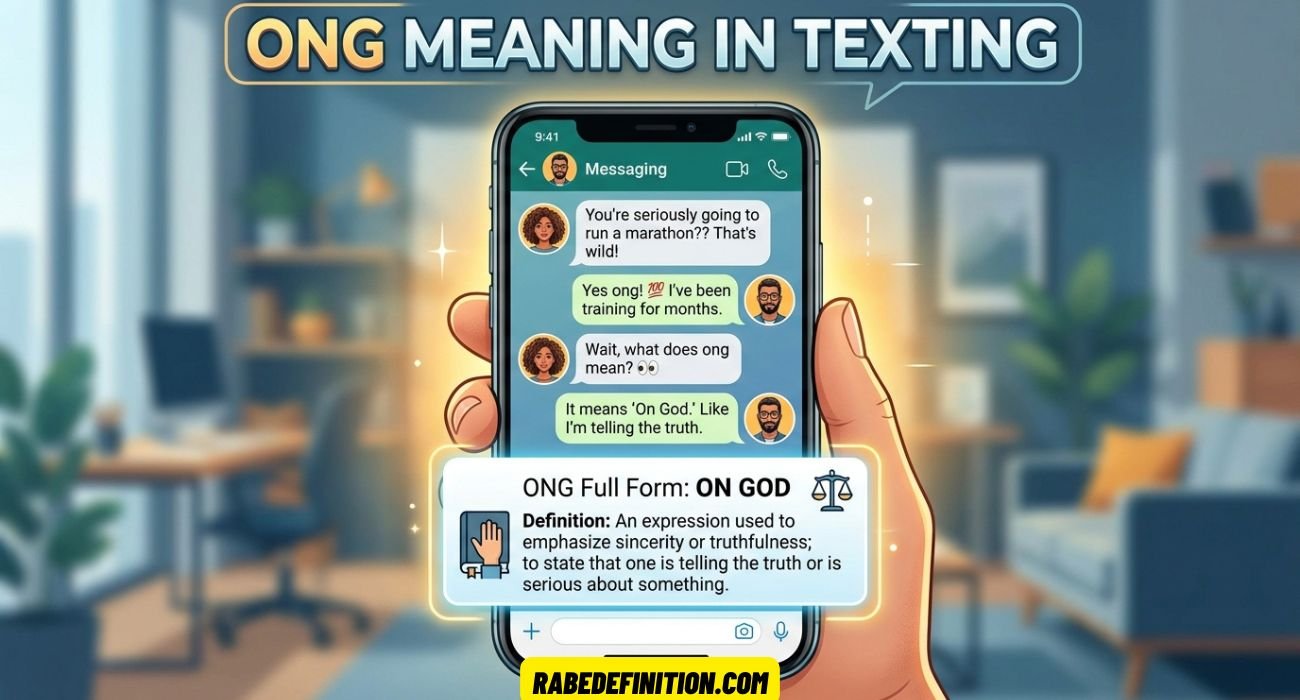
ONG Full Form: What Does ONG Mean in Texting?
If you have seen “ONG” in a text, comment, or social media post, you may have wondered what the abbreviation means. The ONG full form is usually “On God.”
In casual online conversations, ONG is used to emphasize that someone is telling the truth, being serious, or strongly agreeing with something. You may see it in texts, comments, DMs, and other informal conversations.
But the exact tone can change depending on the context. Let’s look at what ONG means, how people use it, how to reply, and how it differs from similar abbreviations.
Quick Answer
The ONG full form in texting and internet slang is “On God.” It is commonly used to emphasize honesty, seriousness, or strong agreement.
For example, someone might text, “ONG, that was the best burger I’ve ever had.” Here, ONG adds emphasis to the speaker’s opinion.
It is an informal expression, so it generally fits casual conversations rather than professional emails, academic writing, or formal communication.
TL;DR
- ONG usually stands for “On God.”
- It is internet and texting slang used to emphasize truth, seriousness, or agreement.
- The meaning can vary slightly depending on the surrounding conversation.
- ONG is generally casual and is common in texts and social media.
- ONG and OMG are different: ONG means “On God,” while OMG means “Oh My God.”
What Does ONG Mean?
So, what does ONG mean when someone sends it in a message?
In online slang, ONG means “On God.” The phrase is used to add emphasis to a statement. Depending on the situation, it can mean something like “I swear,” “I’m serious,” “Honestly,” or “I strongly agree.”
For example:
“ONG, I’m not lying.”
The sender is emphasizing that they are telling the truth.
Or:
“ONG, this song is so good.”
Here, the sender is strongly emphasizing their opinion.
The abbreviation is informal. It is most appropriate when talking casually with friends, family members, or people who are comfortable with internet slang.
What Does ONG Stand For?
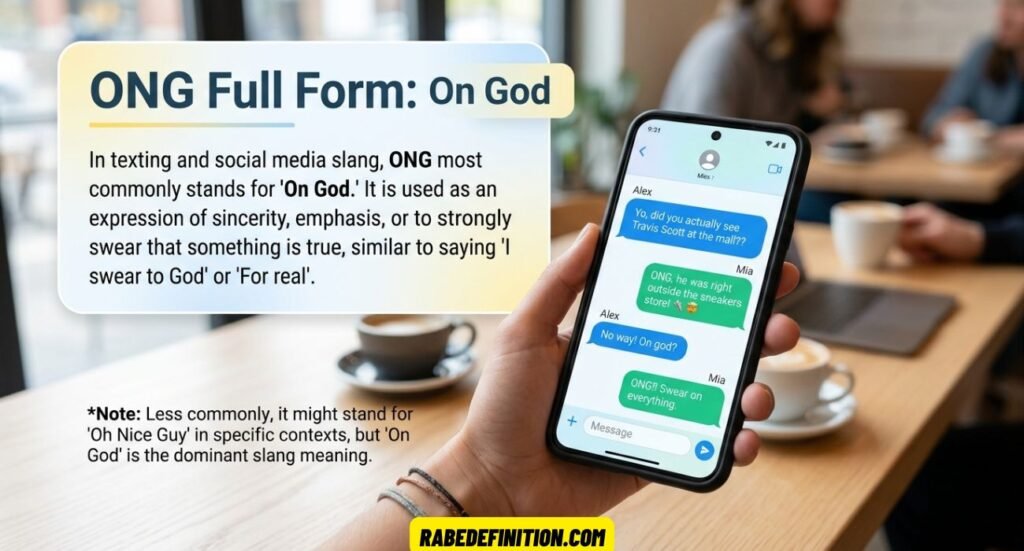
ONG stands for “On God.”
The full phrase existed before the abbreviation became popular in texting. Online users shortened it to ONG because abbreviations are quick and convenient in fast-moving conversations.
The expression doesn’t necessarily refer to a religious discussion. In slang, “on God” is often simply used to emphasize that someone is being truthful or serious.
ONG in Texting
The ONG meaning in text depends heavily on what comes before and after it.
Someone might use ONG to say:
- “I’m telling the truth.”
- “I seriously mean this.”
- “I completely agree.”
- “This is genuinely how I feel.”
- “I’m not exaggerating.”
Consider this message:
“ONG, you need to try that restaurant.”
The sender isn’t necessarily making a solemn promise. They’re simply strongly recommending the restaurant.
Similarly:
“ONG 😂 I thought you were already home.”
The abbreviation can work alongside humor and surprise.
Because of this, don’t assume that every use of ONG has exactly the same emotional intensity. The rest of the conversation provides important clues.
Common Uses of ONG
| Situation | What ONG Means |
|---|---|
| Agreeing with someone | “Absolutely” or “I agree” |
| Emphasizing a statement | “I’m serious” |
| Defending the truth | “I’m telling you the truth” |
| Strong personal opinion | “I genuinely mean this” |
| Excited reaction | Adds emphasis to an emotional statement |
| Casual joking | Can make an exaggerated statement sound playful |
Using ONG to Agree
Someone may use ONG after another person’s opinion to show strong agreement.
Example:
“That ending was completely unexpected.”
“ONG, I was not ready for it.”
Here, ONG reinforces the agreement.
Using ONG to Emphasize the Truth
A person can also use it when they want someone to believe them.
“ONG, I left my keys at home.”
The sender is emphasizing that the statement is true.
Using ONG for Strong Opinions
ONG can make a casual opinion sound more emphatic.
“ONG, this is the best pizza in town.”
It doesn’t make the statement objectively true. It simply shows that the speaker feels strongly about it.
Real Texting Examples
Here are some original examples showing how ONG can appear naturally in everyday conversations.
Example 1: Agreeing With a Friend
Person A: That movie was way better than I expected.
Person B: ONG, the second half was amazing.
Meaning: Person B strongly agrees.
Example 2: Emphasizing Honesty
Person A: Did you really forget your wallet?
Person B: ONG, I left it on my desk.
Meaning: Person B is stressing that they are telling the truth.
Example 3: Strong Recommendation
Person A: Should I try that new coffee place?
Person B: ONG, yes. Their cold brew is incredible.
Meaning: Person B strongly recommends it.
Example 4: Surprise
Person A: I just found out we’re getting Monday off.
Person B: ONG, you’re serious?!
Meaning: ONG emphasizes the surprise and excitement.
Example 5: Casual Opinion
Person A: Which season was your favorite?
Person B: ONG, season three was easily the best.
Meaning: The speaker strongly expresses their opinion.
Example 6: Playful Conversation
Person A: You said you’d only buy one pair of shoes.
Person B: ONG, this is the last pair 😂
Meaning: The speaker is using ONG playfully rather than making a formal statement.
Example 7: Defending Yourself
Person A: You ate the last slice, didn’t you?
Person B: ONG, it wasn’t me.
Meaning: The sender is insisting that they are innocent.
How to Reply to ONG
There isn’t one universal response to ONG. Your reply should match the context.
Casual Response
If the conversation is relaxed, you can simply respond with:
- “For real.”
- “Exactly.”
- “I know!”
- “Facts.”
- “Seriously.”
Friendly Response
If a friend is emphasizing an opinion, you could continue the conversation:
“Right? I couldn’t believe it either.”
This keeps the conversation moving instead of simply repeating another abbreviation.
Funny or Playful Response
If the person is clearly joking, match their energy:
“You swear 😂”
or
“Okay, I believe you this time.”
More Polite Response
If you aren’t comfortable using slang yourself, you can respond normally:
“I completely agree.”
or:
“Seriously? That’s surprising.”
You don’t need to use internet slang just because someone else does.
See Also : ICL Meaning: Understanding the Acronym and Its Usage
ONG Tone and Context
The ONG slang meaning can shift slightly depending on the situation.
| Context | Possible Tone |
|---|---|
| “ONG, you’re right.” | Strong agreement |
| “ONG, I didn’t do it.” | Serious or defensive |
| “ONG 😂” | Playful or humorous |
| “ONG, that’s incredible.” | Excited or enthusiastic |
| “ONG?” | Surprise or disbelief |
Punctuation and emojis can also influence how a message feels.
For example, “ONG.” may look more serious than “ONG 😂”, even though the basic meaning remains the same.
The relationship between the people also matters. Friends may use the abbreviation casually, while someone unfamiliar with internet slang might interpret it differently.
When to Use ONG
Use ONG when you’re having a casual conversation and the people involved understand internet slang.
It can work well in:
- Text messages
- Group chats
- Social media comments
- Direct messages
- Casual conversations
- Memes and humorous posts
- Informal online communities
For example:
“ONG, that was hilarious.”
or:
“ONG, you have to see this.”
The abbreviation works particularly well when you want to add emphasis without writing the entire phrase.
When Not to Use ONG
ONG is not usually the best choice for formal or professional communication.
Avoid it in situations such as:
- Formal business emails
- Job applications
- Academic assignments
- Professional reports
- Official correspondence
- Messages to someone who may not understand internet slang
Instead of:
“ONG, I really appreciate your help.”
a professional message could simply say:
“I really appreciate your help.”
This isn’t because ONG is inherently rude. It is simply informal and may not fit the communication style expected in professional settings.
ONG on Social Media
You may encounter ONG across different forms of online communication, particularly where casual slang is common.
ONG on Snapchat
On Snapchat, users may use ONG in private messages, group conversations, captions, or replies to emphasize something.
For example:
“ONG you missed the funniest part 😂”
The meaning is still “On God,” with the surrounding message determining the tone.
ONG on TikTok
TikTok comments and messages often contain short slang abbreviations. ONG can appear as a reaction to a video or as part of a conversation between users.
For example:
“ONG this is so accurate.”
Here, the person is strongly agreeing with the video’s message.
ONG on Instagram
On Instagram, ONG may appear in comments, DMs, captions, or replies.
“ONG, this outfit is perfect.”
Again, the abbreviation adds emphasis to the statement.
ONG on WhatsApp and Messenger
In private chats, ONG can function like other casual texting abbreviations. Friends might use it when agreeing, insisting that something is true, or reacting strongly to a message.
The platform doesn’t fundamentally change the meaning.
Difference Between ONG and OMG in Online Chats
ONG and OMG look similar, but they mean completely different things.
| Term | Meaning | Main Use |
|---|---|---|
| ONG | On God | Emphasizing truth, seriousness, or agreement |
| OMG | Oh My God | Expressing surprise, excitement, shock, or frustration |
| I swear | A direct expression of emphasis | Emphasizing that something is true |
| FR | For real | Showing agreement or sincerity |
For example:
“ONG, I’m telling you the truth.”
This means “On God, I’m telling you the truth.”
But:
“OMG, you actually won!”
expresses surprise or excitement.
A useful way to remember the distinction is that ONG is generally about emphasis or sincerity, while OMG is generally a reaction to something.
Other Meanings of ONG
Although “On God” is the common interpretation in casual texting and internet slang, abbreviations can have different meanings in other contexts.
For example, ONG may appear as an abbreviation, acronym, name, or organizational reference outside everyday texting.
Therefore, if you encounter ONG in a business document, technical material, news article, or another specialized setting, don’t automatically assume it means “On God.”
Look at the surrounding words and the context.
For ordinary social media messages and casual texts, however, ONG usually refers to “On God.”
Common Mistakes When Using ONG
A few simple mistakes can make ONG confusing.
Confusing ONG With OMG
The letters are similar, but their meanings aren’t.
- ONG = On God
- OMG = Oh My God
Assuming ONG Always Means “I Swear”
“I swear” is often a useful way to understand the emphasis behind ONG, but the abbreviation can also express strong agreement or enthusiasm.
Using It in Formal Writing
ONG is internet slang. Unless you’re intentionally discussing slang itself, it usually doesn’t belong in formal writing.
Ignoring Context
A message such as “ONG 😂” can have a different feel from “ONG, I’m serious.”
Always consider the complete message.
Overusing It
Like any slang term, ONG can sound unnatural if it appears in every sentence. Use it when it genuinely fits the conversation.
See Also : Snowball Kiss Meaning: What It Really Means
How ONG Is Used to Emphasize a Statement
ONG is often added to a message when someone wants to make their words sound more serious or convincing. It can show that the person strongly believes what they are saying and wants the other person to know they are not exaggerating.
For example, someone might say, “ONG, that was the funniest thing ever.” In this case, the abbreviation adds extra emphasis to the speaker’s reaction and makes the statement feel more expressive in a casual conversation.
Can ONG Have Different Meanings in Different Conversations?
Although ONG commonly means “On God” in texting, abbreviations can sometimes mean different things depending on where they appear. The surrounding words, topic, and type of conversation can help you figure out what the sender intended.
If you see ONG in a casual text or social media comment, “On God” is usually the most relevant interpretation. However, if it appears in a professional, technical, or organizational context, checking the surrounding information is a better way to determine its meaning.
Is ONG Used by Everyone Online?
ONG is part of informal internet language, but that doesn’t mean every person uses or recognizes it. Some people may understand the abbreviation immediately, while others may prefer writing out “On God” or using more familiar expressions such as “for real” or “I swear.”
This is why context matters when using slang. If you’re chatting with someone who rarely uses internet abbreviations, writing the full phrase or choosing clearer wording may make your message easier to understand.
Why Context Matters When Understanding ONG
The meaning and tone of ONG can be easier to understand when you look at the complete message. A person may use it to agree with a friend, emphasize that they’re telling the truth, or react strongly to something surprising.
For instance, “ONG, you’re right” sounds like strong agreement, while “ONG, you actually did that?” can express surprise. The abbreviation stays the same, but the surrounding words give the message its specific tone.
FAQ About ONG Full Form
What is the ONG full form?
The ONG full form in texting and internet slang is “On God.” It is used to emphasize truth, seriousness, agreement, or a strong opinion.
What does ONG mean in texting?
ONG means “On God” in texting. Depending on the context, it can mean “I swear,” “I’m serious,” or “I strongly agree.”
What does ONG stand for in chat?
In casual online chat, ONG stands for “On God.” It is an informal abbreviation commonly used to add emphasis to a message.
Is ONG a slang word?
Yes. ONG is generally considered internet and texting slang. It is mainly suited to casual digital communication rather than formal writing.
Is ONG rude?
No, ONG is not inherently rude. Its tone depends on the message and the relationship between the people communicating. It can be serious, enthusiastic, humorous, or simply emphatic.
How do you respond to ONG?
Your response depends on the context. Natural replies include “Exactly,” “For real,” “Facts,” “Seriously?” or a normal sentence that continues the conversation.
What does ONG mean on TikTok?
On TikTok, ONG generally means “On God.” Users may use it in comments or messages to emphasize agreement, sincerity, or a strong reaction.
What does ONG mean on Snapchat?
On Snapchat, ONG generally has the same slang meaning: “On God.” It can be used in casual messages to emphasize that someone is serious or telling the truth.
What is the difference between ONG and OMG?
ONG means “On God,” while OMG means “Oh My God.” ONG is usually used for emphasis, sincerity, or agreement, while OMG commonly expresses surprise, excitement, or shock.
Can you use ONG at work?
You generally shouldn’t use ONG in formal workplace communication unless you’re in a very casual environment where everyone understands the slang. A standard phrase such as “I agree” or “I’m serious” is clearer in professional settings.
Conclusion
The ONG full form is usually “On God,” an informal expression used in texting and online conversations to emphasize truth, seriousness, agreement, or a strong opinion.
If someone sends you “ONG,” look at the surrounding message before deciding exactly how they mean it. In most casual chats, a simple response such as “For real,” “Exactly,” or a natural follow-up is enough.
The key takeaway is simple: ONG = “On God” in internet slang, while OMG = “Oh My God.” Knowing the difference can make casual online conversations much easier to understand.