NP Meaning in Text: What Does NP Mean? Complete Guide
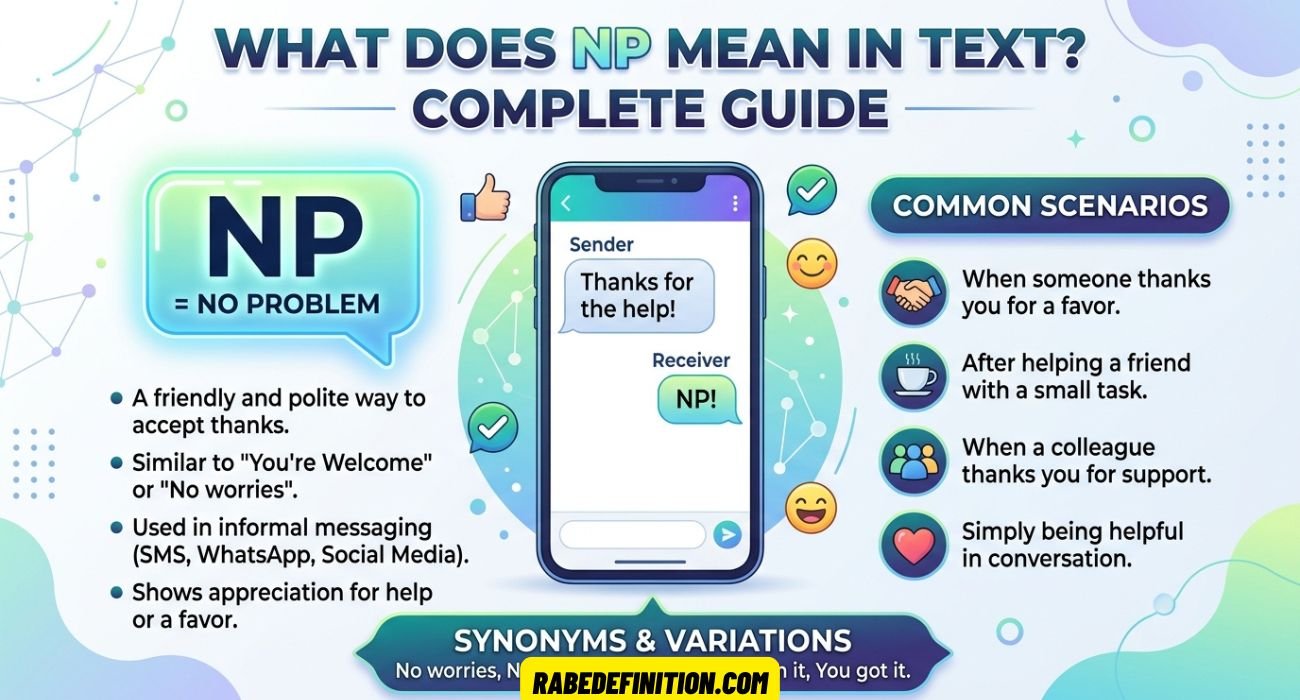
If someone texts you “NP” after you thank them or apologize, they are usually saying “No Problem.” It is a common texting abbreviation used to keep conversations quick, casual, and friendly.
The NP meaning in text can be slightly different depending on the situation. After “thank you,” it often works like “you’re welcome,” while after “sorry,” it can mean “it’s okay” or “don’t worry about it.”
This guide explains what NP means, how people use it in texts and social media, how to respond, whether it is formal or rude, and what other meanings NP can have.
Quick Answer
NP usually means “No Problem” in texting, online chats, and social media.
People commonly use it as a short response to “thank you,” “sorry,” or a small request. For example:
You: “Thanks for helping me with that!”
Them: “NP!”
Here, “NP” simply means “No problem” or “You’re welcome.”
It is generally casual and friendly rather than formal. However, the exact feeling can depend on the conversation and the relationship between the people.
TL;DR — NP Meaning in Text
- NP = No Problem in most casual texting situations.
- After “thank you,” NP usually means “you’re welcome.”
- After “sorry,” NP can mean “it’s okay” or “don’t worry about it.”
- NP is informal and works best in texts, DMs, and casual chats.
- In formal or professional writing, “You’re welcome” or “Happy to help” may be more appropriate.
What Does NP Mean in Texting?
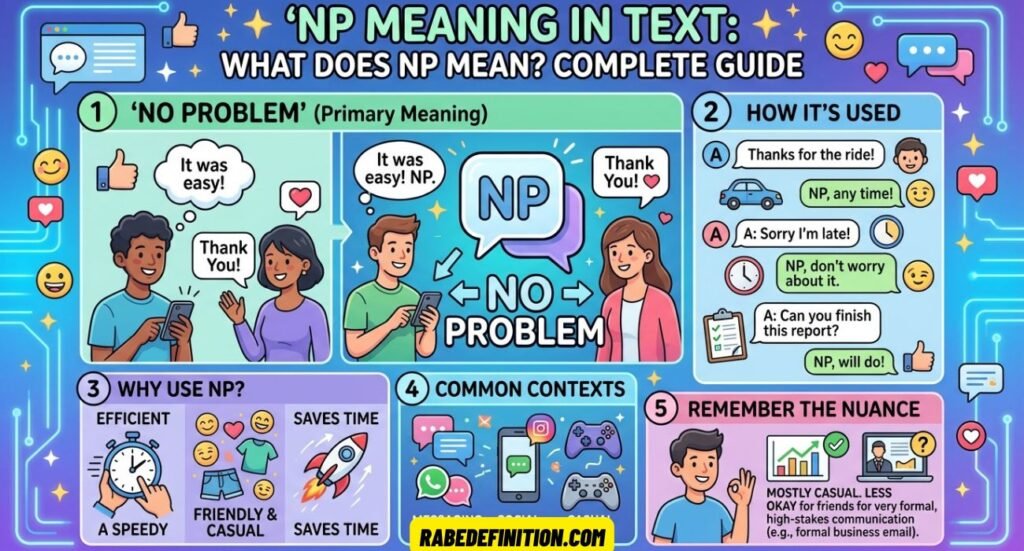
The most common NP meaning in texting is “No Problem.”
It is simply a shortened version of the phrase people use when they want to reassure someone that something is fine.
For example:
Friend: “Can you send me that picture?”
You: “NP, I’ll send it now.”
In this case, NP means that you are fine with the request.
You might also see it written as “np” rather than “NP.” The lowercase version usually carries the same meaning. Texting abbreviations do not generally follow strict capitalization rules.
NP can communicate ideas such as:
- “No problem.”
- “It’s fine.”
- “That’s okay.”
- “Don’t worry about it.”
- “You’re welcome.”
The surrounding conversation determines which interpretation makes the most sense.
Is NP Common in Casual Conversations?
Yes. NP fits naturally into quick digital conversations where people already understand common abbreviations.
It can appear in:
- Text messages
- Group chats
- Direct messages
- Online comments
- Gaming chats
- Social media conversations
- Casual workplace messaging
Because it is short, NP can be useful when a full “No problem” feels unnecessary.
What Does NP Mean in Different Texting Situations?
NP does not always perform exactly the same conversational job. Its basic meaning stays connected to “No Problem,” but the intended message changes with the situation.
| Situation | What NP Usually Means |
|---|---|
| Someone says “Thanks” | You’re welcome / No problem |
| Someone says “Sorry” | It’s okay / Don’t worry |
| Someone makes a small request | Sure / That’s fine |
| Someone asks for a favor | I’m okay with helping |
| Someone worries about an inconvenience | It’s not a big deal |
| Casual social media chat | No problem / All good |
NP After “Thanks”
This is one of the most common uses.
“Thanks for picking that up!”
“NP!”
Here, NP is essentially a quick version of “You’re welcome.”
NP After “Sorry”
When someone apologizes for something minor, NP can reassure them.
“Sorry, I forgot to text you back.”
“NP, it happens.”
The intended meaning is closer to “It’s okay” or “Don’t worry about it.”
NP After a Request
NP can also show that you are willing to do something.
“Can you email me the details?”
“NP.”
Here, the abbreviation means something like “Sure, no problem.”
NP in Friendly Conversations
Among friends, NP can be a very natural shorthand.
“Thanks for covering for me!”
“NP 😊”
Adding an emoji can make the response feel warmer.
NP Texting Examples You Can Actually Use
Here are some original examples showing how NP works in everyday conversations.
Example 1: Responding to Thanks
Person A: “Thanks for saving me a seat!”
Person B: “NP!”
The response means “No problem” or “You’re welcome.”
Example 2: Responding to an Apology
Person A: “Sorry I kept you waiting.”
Person B: “NP, I wasn’t in a rush.”
Here, NP reassures the other person that the delay was not a major issue.
Example 3: Helping Someone
Person A: “Can you check if I left my charger at your place?”
Person B: “NP, I’ll look.”
NP shows that the request is not an inconvenience.
Example 4: Casual Favor
Person A: “Thanks for picking up lunch.”
Person B: “NP. You got it next time 😂”
The abbreviation keeps the first response casual, while the second sentence adds humor.
Example 5: Group Chat
Person A: “Can someone send me yesterday’s notes?”
Person B: “NP, I’ll drop them here.”
This is a straightforward, helpful use.
Example 6: Social Media DM
Person A: “Sorry for messaging you so late.”
Person B: “NP! I’m still up.”
Here, NP means the late message is not a problem.
Example 7: Friendly Response
Person A: “Thanks again. Seriously!”
Person B: “NP 😊”
The emoji adds warmth without changing the basic meaning.
Example 8: Workplace Chat
Coworker A: “Thanks for getting that spreadsheet to me.”
Coworker B: “NP, happy to help.”
This can work in an informal workplace chat, although a more formal message may call for a fuller response.
See Also : WYLL Meaning in Text Explained With Examples and Smart Replies
Is NP Rude, Polite, or Friendly?
NP is usually polite and friendly, but it is also very casual.
By itself, there is normally nothing rude about saying NP. It is simply a shortened way of saying “No Problem.”
However, very short messages can sometimes feel different depending on context.
Compare:
- “NP!” — upbeat and casual
- “NP 😊” — warm and friendly
- “np” — relaxed and understated
- “No problem!” — slightly clearer and more expressive
- “No problem at all!” — more reassuring
If someone sends only “NP” without punctuation, that does not automatically mean they are annoyed. Some people simply text in a very brief style.
The relationship, previous messages, and overall conversation matter more than the abbreviation itself.
What Does NP Mean After “Thank You”?
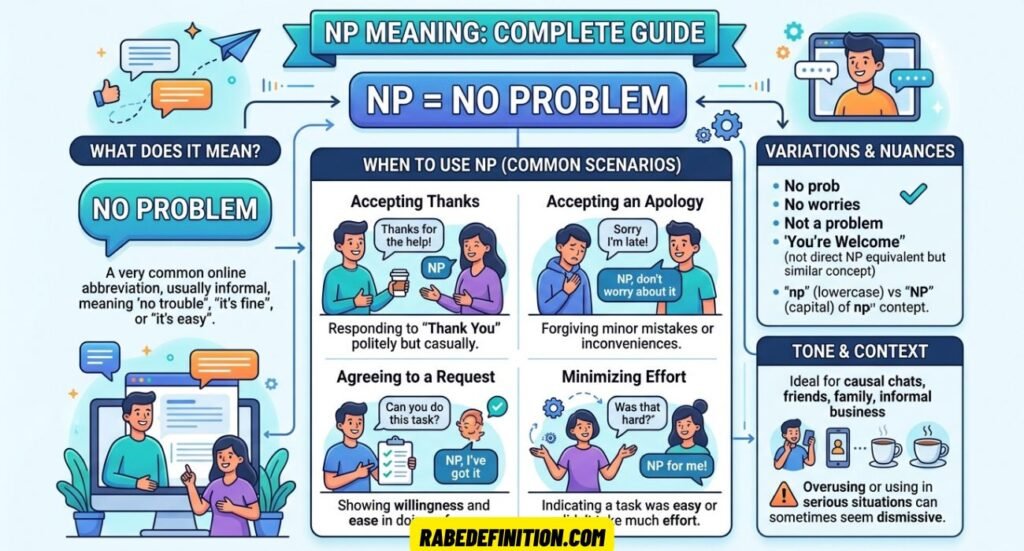
When someone says “NP” after “thank you,” they almost always mean “No Problem.”
In this context, NP functions much like:
- “You’re welcome.”
- “No worries.”
- “Of course.”
- “Anytime.”
- “Happy to help.”
For example:
“Thanks for sending that over!”
“NP!”
There is no hidden meaning in most situations. The person is simply acknowledging your thanks.
The difference is mostly tone. “NP” feels more casual and text-friendly than “You’re welcome.”
What Does NP Mean After “Sorry”?
After an apology, NP usually means “No Problem,” “It’s okay,” or “Don’t worry about it.”
For example:
“Sorry I missed your call.”
“NP, just call me when you’re free.”
It is particularly natural when the mistake or inconvenience is minor.
For a serious apology, however, a more thoughtful response may be better than simply saying NP. The seriousness of the situation should guide the response.
NP vs. “You’re Welcome” vs. “No Worries”
These expressions overlap, but they are not identical.
| Term | Meaning | Typical Tone |
|---|---|---|
| NP | No problem | Casual and brief |
| You’re welcome | Acknowledges thanks | Polite and neutral |
| No worries | It’s okay / don’t worry | Casual and reassuring |
| Of course | Glad to help / naturally | Friendly and warm |
| Anytime | Happy to help again | Friendly |
NP is especially useful when you want a fast response.
You’re welcome is more universally appropriate, including situations where you want to sound polite without being overly casual.
No worries often feels especially natural after an apology or when reassuring someone.
How Do You Respond to “NP”?
You usually do not need to respond to “NP.” In many conversations, it naturally ends the exchange.
If you do want to continue the conversation, your response can depend on the situation.
Short Response
- “Thanks!”
- “Got it.”
- “Appreciate it!”
Friendly Response
- “You’re the best!”
- “Thanks again 😊”
- “I appreciate you!”
Casual Response
- “Awesome!”
- “Perfect, thanks.”
- “Sounds good!”
Playful Response
- “I owe you one 😂”
- “You’re a lifesaver!”
- “Legend!”
There is no special response required simply because someone used NP.
Is NP Formal or Professional?
NP is generally informal.
It is perfectly understandable in casual texting, but it is not usually the best choice for formal writing.
For example, NP can be fine in an informal workplace chat:
“Thanks for handling that!”
“NP!”
But in a formal email to a client, you might prefer:
“You’re welcome. I’m happy to help.”
Or:
“Of course. Please let me know if you need anything else.”
The distinction is not that NP is “wrong” at work. Rather, the communication channel and relationship matter.
It can work with coworkers who regularly use casual messaging, while formal emails, official documents, academic writing, and customer-facing communication generally call for complete words and a more polished tone.
Can NP Be Used at Work?
Yes, NP can be used at work when the environment is informal, especially in quick messages between coworkers.
For example:
“Thanks for jumping on that so quickly.”
“NP!”
That said, consider your audience. If you are writing to a customer, executive, new professional contact, or someone who prefers formal communication, “You’re welcome,” “Of course,” or “Happy to help” may be a safer choice.
What Does NP Mean on Social Media?
On social media, NP generally has the same casual meaning: “No Problem.”
You may encounter it in:
- Instagram DMs
- Snapchat chats
- TikTok messages
- Facebook Messenger
- WhatsApp conversations
- Comments and replies
- Online communities
For example:
“Thanks for sharing this!”
“NP!”
Or:
“Sorry for the random DM.”
“NP, what’s up?”
Social media conversations are usually informal, so abbreviations such as NP fit naturally into these settings.
NP vs. Similar Texting Expressions
Several expressions can look interchangeable with NP, but small differences exist.
| Expression | Meaning | Main Difference |
|---|---|---|
| NP | No Problem | Shortest and very casual |
| YW | You’re Welcome | Specifically responds to thanks |
| No worries | It’s okay | Often emphasizes reassurance |
| Ofc | Of course | Casual agreement or willingness |
| Anytime | Happy to help | Suggests willingness to help again |
| All good | Everything is fine | Often used after a minor issue |
The right choice depends on what you want your message to communicate.
If someone says “Thanks,” “NP” and “YW” can both work.
If someone says “Sorry,” “NP,” “No worries,” and “All good” are usually more natural than “YW.”
Other Meanings of NP
Although “No Problem” is the meaning most people are looking for in casual texting, NP can stand for other things in specialized contexts.
Nurse Practitioner
In healthcare, NP commonly refers to a nurse practitioner.
For example:
“The NP will review your symptoms.”
That meaning has nothing to do with texting slang.
National Park
In discussions about parks, travel, or geography, NP may sometimes be used as an abbreviation for National Park.
For example:
“We visited three NPs during our road trip.”
The exact abbreviation style can vary by organization and context, so it should not automatically be assumed to mean “No Problem.”
Other Specialized Uses
NP can have additional meanings in technical, academic, scientific, or professional settings.
The important point is to look at the surrounding conversation. If someone replies “NP!” immediately after you say “Thanks,” “No Problem” is the obvious interpretation. If NP appears in a medical document, it may mean something completely different.
See Also : PMO Meaning Explained: What Does PMO Mean in Text
Common Mistakes When Using NP
A few simple mistakes can make NP less effective.
Using It in Very Formal Writing
Avoid relying on NP in formal emails, academic assignments, or official documents unless the context specifically allows informal abbreviations.
Assuming It Always Means “You’re Welcome”
NP can function like “You’re welcome,” but its broader meaning is “No Problem.” After an apology, for example, it means something closer to “It’s okay.”
Overthinking a Short “NP”
A message such as “NP” is usually just a quick response. Do not automatically interpret the lack of an emoji or exclamation point as anger.
Ignoring Context
If NP appears in a specialized setting, it may not mean “No Problem.” Always consider the subject of the conversation.
Can NP Sound Cold Over Text?
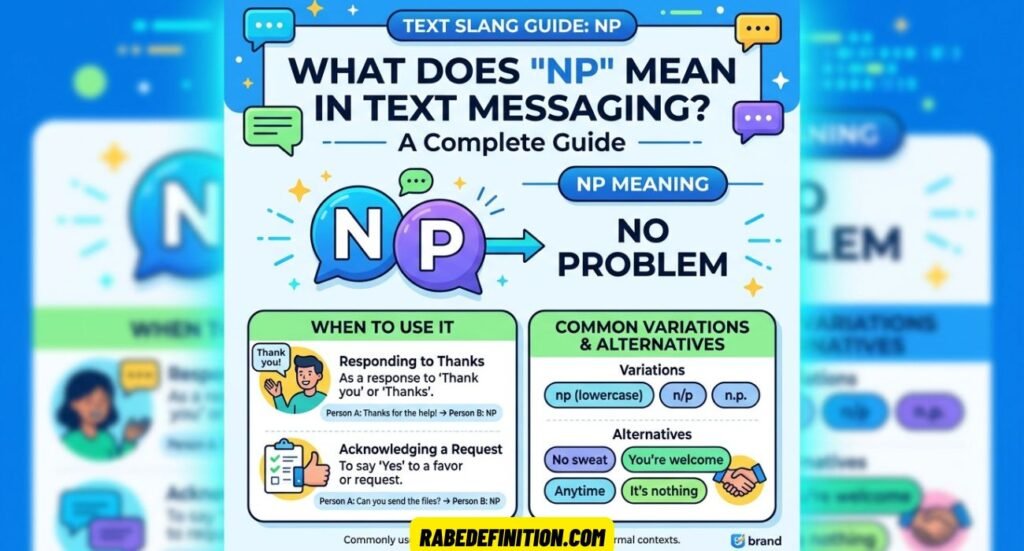
“NP” usually sounds casual and neutral, but because it is so short, it can sometimes feel a little brief. If someone simply replies “NP” without an emoji or extra words, it does not necessarily mean they are annoyed. They may just be keeping the conversation quick.
The tone can feel warmer with small changes. For example, “NP!” sounds more upbeat than “NP,” while “NP 😊” can feel friendlier. The relationship between the people and the rest of the conversation are usually better clues than the abbreviation itself.
What Does NP Mean From a Guy or Girl?
When a guy or girl sends “NP,” it generally means the same thing: “No Problem.” There is no special male or female meaning attached to the abbreviation. If someone sends it after you say “thanks,” they are most likely simply saying that helping you was not an issue.
Whether the message feels friendly, distant, playful, or romantic depends on the surrounding conversation. “NP” by itself does not prove that someone is flirting or showing romantic interest. Look at their other messages, emojis, and overall communication style for more context.
Can NP Be Used in a Flirty Conversation?
Yes, “NP” can appear in a flirty or romantic conversation, but the abbreviation itself is not inherently flirty. For example, someone might say “NP 😊” after their crush thanks them for doing a favor. The friendly tone comes from the situation and the rest of the message, not from NP alone.
If the conversation already has playful or romantic energy, NP can naturally be part of it. However, interpreting “NP” as a romantic signal without considering the surrounding messages can easily lead to misunderstanding.
NP Meaning in Different Types of Online Chats
“NP” is commonly used across different types of online conversations, including private messages, group chats, gaming conversations, and casual workplace messaging. In most of these settings, it simply means “No Problem” and acts as a quick way to reassure someone or acknowledge their thanks.
The level of formality can change depending on where you see it. “NP” may feel perfectly normal between friends or coworkers who regularly chat casually, while a formal email or professional message may be better served by “You’re welcome,” “Of course,” or “Happy to help.”
Common Questions About NP Meaning
What does NP mean in texting?
NP usually means “No Problem” in texting. It is a casual abbreviation commonly used after thanks, apologies, requests, or minor inconveniences.
What does NP stand for?
In casual texting, NP stands for “No Problem.” In professional or specialized contexts, it can have other meanings, such as “nurse practitioner.”
What does NP mean after thank you?
After “thank you,” NP generally means “No Problem” and works as a casual version of “You’re welcome.”
What does NP mean after sorry?
After “sorry,” NP usually means “No Problem,” “It’s okay,” or “Don’t worry about it.”
Is NP rude?
Usually, no. NP is generally a neutral, polite, and casual response. Its shortness can feel a little blunt in some conversations, but the context matters.
Does NP mean you’re welcome?
It can. When someone says “NP” after you thank them, it often serves the same conversational purpose as “You’re welcome.”
How do you respond to NP?
You do not necessarily need to respond. If you want to continue the conversation, try “Thanks!”, “Appreciate it!”, or another natural response related to the conversation.
Is NP formal?
No. NP is generally informal and is most appropriate for texting, DMs, casual chats, and other relaxed communication.
Can I use NP at work?
Yes, when workplace communication is casual. It is generally more suitable for quick chats with familiar coworkers than formal emails or client-facing communication.
What does NP mean on social media?
On social media, NP usually means “No Problem.” It can appear in DMs, replies, comments, and casual conversations.
Final Takeaway: NP Usually Means “No Problem”
So, what does NP mean in text? In most casual conversations, NP means “No Problem.”
It is commonly used after someone says “thank you” or “sorry,” and it can also show that a request or inconvenience is not an issue. The abbreviation is generally friendly and casual.
Just remember that context matters. In a text conversation, NP almost certainly means “No Problem,” while in a medical or professional setting, it may have an entirely different meaning.