45 Good Roasts That Hurt: Funny, Clever & Savage Comebacks
Sometimes the best comeback is not a long argument. It is one perfectly timed sentence that makes everyone laugh—and leaves the other person wondering what just happened.
If you’re looking for 45 good roasts that hurt, you’ve come to the right place. These are clever, funny, and sometimes savage lines designed for playful banter, friendly arguments, group chats, and situations where a sharp comeback fits the mood.
The key is knowing your audience. A roast can be hilarious between close friends and unnecessarily cruel when used on someone who did not sign up for the joke.
Quick Answer
45 good roasts that hurt are witty comebacks that have enough bite to sting while still being funny. The strongest ones usually rely on exaggeration, sarcasm, unexpected comparisons, or a surprisingly accurate observation rather than genuinely cruel personal attacks.
Here are a few examples:
- “I’d agree with you, but then we’d both be wrong.”
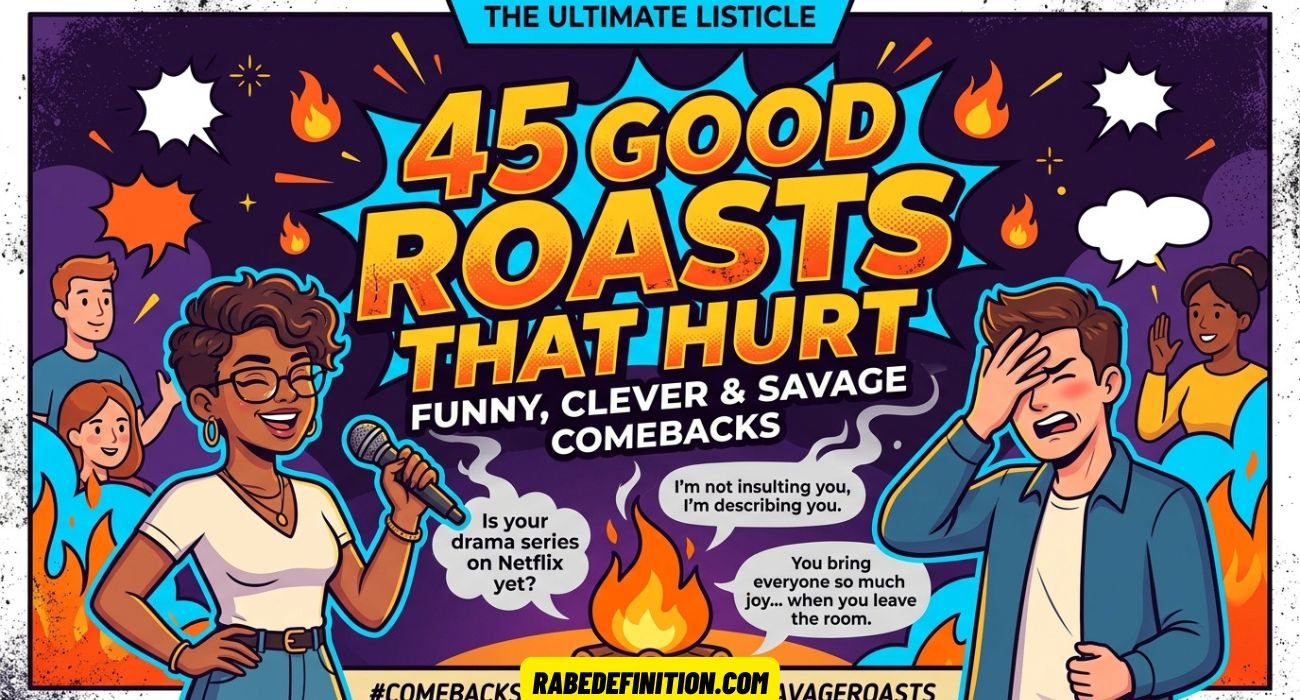
- “You bring everyone so much joy… whenever you leave the room.”
- “Your confidence is impressive for someone who is this consistently wrong.”
- “I was going to explain it to you, but I left my crayons at home.”
- “You have something on your chin. No, the third one down.”
- “You’re not useless. You can always serve as a bad example.”
Use them playfully, and remember that delivery matters almost as much as the words.
TL;DR
- Good roasts are clever, unexpected, and funny, not simply mean.
- The best roast lines target harmless habits, exaggerated behavior, or funny situations.
- Short comebacks often work better because they get to the punchline quickly.
- A savage roast is only funny when the situation and relationship can handle it.
- Avoid sensitive personal subjects when you want the joke to stay playful.
45 Good Roasts That Hurt
Here are 45 original roast lines ranging from mildly sarcastic to seriously savage.
1–10: Clever Roasts
- “I’d explain it to you, but I don’t have the time or the crayons.”
- “You have a real talent for turning simple things into complicated disasters.”
- “I love how confidently you say things that are completely incorrect.”
- “Your train of thought has been delayed indefinitely.”
- “You’re proof that confidence and competence are two completely different things.”
- “I would take your advice, but I’m trying to make better decisions.”
- “You make a strong argument for the existence of a mute button.”
- “Somewhere, a village is missing its fool. Apparently, you escaped.”
- “You bring a unique perspective to every conversation. Unfortunately, it’s usually the wrong one.”
- “You’re not difficult to understand. You’re difficult to take seriously.”
11–20: Funny Roasts for Friends
- “You’re the reason the group chat needs a warning label.”
- “If being late were a personality trait, you’d be the poster child.”
- “You have two speeds: unnecessarily dramatic and completely asleep.”
- “I’d trust you with my life, but probably not with my Wi-Fi password.”
- “Your ability to miss the point deserves its own documentary.”
- “You somehow make bad decisions look like a carefully planned hobby.”
- “You’re my favorite person to argue with because you make losing feel impossible.”
- “You’re not chaotic. You’re just aggressively unpredictable.”
- “Every friend group needs someone who makes questionable choices. Thanks for volunteering.”
- “You have the confidence of someone who has never experienced consequences.”
21–25: Short Roasts That Hurt
- “That sounded better in your head, didn’t it?”
- “Bold of you to say that out loud.”
- “You tried. That’s what matters.”
- “Interesting. Wrong, but interesting.”
- “I’ve heard better arguments from autocorrect.”
Short roasts work particularly well in texting because they do not require a long setup. A quick response can also make the comeback feel more spontaneous.
26–30: Sarcastic Roasts
- “Wow, you almost made a good point. Keep going.”
- “I’m genuinely impressed by how consistently you miss the obvious.”
- “Congratulations. You’ve somehow lowered my expectations again.”
- “I appreciate your enthusiasm. Accuracy would be nice too.”
- “You really do make every room more interesting. Mostly because nobody knows what you’ll say next.”
Sarcasm works because the literal words and intended meaning do not quite match. The contrast creates the joke.
31–35: Modern Life & Tech Roasts
- “Your Wi-Fi has better communication skills than you.”
- “You have 47 tabs open and somehow none of them contain common sense.”
- “Your phone gets more updates than your personality.”
- “Even autocorrect has stopped trying to fix your decisions.”
- “Your screen time report is basically a cry for help.”
These are useful for group chats, social media banter, gaming conversations, and casual texting because they rely on familiar technology rather than deeply personal subjects.
36–40: Savage Roasts
- “You’re not the main character. You’re barely in the deleted scenes.”
- “I’d roast you harder, but life already seems to be handling that.”
- “You have an incredible ability to make people appreciate silence.”
- “I could explain why you’re wrong, but watching you figure it out might be funnier.”
- “Your personality has the same energy as a software update nobody asked for.”
Savage lines should be used selectively. A roast that gets a laugh among close friends can land very differently with a stranger or coworker.
41–45: Brutal but Playful Comebacks
- “You’re not everyone’s cup of tea. More like the water someone forgot to boil.”
- “You have the rare ability to make an entrance and an exit equally exciting.”
- “If self-awareness were money, you’d be asking for a loan.”
- “You’re incredibly memorable. Unfortunately, not for the reasons you’re hoping.”
- “I’d tell you to be yourself, but this seems like enough damage already.”
These are among the sharper good roasts that hurt, so context matters. They work best as playful exchanges where everyone understands that the goal is comedy rather than humiliation.
See Also : ONG Full Form: What Does ONG Mean in Texting?
Why Some Roasts Hit Harder Than Others
A roast doesn’t need profanity or a genuinely insulting subject to be effective.
Often, the funniest line takes something small and recognizable and exaggerates it. Someone who is five minutes late becomes a person who apparently operates on an entirely different time zone. Someone who talks too much becomes a human podcast nobody subscribed to.
That combination of recognition and exaggeration is what gives a roast its sting.
Surprise Makes a Roast Funnier
A predictable insult is easy to ignore. An unexpected comparison can catch someone off guard.
For example, saying someone is “annoying” is ordinary. Comparing their group-chat behavior to an unwanted software update is more specific and surprising.
Specificity Beats Generic Insults
A generic insult could apply to almost anyone. A good roast feels connected to the moment.
The closer the observation is to something everyone just witnessed, the stronger the punchline can be.
How to Roast Without Crossing the Line
The difference between a funny roast and a genuinely hurtful comment often comes down to the target and the relationship.
Good roast material usually includes:
- Funny habits
- Harmless mistakes
- Overconfidence
- Being chronically late
- Dramatic reactions
- Questionable fashion choices
- Group-chat behavior
- Silly arguments
- Everyday awkward situations
Avoid turning a joke toward someone’s serious insecurities, trauma, medical conditions, disabilities, identity, or other deeply personal circumstances.
If the other person stops laughing, becomes uncomfortable, or asks you to stop, the joke has already gone too far.
Why Do People Love a Good Roast?
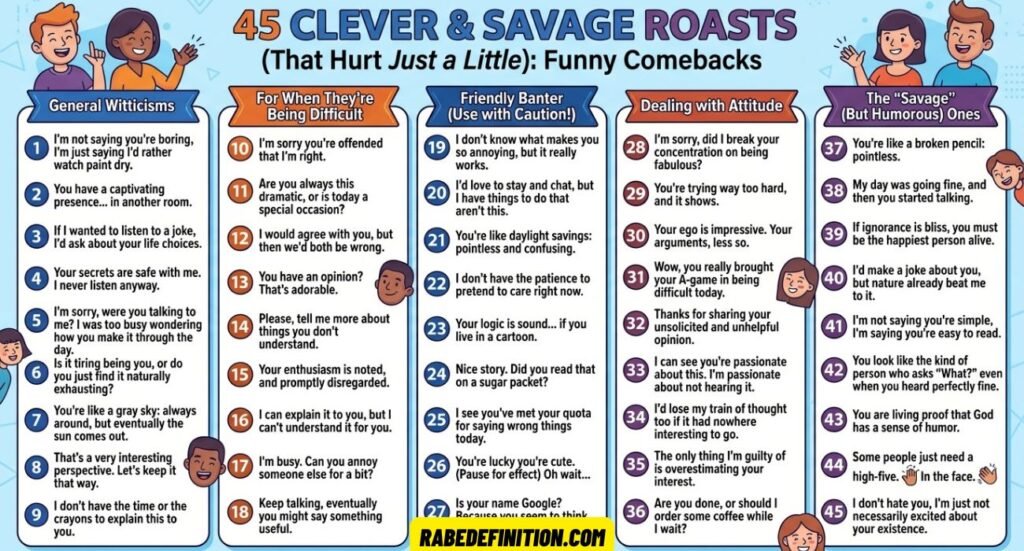
Roasting creates a particular kind of humor because it combines tension with a safe punchline.
Everyone knows an insult is coming, but the audience does not know exactly how it will be phrased. That uncertainty creates anticipation.
A clever roast can also turn an ordinary moment into an inside joke. Friends may remember a single hilarious comeback for years.
The appeal is not necessarily the insult itself. It is the creativity behind the delivery.
How to Create Your Own Funny Roasts
You don’t need to memorize hundreds of roast lines. You can create better comebacks by learning a simple formula.
Start With Something Noticeable
Look for an obvious, harmless behavior.
For example:
- Someone is always late.
- Someone checks their phone constantly.
- Someone gives unsolicited advice.
- Someone keeps changing their story.
Exaggerate It
Take that behavior to an absurd extreme.
Someone who is always late doesn’t simply “have bad timing.” They could apparently be “operating on a calendar from another dimension.”
Add an Unexpected Comparison
Comparisons make familiar observations more interesting.
Try comparing the behavior to:
- Technology
- Food
- Movies
- Animals
- Everyday objects
- Work meetings
- Video games
- Internet culture
Keep the Punchline Short
The longer you explain the joke, the weaker it becomes.
A strong roast usually works best when the setup is minimal and the punchline arrives quickly.
How Timing and Delivery Make a Roast Hit Hard
Even a brilliant roast can fail if the timing is wrong.
A calm, deadpan delivery can make a ridiculous line much funnier. On the other hand, laughing before finishing your own joke can give away the punchline.
In texting, timing works differently. A short response sent at exactly the right moment can be more effective than a paragraph of insults.
For example:
Friend: “I definitely know what I’m talking about.”
You: “That’s usually when I’m most concerned.”
The line works because it responds directly to the confidence in the original message.
Roasts in Texting and Group Chats
Texting has made short roast lines especially convenient.
A few words can communicate sarcasm without requiring a full conversation. Emojis, punctuation, capitalization, and reaction GIFs can also change how a line is interpreted.
For example:
Friend: “I am absolutely the smartest person here.”
You: “This is why we need peer review.”
That response is playful because it exaggerates the friend’s confidence rather than attacking something deeply personal.
In group chats, however, remember that written sarcasm can sometimes be harder to interpret than spoken sarcasm. A joke that would sound playful in person may look harsher on a screen.
How to Reply When Someone Roasts You
Getting roasted does not mean you have to lose the exchange.
The easiest response is often to play along.
Casual Response
“Okay, that was actually good.”
Funny Response
“I’ll remember that when I’m writing your performance review.”
Confident Response
“You really thought you did something there.”
Self-Deprecating Response
“Fair. I walked directly into that one.”
Flip the Roast
“That’s a lot of confidence from someone wearing that outfit.”
The best response depends on your relationship and the tone of the original joke.
See Also : ICL Meaning: Understanding the Acronym and Its Usage
When to Use Good Roasts That Hurt
Roasts generally work best in relaxed, informal situations.
Good settings can include:
- Friendly group chats
- Hanging out with close friends
- Game nights
- Casual parties
- Playful online conversations
- Friendly debates
- Comedy-oriented conversations
Before using a particularly savage roast, consider whether the other person normally enjoys this kind of banter.
When Not to Use Savage Roasts
Be more careful with roasting:
- Strangers
- Customers
- Teachers or professors
- Managers
- Job interviews
- Formal meetings
- Professional emails
- Serious conversations
- Someone who has asked you to stop
Workplace humor can be perfectly normal among colleagues who know each other well, but the safest approach is to keep jokes focused on harmless work situations rather than personal characteristics.
Good Roasts vs. Genuine Insults
| Good Roast | Genuine Insult |
|---|---|
| Designed to entertain | Designed to hurt or demean |
| Usually exaggerated | May be sincerely hostile |
| Often mutual | Often one-sided |
| Targets harmless behavior | May target personal vulnerabilities |
| Works within the right context | Can damage relationships |
| Usually ends in laughter | Can leave someone genuinely upset |
The important distinction is intention and impact. Calling something “a joke” does not automatically make it funny or harmless.
Similar Terms: Roast, Burn, Insult, and Comeback
| Term | Meaning | Typical Use |
|---|---|---|
| Roast | A humorous, often exaggerated jab | Friendly banter or comedy |
| Burn | A sharp and clever insult | Quick verbal exchange |
| Comeback | A response to something someone said | Arguments or banter |
| Insult | A statement intended to offend or criticize | Can be serious or playful |
| Savage comeback | An especially sharp response | Competitive joking or online banter |
“Roast” and “burn” are often used interchangeably in casual conversations, although a roast can describe a broader style of humorous teasing.
Common Mistakes When Roasting Someone
Going Too Personal
A joke about someone’s habit is usually safer than a joke about a serious insecurity.
Trying Too Hard
If you need five sentences to explain why your roast is funny, it probably needs a rewrite.
Ignoring the Audience
The same line can be hilarious with one friend and uncomfortable with another.
Repeating the Same Joke
A roast becomes less funny when you keep returning to the same subject.
Forgetting That Text Has No Voice
Without facial expressions or vocal tone, sarcasm can sometimes sound harsher than intended.
How to Know When a Roast Has Gone Too Far
A good roast should feel like playful banter, not a personal attack. If the other person stops laughing, becomes noticeably uncomfortable, or asks you to stop, that’s a clear sign to back off. The funniest roasts that hurt usually have a lighthearted edge rather than targeting something genuinely sensitive.
Context matters just as much as the words themselves. A joke between longtime friends may work perfectly, while the same line could sound rude coming from a stranger or coworker. When you’re unsure, keep the roast focused on harmless habits, funny mistakes, or the situation itself.
Why Short Roasts Often Work Best
Short roast lines have an advantage because they get to the punchline quickly. Instead of explaining the joke, a concise comeback lets the other person—and everyone listening—make the connection themselves. That’s often what gives good roasts that hurt their extra punch.
They also work especially well in texting and group chats, where long explanations can make a joke feel forced. A quick line like “Bold of you to say that out loud” can be enough to turn an ordinary exchange into a funny moment without taking the conversation too far.
How to Deliver a Roast With Confidence
The words are only part of what makes a roast funny. Saying a comeback calmly and confidently can make even a simple line sound much sharper. A well-timed pause before the punchline can also give the joke more impact and let everyone catch the humor.
Try not to rush or explain the joke afterward. The strongest good roasts that hurt often sound effortless, as if the comeback appeared naturally in the moment. Keep your delivery relaxed, and let the other person’s reaction do the rest.
Funny Roasts That Work in Everyday Conversations
The best roast lines don’t need a special occasion. You can use playful comebacks when a friend is being overly dramatic, making an obvious mistake, arriving late, or confidently giving terrible advice. Everyday situations often provide the funniest material because everyone already understands what’s happening.
For example, a friend who takes forever to choose a restaurant might hear, “At this point, we’re not choosing dinner—we’re planning your retirement.” Simple observations like these make funny roasts feel more natural because they are connected directly to the moment.
FAQ About 45 Good Roasts That Hurt
What are good roasts that hurt but are still funny?
Good roasts that hurt are clever lines with a comedic sting. They usually exaggerate a harmless behavior or use an unexpected comparison rather than attacking something deeply personal.
What is a good short roast?
A short roast such as “Interesting. Wrong, but interesting” works because it is quick, direct, and easy to understand without a long setup.
What is the best roast for a friend?
The best roast for a friend depends on your shared sense of humor. Jokes about harmless habits, lateness, dramatic behavior, or funny mistakes are generally easier to keep playful.
How do you roast someone without being mean?
Focus on temporary situations, silly habits, exaggerated behavior, or the person’s obvious overconfidence. Avoid serious insecurities and stop if the other person is genuinely uncomfortable.
Are savage roasts rude?
They can be. “Savage” describes how sharp a roast feels, but whether it is rude depends heavily on the relationship, setting, subject, and delivery.
What is the difference between a roast and an insult?
A roast is normally intended as humor, while an insult may be intended to offend or demean. Context can blur the distinction, especially when sarcasm is involved.
Can I use roasts in a group chat?
Yes, if the group is comfortable with that kind of humor. Remember that written jokes can be misinterpreted, so particularly harsh lines may not work as well over text.
How do I respond when someone roasts me?
You can laugh it off, compliment the comeback, make a playful counter-roast, or simply change the subject. You do not have to participate if the joke crosses a boundary.
What makes a roast actually funny?
Surprise, timing, specificity, exaggeration, and a recognizable observation usually make a roast more effective than simply using harsh language.
What are the best 45 good roasts that hurt?
The best lines are the ones that fit the moment. A short, perfectly timed comeback will usually land better than an extremely harsh insult that feels forced or out of place.
Conclusion
The best 45 good roasts that hurt are not necessarily the cruelest ones. They are the lines that combine wit, timing, exaggeration, and just enough truth to create that satisfying “ouch, that’s actually funny” reaction.
Use the lighter roasts for casual banter and save the sharper ones for people who genuinely enjoy that style of humor. When in doubt, roast the situation—not someone’s deepest insecurity.
A great comeback should leave people laughing, not looking for a way out of the conversation.