Current Phase of the Moon Emoji: Meanings, Uses, and Examples
Have you ever wondered which emoji matches the current phase of the Moon? If you are searching for the current phase of the moon emoji, you are probably trying to connect what is happening in the night sky with the right symbol on your phone.
Moon emojis such as 🌑, 🌒, 🌓, 🌔, 🌕, 🌖, 🌗, and 🌘 represent different stages of the lunar cycle. However, these emojis do not automatically update based on the actual Moon in the sky.
The key is simple: first find the Moon’s actual phase for the date and time you care about, then choose the emoji that most closely represents it.
Quick Answer
The current phase of the moon emoji is the Moon emoji that best corresponds to the Moon’s actual astronomical phase at a particular time. For example, a Full Moon is represented by 🌕, while a New Moon is represented by 🌑.
Moon emojis are standardized symbols, not live astronomical indicators. Your phone will not automatically change 🌕 into 🌖 when the real Moon begins waning. To find the correct emoji for today’s Moon phase, check a current lunar-phase calendar or astronomy tool and then match the phase to its emoji.
TL;DR
- 🌑 represents the New Moon.
- 🌒 and 🌘 represent Waxing Crescent and Waning Crescent.
- 🌓 and 🌗 represent the First Quarter and Last Quarter.
- 🌔 and 🌖 represent Waxing Gibbous and Waning Gibbous.
- 🌕 represents the Full Moon.
- Moon emojis are visual symbols and do not automatically reflect the real-time Moon phase.
What Does the Current Phase of the Moon Emoji Mean?
The phrase current phase of the moon emoji is not the name of one specific emoji. Instead, it refers to choosing the Moon emoji that corresponds to the Moon’s present or selected lunar phase.
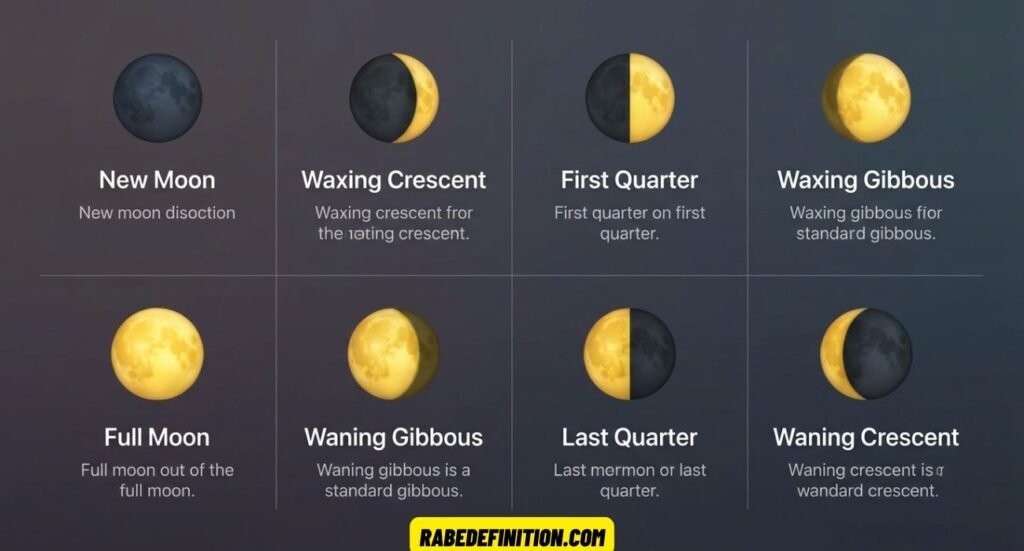
There are several phase-specific Moon emojis. Each one gives a simplified visual representation of a stage in the approximately month-long lunar cycle.
Here is the basic mapping:
| Actual Moon phase | Emoji | What it represents |
|---|---|---|
| New Moon | 🌑 | Little to no illuminated portion visible from Earth |
| Waxing Crescent | 🌒 | A growing illuminated crescent |
| First Quarter | 🌓 | Roughly half of the visible disk illuminated |
| Waxing Gibbous | 🌔 | More than half illuminated and increasing |
| Full Moon | 🌕 | Nearly the entire visible disk illuminated |
| Waning Gibbous | 🌖 | More than half illuminated but decreasing |
| Last Quarter | 🌗 | Roughly half illuminated |
| Waning Crescent | 🌘 | A shrinking illuminated crescent |
The important distinction is that astronomy tells you what phase the Moon is actually in, while the emoji gives you a convenient symbol for that phase.
Is There One Emoji for the Current Moon Phase?
No. There is not a special emoji that automatically means “whatever phase the Moon is in right now.”
Instead, you select one of the available Moon phase emojis. The correct choice depends on the actual lunar phase you want to represent.
Current Phase of the Moon Emoji in Texting
In texting, Moon emojis are usually much more flexible than they are in astronomy.
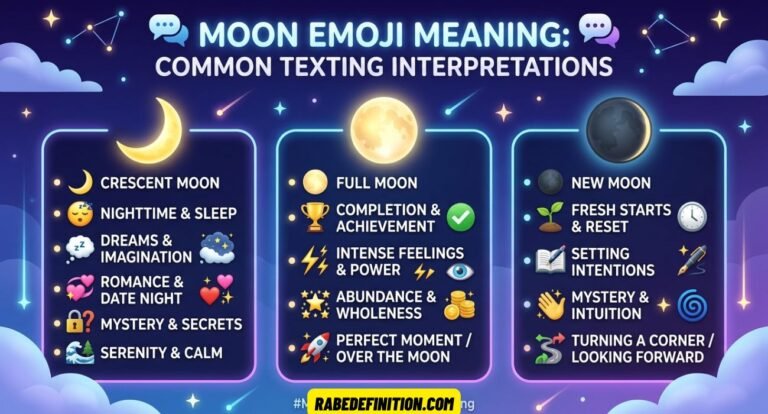
Someone might use 🌙 simply to say “good night,” refer to nighttime, or create a calm, dreamy mood. They may not be trying to describe the Moon’s actual phase at all.
When someone deliberately uses 🌑 through 🌘, however, the emoji can have a more specific visual meaning.
For example:
Person A: “The Moon looked almost completely full last night.”
Person B: “🌕”
Here, the emoji is being used literally.
But:
Person A: “Goodnight, I’m exhausted.”
Person B: “Sleep well 🌙”
Here, 🌙 is primarily decorative or associated with nighttime rather than a precise lunar observation.
The tone can therefore be literal, aesthetic, peaceful, playful, or symbolic, depending on the conversation.
Common Uses and Situations
| Situation | What the Moon emoji usually communicates |
|---|---|
| Astronomy discussion | A specific lunar phase |
| Goodnight text | Nighttime or sleep |
| Social media caption | Aesthetic or dreamy mood |
| Astrology post | Lunar symbolism or a particular phase |
| Moon photography | Reference to the photographed phase |
| Spiritual content | Symbolic meaning associated with a lunar phase |
| Casual conversation | The Moon, night, or a nighttime feeling |
Astronomy and Moon Watching
If you are talking about an actual lunar observation, a phase-specific emoji can make the message easier to understand.
For example:
“The Moon is almost completely illuminated tonight 🌔”
The emoji reinforces the description.
Goodnight Messages
A simple 🌙 can work perfectly well when the exact phase is irrelevant.
“Goodnight! 🌙”
You do not need to determine whether the Moon is waxing or waning just to send a nighttime message.
Social Media Captions
Moon emojis are also common in captions because they add visual atmosphere.
“Quiet nights and clear skies 🌌🌙”
In this type of use, the emoji is usually expressive rather than scientifically precise.
Real Texting Examples
Example 1: Full Moon
Person A: “Is tonight the full Moon?”
Person B: “Yep 🌕”
The emoji reinforces the literal meaning.
Example 2: General Nighttime Meaning
Person A: “I’m heading to bed.”
Person B: “Goodnight 🌙”
Here, 🌙 simply creates a nighttime mood.
Example 3: Waxing Crescent
Person A: “I could only see a thin slice of the Moon tonight.”
Person B: “🌒 That’s such a cool phase.”
The emoji represents a crescent that is growing toward First Quarter.
Example 4: Astronomy Hobby
Person A: “I’m trying to photograph every Moon phase.”
Person B: “Starting with 🌑?”
The New Moon emoji is being used as part of the lunar sequence.
Example 5: Social Media
Person A: “Posted some pictures from last night’s walk.”
Person B: “The sky looks amazing 🌙✨”
This is aesthetic rather than an attempt to identify the exact lunar phase.
Example 6: Astrology Content
Person A: “New Moon intentions tonight.”
Person B: “🌑✨”
Here, the emoji supports the symbolic context of a New Moon.
Example 7: Checking the Actual Phase
Person A: “Which Moon emoji should I use for tonight?”
Person B: “Check the lunar calendar first, then match the phase to the emoji.”
This is the most accurate approach when the phase matters.
See Also : 45 Good Roasts That Hurt: Funny, Clever & Savage Comebacks
How to Match the Current Moon Phase to the Right Emoji
The easiest method is to treat the process as a two-step check.
Step 1: Find the actual lunar phase.
Use a reliable, up-to-date Moon-phase calendar or astronomy resource for the date and time you have in mind.
Step 2: Match it to the emoji.
Use the phase chart:
- New Moon → 🌑
- Waxing Crescent → 🌒
- First Quarter → 🌓
- Waxing Gibbous → 🌔
- Full Moon → 🌕
- Waning Gibbous → 🌖
- Last Quarter → 🌗
- Waning Crescent → 🌘
The Moon changes continuously, while emojis provide a limited set of visual categories. That means the closest emoji may sometimes be an approximation rather than an exact picture of what you see.
Tone and Context
Moon emojis can communicate different things depending on how they are used.
| Context | Possible tone |
|---|---|
| “Goodnight 🌙” | Warm, calm, friendly |
| “Look at the Moon 🌕” | Literal |
| “New Moon energy 🌑✨” | Symbolic or spiritual |
| “That sky 😍🌙” | Appreciative or aesthetic |
| “🌘” in an astronomy chat | Informational |
| Several Moon emojis together | Decorative or playful |
The surrounding words are often more important than the emoji itself.
A 🌙 at the end of a message about sleep usually means something different from 🌙 in a conversation about lunar observation.
When to Use It
Use a Moon phase emoji when:
- You are discussing the Moon or nighttime.
- You want to add atmosphere to a social post.
- You are talking about a particular lunar phase.
- You are sharing astronomy or Moon photography.
- You are discussing astrology or lunar symbolism.
- You want a simple visual element in a casual message.
If you are specifically describing the current Moon phase, check the actual phase before choosing a phase-specific emoji.
When Not to Use It
There is generally no major problem with using Moon emojis casually. The main issue is accuracy and clarity.
In a formal email, academic paper, business document, or professional report, a Moon emoji is usually unnecessary unless the communication specifically calls for emojis.
For example, instead of writing:
“The observation occurred during 🌔.”
a scientific or academic context would normally use the actual lunar phase name.
Likewise, if the person receiving your message may not understand phase-specific emojis, simply writing “waxing gibbous Moon” is clearer.
Social Media Usage
Moon emojis work especially well on visual and conversational social platforms.
Creators may use 🌙, 🌕, or other Moon emojis in captions about:
- Night photography
- Travel
- Stargazing
- Astrology
- Self-reflection
- Evening activities
TikTok
Moon emojis can appear in captions, comments, or text overlays. Their meaning depends heavily on the surrounding content.
Snapchat
A Moon emoji may be used simply as a nighttime or aesthetic symbol, although users can also use phase-specific emojis literally.
WhatsApp and Messenger
In private conversations, 🌙 is often a simple goodnight or nighttime symbol. More specific Moon emojis are useful when the conversation is actually about lunar phases.
The same principle applies across platforms: the emoji itself does not tell you whether the Moon is actually in that phase right now.
See Also : ONG Full Form: What Does ONG Mean in Texting?
Similar Moon Symbols and Comparisons
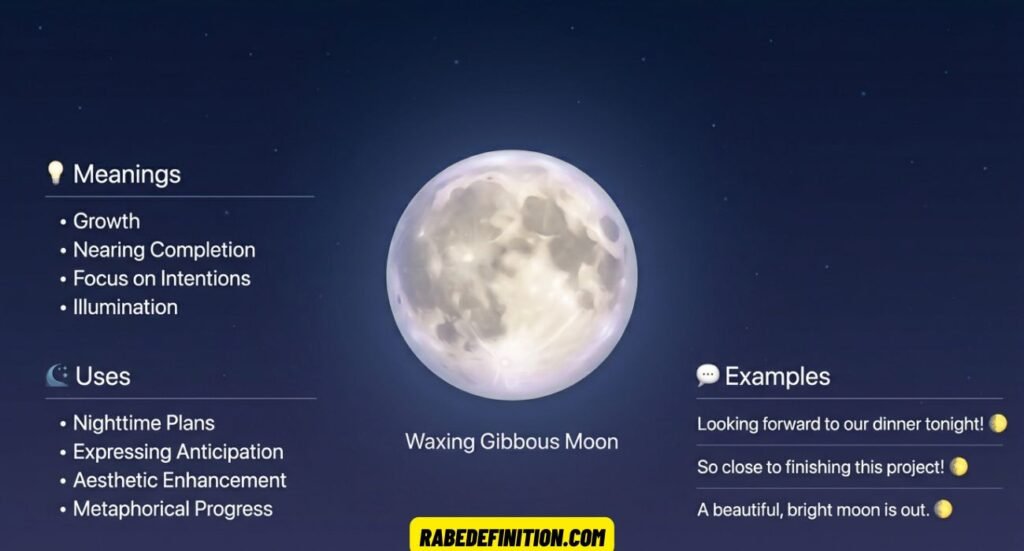
Several Moon-related symbols can look similar but serve different purposes.
| Symbol | Typical meaning | Main difference |
|---|---|---|
| 🌙 | Crescent Moon/night | General nighttime symbol |
| 🌑 | New Moon | Specific lunar phase |
| 🌒 | Waxing Crescent | Crescent that is increasing |
| 🌘 | Waning Crescent | Crescent that is decreasing |
| 🌕 | Full Moon | Nearly fully illuminated Moon |
| ☾ / ☽ | Moon symbol | Often used as a symbol or astrological glyph |
🌙 vs. 🌒
These are easy to confuse.
🌙 is commonly used as a general crescent Moon or nighttime symbol. 🌒 specifically represents a Waxing Crescent Moon.
So if you are simply saying “goodnight,” 🌙 is usually more natural. If you are identifying a lunar phase, 🌒 is more specific.
🌒 vs. 🌘
Both are crescent-shaped, but they represent different stages.
🌒 = Waxing Crescent
🌘 = Waning Crescent
“Waxing” means the illuminated portion is increasing. “Waning” means it is decreasing.
🌕 vs. 🌔
🌕 represents the Full Moon, while 🌔 represents a Waxing Gibbous Moon.
If the Moon is more than half illuminated but has not yet reached full, 🌔 is the closer phase emoji.
Other Meanings
The phrase current phase of the moon emoji does not have a separate slang, texting abbreviation, medical, financial, or technical definition.
Its meaning is primarily literal: finding the Moon emoji that corresponds most closely to a particular lunar phase.
However, individual Moon emojis can have symbolic meanings in different communities.
For example, a New Moon emoji may appear in astrology or spiritual posts, while a crescent Moon may simply represent nighttime in a casual text.
Those interpretations come from context rather than from the emoji being a secret slang term.
Common Mistakes
Here are a few mistakes people make when choosing a Moon phase emoji:
Assuming the Emoji Is Live
Moon emojis do not automatically synchronize with the sky.
Treating Every Crescent as the Same
🌒 and 🌘 represent different directions in the lunar cycle.
Confusing 🌙 With a Specific Phase
🌙 is commonly a general crescent/night symbol, not a precise replacement for every crescent phase.
Forgetting That the Moon Changes Gradually
The actual Moon does not suddenly jump from one emoji category to another. The emojis simplify a continuously changing astronomical cycle.
Assuming Every Device Displays It Identically
Emoji artwork can vary between platforms and operating systems, even when the underlying character has the same standardized meaning.
How Moon Phase Emojis Help Explain the Lunar Cycle
Moon phase emojis make it easier to talk about the different stages of the lunar cycle without using long astronomical descriptions. Symbols like 🌒, 🌓, 🌔, and 🌕 give readers a quick visual idea of how much of the Moon is illuminated.
They can be especially useful in social media posts, astronomy conversations, or casual messages. While emojis are not as precise as an astronomy chart, they provide a simple way to connect a visual symbol with a particular Moon phase.
Can the Current Moon Phase Be Shown With One Emoji?
Yes, you can use one emoji to represent the Moon’s current phase, but you first need to know what phase the Moon is actually in. Once you identify it, you can choose the closest matching emoji from the standard Moon phase symbols.
For example, a Full Moon can be shown with 🌕, while a New Moon can be represented by 🌑. If the Moon is somewhere between major phases, the closest emoji may only provide a general visual representation rather than an exact match.
Why Moon Phase Emojis Are Popular Online
Moon emojis have become popular because they can communicate both information and mood at the same time. A single symbol can suggest nighttime, calmness, mystery, beauty, astronomy, or a connection to the lunar cycle.
Their meaning also changes depending on the platform and conversation. Someone posting 🌙 on Instagram may simply want an aesthetic look, while someone using 🌗 in an astronomy discussion may be referring specifically to the Moon’s Last Quarter phase.
What Is the Best Emoji for the Moon Tonight?
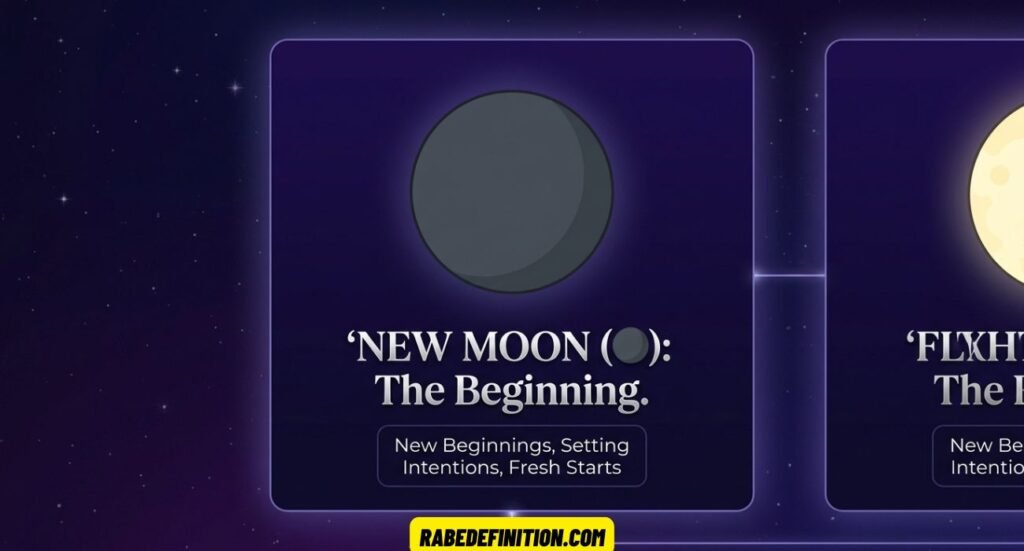
The best emoji for the Moon tonight depends on the actual lunar phase at the time you are referring to. Checking a current Moon-phase calendar is the easiest way to avoid choosing an emoji that does not match the sky.
If accuracy is not important, a general symbol such as 🌙 can work for a nighttime message or social media caption. If you are specifically discussing the Moon’s appearance, however, matching the emoji to the actual phase makes your post or message more informative.
FAQ About the Current Phase of the Moon Emoji
What is the current phase of the moon emoji?
It means the Moon emoji that best matches the Moon’s actual phase at a particular date and time. You need current lunar-phase information to determine which emoji is the best match.
What emoji represents the Full Moon?
The Full Moon emoji is 🌕.
What emoji represents the New Moon?
The New Moon emoji is 🌑.
What is the difference between 🌒 and 🌘?
🌒 represents a Waxing Crescent Moon, while 🌘 represents a Waning Crescent Moon. The former is moving toward greater illumination; the latter is moving toward less illumination.
Does the current Moon phase emoji update automatically?
No. Standard emojis are static Unicode characters. Your device does not change a Moon emoji according to the actual lunar cycle.
What is today’s Moon phase emoji?
There is no single permanent answer because the Moon’s phase changes with time. To find today’s matching emoji, check the current lunar phase and match it with the corresponding phase symbol.
Is 🌙 the same as the current Moon phase?
Not necessarily. 🌙 is commonly used as a general crescent or nighttime symbol. It does not automatically identify the Moon’s exact current astronomical phase.
Can Moon emojis be used for astrology?
Yes. Moon emojis are frequently used as visual symbols in astrology-related content. Their symbolic use should be distinguished from the astronomical measurement of the Moon’s actual phase.
Why does my Moon emoji look different on another phone?
Emoji artwork is rendered by the device or platform, so the same standardized emoji can have a somewhat different appearance on different systems.
How do I choose the right Moon phase emoji?
First determine the actual lunar phase for the date and time you are discussing. Then select the corresponding emoji: 🌑, 🌒, 🌓, 🌔, 🌕, 🌖, 🌗, or 🌘.
Conclusion
The current phase of the moon emoji is not a special live emoji that changes with the lunar cycle. Instead, it is the phase-specific Moon emoji that most closely represents the Moon’s actual phase at a particular time.
For casual messages, 🌙 may be all you need. But if you are talking about astronomy, Moon photography, or a specific lunar event, check the real Moon phase first and then choose the matching symbol.
The simplest rule is: check the Moon first, choose the emoji second.