Inseam Meaning: What Is an Inseam, and How Do You Measure It?
The answer to what is an inseam is refreshingly plain: it is the length of the inside of a pant leg, measured from the crotch seam straight down to the hem. The word does double duty, because it also names the stitched seam that runs along that same inside line. It is a plain sizing term from the tailoring trade, not an abbreviation or a piece of slang, and it behaves the same in a tailor’s shop as on a size chart.
You meet the word wherever pants are sold: on size labels printed as a pair of numbers, in online size charts, and in fitting rooms where a salesperson asks for it by name. Two shoppers can share a waist size and still need different inseams, because leg length varies on its own, independently of waist width. British shoppers will more often see the same measurement called the inside leg, which is Oxford’s listed British equivalent for the term.
This page walks through the meaning in plain words, then shows two reliable ways to measure your own with a tape. It also covers the lengths jeans and shorts are actually sold in, how context tells you whether someone means the seam or the measurement, and what to say back when the word comes up in conversation. By the end, a size label should read like plain English instead of a code.

What Does Inseam Mean?
An inseam is the inside-leg measurement of a pair of pants — crotch seam to bottom hem — and, in the sewing sense, the stitched seam that runs along that line.
| Detail | Explanation |
|---|---|
| Most Common Meaning | The length of the inside leg, given in inches |
| Full Form | None — a whole word, not initials |
| Common Use | Pant sizes, size charts, and tailoring |
| Formal or Informal | A standard clothing term, fine in any setting |
Merriam-Webster files the word in that same order: the inside-leg seam first, and the length of that seam second. Oxford’s learner dictionary defines it from the measuring side, as the length of the inside of somebody’s leg, used for making or choosing trousers of the correct size.
Watch for it on labels. A pair marked 32×30 is telling you two different things: the first number is the waist, and the second is the inseam, so the legs are thirty inches long on the inside.
How to Pronounce Inseam
Say it as IN-seem: two syllables, emphasis up front. Oxford gives the sound as /ˈɪnsiːm/, and it rhymes with “in dream” if you squash the two words together. Nobody spells the letters out, because the word was never an abbreviation to begin with.
The Main Meaning of Inseam
When people use the word in everyday life, the measurement is almost always what they mean. It exists because waist size alone cannot describe a pair of pants. Legs come in more lengths than waists come in widths, so manufacturers print both numbers and let each shopper match the pair to their own body.
The number also decides how the pants finish. A matched inseam lets the leg end cleanly at the shoe, while a long one bunches and drags and a short one rides up and shows ankle the wearer never planned on. One fresh example covers most real uses: “The waist fits me perfectly, but I need a shorter inseam.” Nothing about the top of the pants is wrong; the legs simply run long.
How to Read a Pants Size Label
Most men’s pants are sold under a two-number label, waist first and inseam second, so 32×30 means a 32-inch waist on a 30-inch leg. Levi’s product size guide shows the pattern plainly: every waist it lists, from 28 to 38, comes with the same three inseam choices — 30, 32, or 34. Picking a pair is really two separate decisions sharing one tag.
Some brands swap the second number for a letter or a word. Levi’s UK chart letters its lengths beside the heights they suit — 28 S, 30 M, 32 L — and other labels print Short, Regular, or Long instead of inches. Women’s labels vary more again: some carry inch figures, others only the length names. When a tag shows just one number, it is almost always the waist, with the length left at that brand’s regular.
Alternative Meanings of Inseam
This is a short section, because the word honestly has only one small family of senses. There is no slang reading, no acronym expansion, and no platform-specific twist hiding behind it.
The measurement. The sizing sense, and the one nearly every shopper means: a number in inches that states how long the inside leg is.
The seam itself. The construction sense: the line of stitching that joins the front and back of the leg along the inside, as in “the inseam split at the knee.” Tailors and repair shops use the word this way most.
One point is worth settling early, because searchers often come hunting for it. Unlike icl, which really does unpack into a full phrase, inseam shortens nothing — it is one ordinary word that has always been spelled out in full.
Why the Inseam Is Important
Fit is the whole reason the number exists. Pants with the wrong inseam announce it all day: hems that pool over the shoes and fray against the ground, or legs that stop short and make a full-length style look borrowed. A matched length walks comfortably, sits cleanly, and makes even an inexpensive pair look deliberately chosen.
The measurement matters just as much when nothing is wrong with the pants themselves. Two people of the same height can carry their height differently — longer legs on a shorter torso, or the reverse — so height alone cannot pick the length. The inseam can, because it measures the leg itself rather than the person standing in it.
How to Measure Your Inseam
You need a soft tape measure, a flat surface, and about two minutes. Both methods below are standard; the first is the one tailors tend to trust more.
Method 1: Measure a Pair of Pants
Pick a pair you already own that fits the way you like, and lay it flat with the legs straight and the wrinkles smoothed out. Find the point where the inside seams meet at the crotch, and set the end of the tape there. Run the tape down the inside of one leg, following the seam, until you reach the bottom edge of the hem. The number you land on is the inseam of that pair — and the length to shop for.
Method 2: Measure Your Body
Stand barefoot against a wall with your back straight and your feet slightly apart. Tuck a thin book or a stiff magazine up between your legs, snug against your body, to stand in for the crotch seam. Measure from the top edge of the book straight down to the floor, keeping the tape vertical. A helper makes this far more accurate, and even then, treat the result as a starting point: bodies are harder to measure than garments, which is why the pants method wins when a good pair exists.
Inseam Lengths for Jeans, Trousers, and Shorts
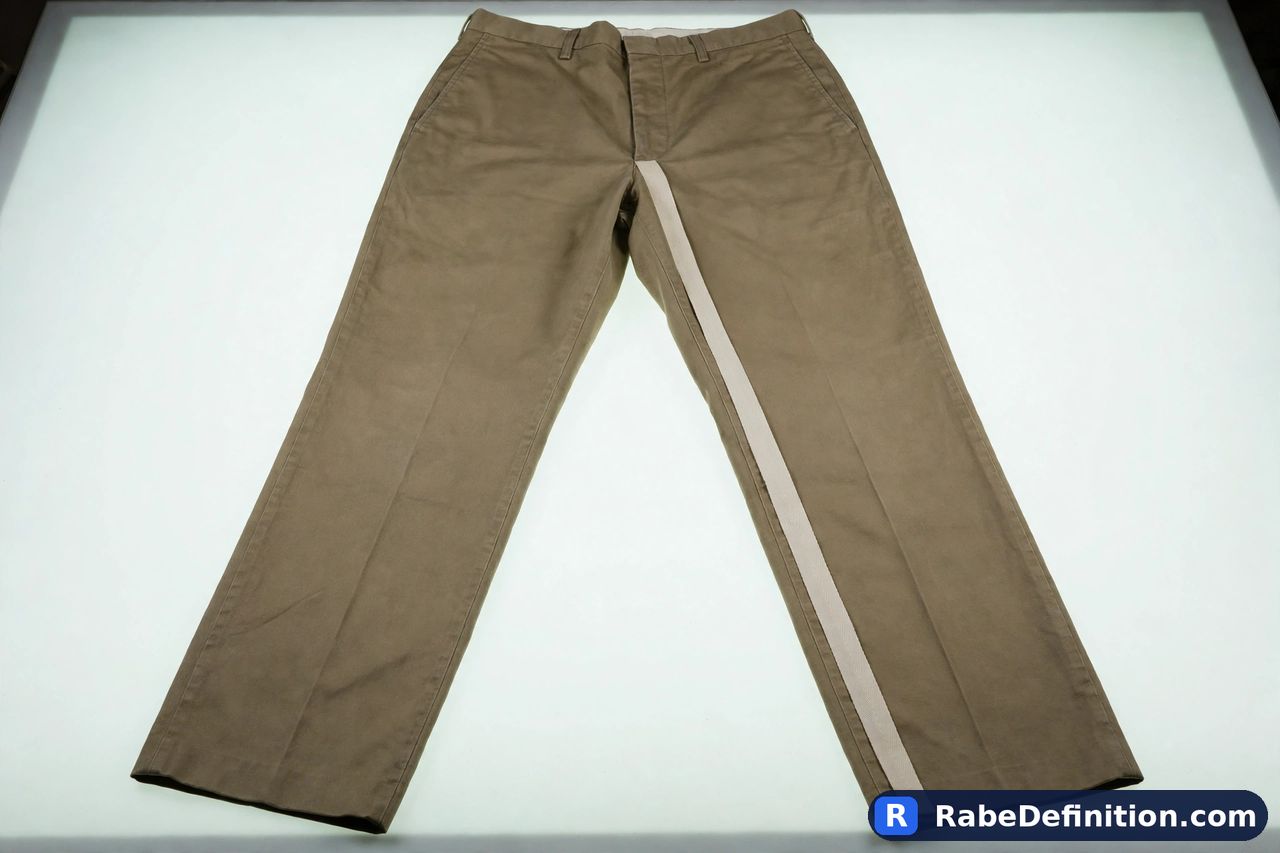
Full-length pants cluster in a narrow band. Levi’s own men’s size guide, for example, sells its jeans in inseams of 30, 32, and 34 inches across nearly every waist, with its length chart pairing a 30 with heights around 5’6″ to 5’8″, a 32 with 5’8″ to 6′, and a 34 with 6′ to 6’4″. Longer 36-inch options appear in tall ranges, and shorter ones in petite ranges, but that 30-to-34 middle covers most adult shoppers.
Shorts play by different numbers entirely, because the leg stops far above the ankle. Their inseams run in small single digits and low teens, and the figure is a style choice as much as a fit one: a fashion report quoted in Merriam-Webster’s recent examples describes a pair of shorts built around a three-inch inseam. When a listing gives one number for shorts and a much bigger one for jeans, both are inseams — the garments simply end in different places.
How Context Changes the Meaning
The definition never moves, but the words around it tell you which of the two senses a speaker is using. A number with inches attached is always the measurement: “Order the 31 inseam” is a sizing instruction and nothing else. Damage words flip the reading to the physical seam, so “the inseam tore on the stairs” is about stitching giving way, not about anyone’s leg length.
Fit complaints sit in the middle and usually mean the measurement again: “the inseam feels snug” reports how the inside of the leg fits, not the condition of the thread. And on a product page or a size chart, the word is doing its clerical job — a listed specification, there to be compared against your own number before you buy.
Inseam in British English: The Inside Leg
Cross the Atlantic and the garment stays the same while the vocabulary changes. Oxford lists “inseam” as the North American term and gives “inside leg” as the British English equivalent, and Wikipedia’s sewing reference notes the same split: in the UK, the figure is usually known as the inside-leg measurement.
British charts present the figure under that inside-leg name, sometimes sorted into short, regular, and long length bands. The measurement underneath is identical either way.
Inseam Meaning Across Different Shopping Platforms
Every platform means the same thing by the word; what changes is where the number sits and how much help you get finding it.
Online Clothing Stores
Retail sites fold the inseam into the size selector or the product details, usually as a second dropdown beside the waist. Choosing it before checkout is the whole game, because the same style is often cut in several lengths that look identical in the photos.
Fashion Apps and Brand Websites
Brand apps push fit tools — quizzes, saved profiles, recommended sizes — but the underlying figure is still the inseam. The comment sections under a product may grade the look with slang like zesty, while the size field above them stays a plain, literal number.
Secondhand Marketplaces
On resale listings, the inseam does extra work. A previous owner may have had the pants shortened, so the tag size no longer tells the truth, and careful sellers measure the inside leg themselves and list the actual figure. When a listing gives one, trust it over the printed label.
Tailoring Services
A tailor treats your inseam as an instruction. Hand over the number, or the pair that fits you, and the shop shortens or adjusts the leg to match — the classic fix being a hem taken up so the finished inside leg lands where you asked.
Real Conversation Examples
At a jeans display: “Do these come in more than one length? My waist is a 32, but a 32 inseam swamps me.” — “They do. Try the 30 — same waist, shorter leg.” The shopper is separating the two numbers and shopping by the second one.
After a first wear: “My new trousers keep catching under my heels.” — “Then the inseam is longer than your leg. A tailor can take them up an inch.” Here the measurement explains a fit problem and points at the fix.
On a video call with a tailor: “Can you shorten the grey pair before Friday?” — “Of course. What inseam do you want them finished at?” The tailor is asking for the target length, not the current one.
Is Inseam a Slang Term?
No. Some lookups end with a hidden slang sense, but this one ends the way a solace lookup ends: the word is ordinary, dictionary-listed English with a practical job. Merriam-Webster and Oxford both record only the clothing senses — the seam, and the length of the seam — and neither marks the word as slang, informal, or an abbreviation.
That is worth knowing before you search, because the internet’s meaning sites train people to expect a secret. Here there is none. If the word shows up in a text message, the sender is talking about pants, almost certainly because a purchase, a return, or a trip to the tailor is involved.
Tone and Meaning
The word carries no charge at all. It belongs to the neutral vocabulary of fitting rooms and size charts, and it reads the same in a text to a friend as it does on a printed label.
Is Inseam Rude?
No. It is a routine measurement word, used openly by sales staff, tailors, and brands every day, and nobody hears an insult in it.
Is Inseam Offensive?
No — and the contrast is useful. A slang label like dsl grades a person’s appearance and can genuinely give offense, while an inseam says nothing about the wearer at all. It describes a garment’s dimensions, full stop.
Can It Sound Awkward?
Slightly, for some people, and the reason is geography: the top of the measurement sits at the crotch, which can make a first fitting feel oddly personal. In practice the awkwardness lasts seconds. Professionals take the measurement on a pair of pants laid flat whenever they can, which is one more reason the pants method in this article is the standard one.
How to Reply When Someone Mentions an Inseam
Most inseam talk is practical, so most replies are short. Match the setting: a number for a shop, a question for a friend, and a clarification whenever the sense is unclear.
Friendly Replies
- “Mine’s a 30 — what are you ordering?”
- “Measure your best pair first; it saves the guessing.”
- “The shorter length will suit you better, honestly.”
- “Mine came up long too. The tailor sorted it in a day.”
Polite Replies
- “Could you confirm the inseam on that size?”
- “I’d suggest checking the size chart before you order.”
- “A tailor can adjust that length if it runs long.”
- “Let’s compare your measurement against the listing.”
Replies When You’re Confused
- “Do you mean the leg length, or the seam itself?”
- “Is that the number printed on the size label?”
- “Sorry — is an inseam the inside measurement?”
- “Can you show me where the chart lists it?”
When to Use the Term
Use it whenever a leg length is being chosen, checked, or changed: buying jeans or trousers, reading a size chart, ordering uniforms for a team, getting measured for athletic wear, or handing a pair to a tailor. It is also the right word in reviews and listings, where “the inseam runs long” tells the next shopper something a star rating cannot.
In short, any conversation where the difference between a 30 and a 32 changes what someone should buy is a conversation where this word earns its place.
When to Avoid the Term
Skip it only when your listener has no reason to know it and a plainer phrase costs you nothing. A first-time shopper, a child being measured for school trousers, or a friend helping you shop abroad may all follow “inside leg length” faster than the trade term.
The word itself is never impolite, so this is purely about clarity. If the person across from you pauses, swap in the longer phrase and keep moving — the measurement matters more than the vocabulary.
Common Mistakes
Confusing the inseam with the overall length of the pants. The inseam starts at the crotch, so it leaves out everything above it. Overall length runs from the waistband to the hem and is always the bigger number, which is why a pair can match your inseam and still sit differently if the rise differs.
Assuming the same waist always takes the same inseam. Waist and leg length are independent measurements. Two shoppers in a 34 waist may need a 30 and a 34 inseam respectively, and neither of them is an unusual shape.
Treating the word as an abbreviation. Readers trained by chat shorthand like asl go looking for letters to unpack, and there are none here. Inseam is a single whole word, built from “in” and “seam,” and it has never stood for a phrase.
Similar Clothing Terms
| Term | Meaning | Main Difference |
|---|---|---|
| Outseam | The length from the top of the waistband down the outside of the leg to the hem | Covers the full side of the pants, rise included |
| Rise | The distance from the crotch seam up to the waistband | Sets how high the pants sit on the body |
| Hem | The folded, stitched bottom edge of the leg | An edge finish, not a length |
| Waist | The measurement around the middle, matched to the waistband | Measures around the body, not down the leg |
| Leg Opening | The width across the bottom of the pant leg | Describes the shape of the leg, not its length |
Of the five, the outseam causes the most mix-ups, because it sounds like the inseam’s twin and measures a nearby line. The giveaway is the starting point: waistband for the outseam, crotch seam for the inseam.
What to Say Instead of Inseam
- “Inside leg measurement” — the full plain-English version, and the everyday British term.
- “Leg length” — the quick swap most shoppers already use with each other.
- “From the crotch seam down to the hem” — the unpacked description, clearest of all for a beginner.
- “Trouser length” — common in British shops, where it usually means the inside leg figure.
Each substitute gives up a little precision so a listener outside the clothing world can follow instantly — a fair swap whenever the person across from you does not sew.
Origin and Popularity
The word is a transparent compound: “in” plus “seam,” naming the seam that runs up the inner leg. Merriam-Webster’s first recorded sighting of the word is 1886, which makes it a product of the ready-to-wear era, when clothing began to be sold by printed sizes instead of being made one customer at a time.
That is still where its popularity lives. The word never trended, never became a meme, and never picked up a second life online; it simply appears wherever pants are sized, from a tailor’s notebook to the filter panel of a clothing app. Standardized sizing needed a word for the inside leg, and this is the one the trade settled on.
Frequently Asked Questions
What does inseam mean?
It is the inside-leg measurement of a pair of pants, taken from the crotch seam down to the hem.
The same word also names the stitched seam that runs along that inside line.
Is inseam the same as pant length?
No — the inseam covers only the inside leg, while full pant length also counts the rise and waistband above it.
Two pairs with the same total length can still carry different inseams.
What does inseam mean in clothing sizes?
It is the second number in a waist-by-length label like 32×30, and it states the leg length in inches.
Brands cut the same waist in several inseams so different leg lengths can share one style.
How do you measure your inseam?
Lay a pair of pants that fit you well flat, and measure from the crotch seam down the inside leg to the hem.
Measuring a good pair beats measuring your body, which is harder to do accurately alone.
Can inseam have different meanings?
Yes, two related ones: the leg-length measurement, and the physical inside seam itself.
Nearby words settle which one is meant — a figure in inches, or talk of stitching and tearing.
Final Thoughts
An inseam is the inside leg of a pair of pants, measured from the crotch seam down to the hem, and the word also names the seam stitched along that same line. It is a plain tailoring term with no slang sense, no full form, and the same meaning on every size chart and in every shop you will ever meet.
Keep the starting point straight and the rest follows: begin at the crotch seam, never the waistband itself, and finish at the hem. Measure a pair that already fits you well before you shop, pick the closest listed length for your legs, and let a tailor close any remaining gap. Fit improves immediately when the inside leg is right.