
SOS Meaning: What Does SOS Mean in Text, Chat, and Emergencies
Anyone asking what does sos mean usually expects a hidden phrase tucked behind the letters, and there is none. SOS is the international distress signal in Morse code: dot-dot-dot, dash-dash-dash, dot-dot-dot, sent as one unbroken string. The letters were never short for any words, whatever the famous expansions claim.
On the water and in the air, that signal still means grave danger and a call for immediate rescue. In group chats and comment sections, the same three letters have shrunk into a playful cry for help about homework, deadlines, and minor disasters. Setting decides which SOS you are looking at, and the gap between the two uses is wide.
This page gives the full picture in one place. It covers the Morse pattern and the 1906 decision that carried it worldwide, the expansions people invented for it later, and the slang life it leads on each platform. It also explains how to answer one, when to leave it out, and how to send the genuine signal if you ever need it.

Quick Answer
SOS is the international distress signal. In Morse code it runs dot-dot-dot, dash-dash-dash, dot-dot-dot, and in a chat it is a playful way to say “help.”
| Aspect | Details |
|---|---|
| Meaning | The international distress signal in Morse code: three dots, three dashes, three dots |
| Common Misconception | Widely believed to be short for “Save Our Souls” or “Save Our Ship” — it is not |
| Primary Context | Real emergencies where help is needed fast |
| Texting/Slang Use | A playful cry for help when overwhelmed or stuck |
| Example | “SOS — three exams tomorrow and I have not opened a book” |
| Tone | Deadly serious in a real emergency; dramatic and joking in chats |
What Does SOS Mean?
SOS is a distress signal built for Morse code, the old system that spells messages out in short and long pulses. Its whole pattern is three dots, then three dashes, then three dots again, run together without the usual gaps between letters. Nothing about it is an abbreviation.
The Morse Code Connection
Morse code gives every letter its own pattern of short pulses, called dots, and long pulses, called dashes. Three dots make the letter S, and three dashes make the letter O. Read in order, the distress pattern spells S-O-S, which is how the signal got the name everyone remembers.
Operators sent it as one continuous string, not as three separate letters with pauses. That unbroken rhythm is the point: it sounds like nothing else on the air, so a listener can pick it out through static and weak reception.
The True Origin
The signal began in Germany, whose maritime radio rules adopted it effective April 1, 1905. A year later, delegates in Berlin signed the first International Radiotelegraph Convention on November 3, 1906, and its service rules carried the German signal worldwide. Those rules took effect on July 1, 1908.
Before one standard existed, ships relied on rival calls. The Marconi company set CQD as its distress call in 1904, and the U.S. Navy suggested borrowing the flag signal NC, which meant a vessel in distress wanting immediate assistance. The Berlin convention ended the rivalry by giving every ship the same pattern.
The first reported SOS calls came in 1909, from the liner Slavonia in June and the steamer Arapahoe that August. The signal’s most famous night arrived in April 1912, when the Titanic’s operators sent SOS mixed in with the older CQD. After that, CQD faded away.

How to Pronounce SOS
Spell it out letter by letter: “ess-oh-ess.” There is no word form and no special stress to learn. Spoken aloud in a real emergency, the letters are rarely used at all — voice radio has its own call, Mayday, covered further down this page.
Full Definition
Official Definition
Merriam-Webster defines SOS as an internationally recognized signal of distress in radio code, used especially by ships calling for help. Britannica describes it the same way: a signal sent in International Morse code as a single pattern of dots and dashes, three short, three long, three short, used mainly by ships and aircraft in danger.
Broader Meaning
The dictionary’s second sense is the everyday one: a call or request for help or rescue of any kind. An office manager can “send out an SOS for extra staff” before a deadline, and nobody pictures a sinking ship. The letters now stand, loosely, for any urgent appeal.
What SOS Does NOT Stand For
SOS is no acronym, and no official expansion exists for it. “Save Our Souls” is the most famous invention; “Save Our Ship” runs a close second. Both are backronyms, phrases fitted to the letters afterward because they were easy to remember and teach. Rarer inventions like “Save Our Spirits” and “Send Out Someone” belong to the same family of folk guesses.
SOS is not the only term carrying a famous invented backstory. The fascist meaning gets flattened into a one-line label in much the same way, and in both cases the documented record turns out narrower than the folklore.
Why the Letters S, O, and S?
Because the pattern came first and the letters second. The 1905 and 1906 rules describe a continuous Morse sequence and name no letters at all. Operators noticed that the sequence matches three dots for S and three dashes for O, and “SOS” stuck as the convenient label.
The same unbroken string could, in theory, be chopped into other letter groupings. None of them caught on, because S-O-S is easy to say, easy to teach, and easy to spot. The letters also read the same upside down, which helps when the signal is spelled out in logs on a beach or stamped in snow.
Context and Usage
Serious Emergency Context
In its original setting, SOS reports life-threatening danger: a ship taking on water, an aircraft in trouble, a hiker lost in rough country. It asks for rescue, not advice, and anyone who receives it is expected to act or pass it on. There is nothing casual about this use.
Casual and Playful Context
In texts and posts, SOS usually reports a much smaller emergency. Students send it over stacked deadlines, friends send it from awkward dates, and coworkers send it when a meeting runs off the rails. It sits in the same chat family as classmates tweaking meaning over a homework pile — a dramatic label for a problem that coffee and company can fix.
The Slang Evolution
The slide from distress call to slang happened because the letters are short, famous, and easy to type. A signal everyone already recognized as “help” was ready-made for exaggeration. Digital conversation did the rest: SOS became a two-second way to say “I am overwhelmed” without typing the sentence.
Real-Life Examples
1: Serious Emergency
Radio operator: “SOS, SOS. Our engine room is flooding and we are listing. Position twelve miles east of the harbor light.”
Coast station: “Copy your SOS. Vessels in your area are being alerted. Keep transmitting.”
Here the pattern does its original job, and every word around it is practical.
2: Academic Overwhelm
Nadia: “Two essays, one lab report, and a quiz, all before Friday.”
Chris: “SOS. My planner just gave up on me.”
Nadia: “Library at six. We rescue each other.”
The emergency is real to them and tiny to everyone else, which is exactly the joke.
3: Relationship Drama
Priya: “He liked every photo except the one I posted for him. SOS, interpret that.”
June: “It means nothing until he says something. Do not spiral.”
Priya: “Too late, spiraling, but thanks.”
Sent as a flare for emotional backup, not information.
4: Workplace Warning
Tom: “Careful — SOS. The regional manager just walked past your desk.”
Ana: “Noted. Closing the chat and looking extremely productive.”
At work, the letters can work as a quiet shoulder-tap: someone is watching, adjust now.
5: Group Chat Reaction
Leo: “Update: the landlord is raising rent AND the car failed inspection.”
Mia: “SOS nooo, one crisis per week is the limit.”
Leo: “Tell that to my life.”
A bare SOS in a group chat is a reaction, not a request — it says “this is too much” in three letters.

Platform-Specific Meaning
SOS on WhatsApp
On WhatsApp the letters carry two readings. The common one is the playful cry for help inside family and friend chats. The second is a quiet warning borrowed from older chat shorthand: “someone on shoulder,” meaning a parent, partner, or coworker can see the screen, so watch what you type.
Private chats change how a bare SOS lands. The friend who stays silent for weeks — the introvert meaning type — may still drop one when genuinely stuck, so read the sender before deciding it is a joke. WhatsApp also lets you share your live location with a contact, which is the practical step when the SOS turns out to be real.
SOS on Snapchat
Snapchat treats SOS as pure reaction. It turns up in captions, replies, and stickers when something is overwhelming, embarrassing, or funny enough to demand backup. Nobody on the app reads it as a maritime signal; the drama is the point.
SOS on TikTok
TikTok comments fill with SOS under plot twists, cringe clips, and relatable disasters. Comment sections run on ready-made reactions, and SOS travels in the same pack as the huzz meaning catchphrases: quick, copyable lines dropped under a video instead of a full sentence. Read a comment-section SOS as “this is too much — send help,” said with a grin.
SOS on iPhone
On an iPhone, SOS can be a status, not a message. When the top of the screen shows “SOS” or “SOS Only,” the phone has lost its own carrier’s network but can still reach another network for emergency calls. Separately, Apple’s Emergency SOS feature lets the phone call local emergency services quickly and alert the contacts set up for it.
Alternative Meanings
The distress signal owns the letters, but chat culture has hung a few side meanings on them. Treat the entries below as reported slang senses, not official definitions.
Same Old Stuff
A flat answer to “what’s new?”: nothing is new. “SOS” here shrugs that the routine is unchanged, usually with mild boredom attached.
Someone On Shoulder / Someone Over Shoulder
A coded warning that someone nearby can see your screen or hear the conversation. It tells the other person to pause, switch topics, or move the chat somewhere private.
Save Our Ship / Save Our Souls
The two famous backronyms. They are wrong as history — the signal was never built from words — but they are so widely repeated that many people learn them first and the true story second.
Shit on a Shingle
Old U.S. military slang for creamed chipped beef served on toast, a mess-hall staple soldiers loved to complain about. The rude initials gave the dish a name that could be said anywhere.
Same Old Shit
A coarser twin of “same old stuff,” used for grinding, repetitive routines. It circulates in prison slang and other closed communities where the days blur together.
Screenshots on Sale
A minor online joke expansion, used when someone is sharing or trading screenshots, usually in meme and gaming circles. It has no life outside those threads.
Short on Time
An occasional chat reading: the sender is busy and answers will be brief. It is far less common than the distress or “same old stuff” senses, so context has to carry it.
Medical Usage
On prescriptions, SOS comes from the Latin si opus sit, “if it should be necessary.” It tells the patient to take the dose only when it is needed rather than by the clock.
Related Terms and NLP Variations
Synonyms and Variations
| Term | Meaning | Context |
|---|---|---|
| Help | A plain request for assistance | Everyday speech and writing |
| Distress signal | Any agreed sign that someone is in danger | Maritime and aviation safety |
| Mayday | The spoken radio distress call | Voice radio in aviation and at sea |
| Pan-pan | An urgency call below full distress | Voice radio, serious but not life-threatening |
| CQD | The Marconi distress call used before SOS | Historical, mainly before 1912 |
| S.O.S. | The same signal written with periods | Older or formal writing |
Related Slang Terms
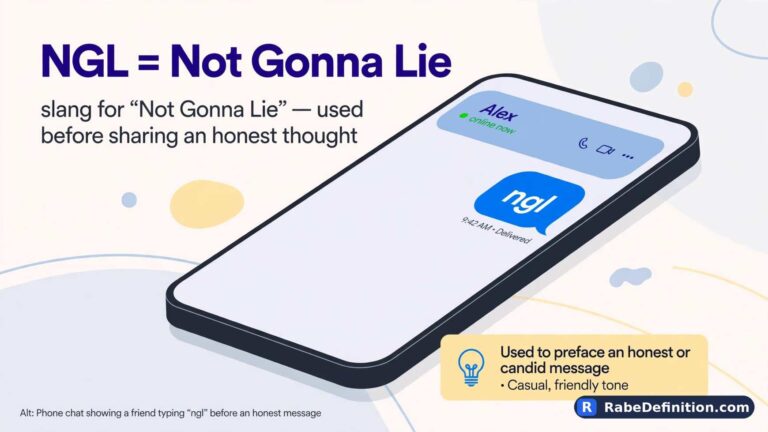
- NGL (not gonna lie) — a honesty marker often parked next to an SOS confession
- FR (for real) — confirms the sender means the overwhelm, at least partly
- No cap — “no lie,” used to swear the small emergency is genuine
- Lowkey — softens the drama: “lowkey SOS” confesses the meltdown at half volume
- SMH (shaking my head) — disbelief or disappointment, a frequent reply to someone else’s SOS
Semantic Relationships
Context does all the sorting. The same letters are a rescue request at sea, a status label on a phone, and a joke in a group chat, and the platform usually announces which one you are reading before the content does. Formal settings pull the meaning back toward danger; casual feeds push it toward exaggeration.
How to Signal SOS in an Emergency
The signal works with almost anything that can make a pattern. With a flashlight, a mirror flash, a whistle, or taps on a wall, send three short, three long, three short, then pause and repeat. Rescue guidance treats that rhythm as a distress signal whatever tool carries it.
Keep the groups clean and the pace steady; a rushed blur reads as random noise. If you can spell the letters out physically — logs on a beach, stones on a hillside, marks in snow — do that too, since the letters are recognizable from the air and read the same upside down.

SOS vs. Mayday: What Is the Difference?
Both calls report the same level of danger; they travel by different channels. SOS is the Morse signal, sent as pulses, flashes, or written letters, and it belongs to the era of telegraph keys. Mayday is its spoken counterpart for voice radio, adopted by the 1927 International Radio Convention from the French m’aider, “help me.”
Below Mayday sits pan-pan, the call for an urgent situation that is not yet life-threatening. So the ladder runs: Mayday or SOS for grave and immediate danger, pan-pan for serious trouble that can still wait its turn.
How to Respond to an SOS
In Emergency Situations
Treat it as real until proven otherwise. Get the location and the nature of the danger, call the local emergency number — 911 in the United States — and stay in contact if you safely can. A calm voice and exact details help responders more than panic does.
In Casual Texting
Read the tone first. Most chat SOS messages want company, advice, or a laugh, in that order. Ask what is wrong, match the sender’s energy, and offer the practical thing — notes, a ride, a second pair of eyes — when there is one.
Examples of Good Responses
Casual SOS: “SOS, my laptop died and the draft is due at midnight.”
Good response: “Send me what you have. We rebuild it together, section by section.”
Playful SOS: “SOS, I waved back at someone who was not waving at me.”
Good response: “A classic. Walk faster and never return to that street.”
Serious SOS: “SOS. Car died on the highway, I am alone and it is getting dark.”
Good response: “Share your location now. I am calling roadside help and staying on the line.”
Misinterpretations
Common Misunderstandings
“SOS is an acronym.” It never was one. The pattern was picked as a signal first; the words were fitted to it years later by popular usage.
“It only means Save Our Souls.” That phrase is one backronym among several, and not one of them is where the signal came from. Its real story is German radio rules and a 1906 convention.
“SOS is only for ships.” It began at sea, but it is now recognized with any signaling method, and it lives on phones and in chat slang far from any harbor.
“Casual use is always disrespectful.” Context settles this. A joking SOS between friends harms no one; the same joke dropped into a channel where real emergencies are reported is a different act.
“SOS and Mayday are the same thing.” They mark the same level of danger, but one is a Morse signal and the other is a spoken radio word. The channel, not the urgency, separates them.
When to Avoid Using SOS
One caveat meaning belongs in every casual use: skip SOS in formal or professional writing unless a genuine emergency is being reported. Leave it out when the reader might take it literally — an older relative, a new coworker, anyone outside chat culture. And never spend it on every small annoyance; a signal fired daily stops meaning anything.
When NOT to Use SOS
In Professional Settings
Work email, client chats, and formal reports have no room for it. Outside a real emergency, SOS in a professional thread reads as unprofessional or melodramatic, and it can alarm people who only know the serious sense.
With People Who Do Not Understand Slang
Some readers only know the distress signal. A playful SOS to a grandparent or a manager from another generation can trigger real worry, so spell the problem out in plain words instead.
For Trivial Issues
Save the letters for moments that at least feel big. SOS over a slow coffee machine trains your friends to ignore it, and the day you send it half-seriously, nobody will hurry.
In Emergency Situations (Don’t Cry Wolf)
The sharpest rule runs the other way: never joke with SOS where it could be mistaken for the real thing — a boating channel, a hiking group, a workplace safety thread. A false alarm wastes rescuers’ time and can bury a genuine call for help under yours.
Usage Tips
How to Use SOS in Texting
- Add the reason. “SOS” alone is a riddle; “SOS, locked out again” tells friends what to bring.
- Match the room. Dramatic chats welcome it; quiet or formal threads do not.
- Use the SOS emoji sparingly. The red SOS button symbol underlines the joke, but a wall of them turns drama into noise.
- Do not overuse it. Twice a week is a personality; twice an hour is static.
How to Use SOS on Social Media
- Caption honestly. SOS works on posts about genuine overwhelm, funny disasters, and relatable struggles.
- Hashtag with care. #SOS can join real awareness campaigns as easily as meme threads, so check the neighborhood before posting.
- Keep it off serious news. Dropping a joking SOS under a report of an actual emergency reads as mockery, however it was meant.
SOS in Music and Pop Culture
Songwriters reached for the letters early and often, because everyone already knew what they meant. ABBA’s “SOS,” released in 1975, turned the signal into a plea from a failing relationship. Rihanna’s “SOS” did the same for dance-pop in 2006, spending three weeks at number one in the United States on the back of a “Tainted Love” sample.
The pattern in both songs is the slang pattern: no ships, no sinking, just a person asking to be rescued from a feeling. Pop culture is where the casual meaning and the serious signal learned to share three letters without confusion.
FAQs
Q1: Does SOS actually stand for anything?
No — the letters were never assigned any words.
The signal is a Morse pattern, and the famous phrases were attached later.
Q2: What does SOS mean in texting?
It works as a playful cry for help.
Friends send it when they feel overwhelmed, stuck, or dramatic about a small problem.
Q3: What does SOS mean on iPhone?
An SOS or SOS Only label means the phone can reach emergency calls but has no regular carrier signal.
The Emergency SOS feature also lets the phone call emergency services fast.
Q4: What does SOS mean on Snapchat?
There it is slang, not an emergency.
Users drop it into snaps and chats as a dramatic “send help” reaction.
Q5: What does SOS mean on TikTok?
It is a reaction pasted under overwhelming, funny, or shocking videos.
Read it as “this is too much — send help.”
Q6: Is SOS still used as an emergency signal today?
Yes — it is still recognized worldwide and can be sent by light, sound, or radio.
Satellite-based safety systems have largely replaced hand-keyed Morse at sea since 1999.
Q7: What is the difference between SOS and Mayday?
SOS is the Morse code signal, sent as dots and dashes or flashes.
Mayday is the spoken voice call used on radio for the same level of danger.
Q8: Can I use SOS casually?
Yes, with friends who understand the slang sense.
Keep it out of work messages and away from anyone who might read it as a real emergency.
Q9: What does SOS mean in a relationship context?
It is usually playful romantic overwhelm.
A partner sends it to say they miss you, want attention, or need rescuing from a dull evening.
Q10: What are some other meanings of SOS?
Reported side senses include “same old stuff” and “someone on shoulder.”
On prescriptions it is Latin, si opus sit: take only if necessary.
Conclusion
The question what does SOS mean has one steady answer. SOS is a distress signal in Morse code, three short pulses, three long ones, three short pulses, adopted in 1906 because it is easy to send and hard to mistake. It never stood for “Save Our Souls” or any phrase; those expansions came later. In an emergency it still calls for rescue; in a chat it playfully asks for help.
Match the signal to the setting. Keep the casual SOS for friends who share the joke, and never let it blur a real call for help. If you need the signal, the Morse code pattern is three short, three long, three short: easy to tap, flash, or key under pressure.



2 Comments