
WYLL Meaning: What Does WYLL Mean in Text and Slang?
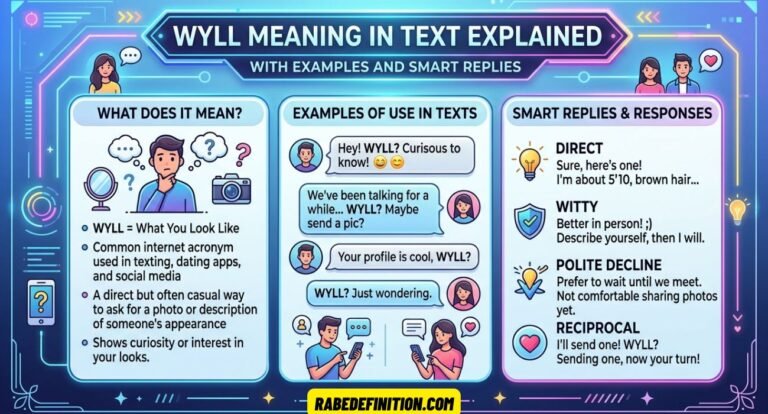
The wyll meaning is “what you look like”: four letters that compress a plain appearance question into a single short message. Dictionary.com enters wyll as a texting and social-media abbreviation used to request photos or an account of how somebody looks. Merriam-Webster’s slang pages print the same idea in question form, “what do you look like?”, and file the word as informal shorthand.
The ask is nearly always a hope for a picture rather than a written answer, and Snapchat is the ground where it appears most. Between friends it can read as simple curiosity, while the same four letters from a stranger often land as blunt or pushy. Clumsy or aggressive use draws open mockery online, and that reputation now travels with the word wherever it lands.
The sections below trace where the shortening came from, how the big platforms each treat it, and which replies fit which situation. They also separate the chat sense from the Baldur’s Gate 3 companion who shares the spelling, and from two rumoured expansions that no dictionary records. Fresh conversations, the usual mistakes, and the answers readers hunt for are all covered along the way.
Quick Answer Box
| Category | Details |
|---|---|
| Meaning | What You Look Like |
| Context | Texts, direct messages, dating apps |
| Usage | Asking to see a photo or hear a description |
| Platforms | Snapchat first, then TikTok, Instagram, WhatsApp |
| Example | “We have talked for a week and I still have no face for the name — wyll?” |
| Tone | Casual and curious; flirty or rude depending on timing |
What Does WYLL Mean?
WYLL means “what you look like” — a four-letter question asking to see the human behind the screen name.
Each letter stands for one word of that question, with the “do” of the fuller version dropped along the way. The word lives almost entirely in writing: text messages, direct messages, and chat apps are its whole habitat. Capital letters or lowercase make no difference, and neither does the missing question mark — the ask reads the same either way.
What the sender wants is a visual answer. A photo is the usual hope, a short video does the same job, and a written description is the accepted fallback when no picture is coming. It helps to hold onto one point: the letters form a question, not a statement, and they expect a reply of that specific kind.
How to Pronounce WYLL
Read aloud, the four letters usually blur into the name Will, which is why a spoken “wyll” can confuse anyone hearing it cold. Dictionary.com takes the slower route in its pronunciation key and spells the letter names out one by one instead.
In practice, the word lives in typing and is hardly ever spoken. Most readers never pronounce it at all; they simply hear the full question in their heads as their eyes pass over the letters.
Full Definition and Origin
Where Did WYLL Come From?
Dictionary.com traces the shortening to an informal reworking of the question “What do you look like?” and dates its use to at least early 2020. By late 2022 it had grown common enough on Snapchat to draw criticism on other platforms, where screenshots of it arriving as a first message were shared and mocked.
No single coiner and no exact first use appears anywhere in the sources consulted. Like most chat shorthand, the word spread by imitation — one person typed it, the next copied it — rather than by any single act of invention.
The ASL Connection
Older chatrooms ran on ASL, short for age, sex, location: three basic facts requested before a conversation had properly started. WYLL belongs to the same family of instant identity checks, narrowed down to the one thing plain text cannot show.
The difference sits in the answer being requested. ASL could be settled with three typed facts, while WYLL asks for an image, which is a considerably larger thing to hand to a stranger.
Cultural Context
Chat culture rewards compression, and WYLL sits inside a wide family of clipped questions and reactions traded at typing speed. The same habit turned “in search of” into iso in marketplace posts, where three letters flag a request before the details start.
What sets this word apart from most of that family is its target. Appearance is personal in a way that plans, prices, and opinions are not, so the shortcut carries more social weight than its four letters suggest.
Context and Usage
When Do People Use WYLL?
Four situations account for nearly every appearance of the word.
Meeting someone new. Two people have traded messages without ever seeing each other — a fresh match, a new follower, a gaming contact — and one of them wants a face to attach to the name.
Casual flirting. Interest is doing the asking here: someone drawn to the other person hopes a photo will follow, and the four letters test that interest at very low cost.
Genuine curiosity. A long conversation builds a mental picture that may be completely wrong, and sometimes the ask is nothing more than wanting to correct it.
Online gaming. In game chats the question can aim at the character on screen rather than the player holding the controller, asking how an avatar is built or dressed.
Who Uses WYLL?
The word belongs mostly to younger users on photo-first platforms, with Snapchat at the centre of its range. Merriam-Webster’s record adds a sharper detail: young men do much of the asking on social media, yet the bulk of the examples its editors gathered are complaints from women on the receiving end.
The person asked may also be sitting beside family when the message lands, which is precisely the spot the older code pos was invented to warn about.
Real Life Examples
Five brief conversations show the letters doing their different jobs.
1: Getting to Know Someone
Person A: Three weeks of voice notes and I still picture you as your avatar.
Person B: Ha, the avatar is flattering. Okay, wyll trade — you first.
Person A: Deal. Sending the least awkward one I own.
A trade is offered instead of a one-way answer, and the exchange stays easy because the conversation behind it was already warm.
2: Playful Friend Banter
Person A: The barber had a vision and it was not the one I described.
Person B: That bad? Wyll, I need evidence.
Person A: Evidence denied. The hat era starts today.
Between friends the question becomes a joke about a haircut, and the refusal is part of the joke rather than a boundary being drawn.
3: Online Dating
Match: Your profile photos are all group shots and sunglasses.
You: Fair point. Wyll, honestly — which one is even you?
Match: The tall one. Here is a clearer one from last week.
On a dating app the ask can be purely practical: sorting one person out of a row of group photos.
4: The Annoying Opener
Stranger: wyll
You: That is the whole message? Not even a hello first?
Stranger: sorry. hi. how is your day going
Four letters with no greeting is the version the word’s bad reputation was built on, and the recovery begins with basic manners.
5: Gaming Context
Player 1: Your build carried that whole fight. Wyll in game?
Player 2: Full plate, tower shield, helmet with the horns.
Player 1: Figures. You were a wall with a sword.
Here the question concerns the character rather than the player, and nobody’s real appearance is involved at all.
Platform Specific Meaning
Every app gives the letters the same meaning, while each platform’s habits bend what the question expects as an answer.
Snapchat
Snapchat is where the word lives most naturally, the app Dictionary.com names first for it. A camera-first design makes the ask feel routine, and a photo answer takes only seconds to send.
The vanishing messages lower the stakes further. A casual snap disappears after viewing, so sharing one feels cheaper than posting a permanent picture anywhere else.
TikTok
On TikTok the word lives mostly in direct messages and in complaint videos about receiving it. Creators film their reactions to bare “wyll” openers, and those clips have spread the word at least as widely as the messages themselves.
In comments it turns up as a joke at the opener’s expense more often than as a genuine question.
Instagram profiles usually display photos already, so the question there often means something narrower: a recent picture, a casual one, or proof that the profile shots are current.
On private accounts with no visible photos it keeps its plain meaning — a request to see the person behind the follow request.
WhatsApp chats usually involve people who already hold each other’s numbers, so the word surfaces less often than on stranger-first apps. When it does appear, it works exactly as it does in an ordinary text message: a quick ask for a photo from someone not yet met in person.
Dating Apps (Tinder, Bumble, Hinge)
Profiles carry photos by design, yet the word still circulates. Matches use it to request clearer pictures, extra angles, or reassurance that the person matches the profile they swiped on.
It can also serve as a bridge toward moving the conversation to another app, where sending a fresh photo feels more natural than it does inside the match window.

Alternative Meanings
One namesake is fully documented, and two rumoured expansions are not — the difference matters, so each one gets its own honest label.
Baldur’s Gate 3 Character
Lowercase or capitalised, Wyll is also a person: Wyll Ravengard, an origin character and recruitable companion in Baldur’s Gate 3. The game’s wiki describes him as a human warlock with the Folk Hero background, famous as the “Blade of Frontiers” and the son of Grand Duke Ulder Ravengard.
In gaming spaces, a mention of Wyll with a capital W is far more likely to be this character than the slang abbreviation.
Damn Girl, Yes
Some slang pages repeat this as a second expansion, an admiring shout aimed at someone’s outfit or success. No dictionary consulted for this article records it, and no dated example of it in real use could be found.
Read it as an unverified explainer-page claim: possible inside a small circle, but not a settled meaning that a stranger will understand.
You Look Like a Clown
The same caution applies to this sarcastic reading, which would turn the letters into a taunt about foolish behaviour. It appears in no fetched dictionary either, and the documented record gives the letters one job only.
A mocking tone can certainly ride on the ordinary question. The clown expansion itself, though, stays unproven.
Related Terms and NLP Variations
Common Variations
WULL? – A stretched spelling that circulates on slang pages. No fetched dictionary documents it, so treat it as a playful respelling rather than a separate term with its own meaning.
WYLLN? – Presented elsewhere as “what you looking like now.” It is likewise missing from the fetched dictionary record and survives at explainer strength only.
WYD – “What you doing,” the activity question that keeps company with WYLL in the same conversations.
HBU – “How about you,” the standard device for handing any question back to the person who asked it.
IRL – “In real life,” the tag that separates somebody’s online self from the offline one.
LMK – “Let me know,” a soft closer often attached to the end of a request.
Synonyms and Similar Phrases
Plain English does the same job at full length. “Send a pic,” “can I see you?”, “what do you look like?” and “got any photos?” all ask for the same thing with the compression removed.
The spelled-out question is the safest of the set, because full sentences leave room for a polite frame around the ask.
Semantic Relationships
The word’s behaviour follows three links. Meaning to usage: it is a question that expects a visual answer, a photo or a description, rather than words about anything else. Slang to context: it belongs to the efficiency family of chat shorthand, where saving keystrokes is the entire point. Platform to behaviour: photo-first apps normalise the ask, while text-first spaces make the same four letters feel abrupt.
| Term | Stands for | What it asks for |
|---|---|---|
| WYLL | What you look like | A photo or a description |
| WYD | What you doing | News of current activity |
| ASL | Age, sex, location | Three basic facts |
| HBU | How about you | The same question, returned |
Is WYLL Slang?
Yes, and the reference shelf agrees for once. Merriam-Webster files the word on its slang pages, and Dictionary.com treats it in its acronym coverage as informal usage, openly calling its own entry an informal word summary rather than a settled definition.
Wiktionary, notably, carries no slang entry for the spelling at all: its wyll page holds only obsolete spellings of will and well, plus some Welsh forms. So the word is real, current, and documented — but it lives in the informal layer of the language and has no place in formal writing.
How to Respond to WYLL
The right reply depends on who is asking and how much you want to share. Every option below is a legitimate one.
Send a Photo
If the person is known to you and you are happy to share, a photo is the answer the question is fishing for. A casual, recent picture is enough; nothing about the exchange requires a polished one.
Describe Yourself
Words work when a picture feels like too much. Height, hair, build, and one distinguishing detail give the asker a workable picture of you.
This route answers the question honestly while keeping every actual image in your own hands.
Send Your Bitmoji
On Snapchat, the cartoon avatar is the accepted middle path: a visual reply that reveals nothing real. It signals friendliness and a boundary at the same time, which is exactly why it is so common there.
Ask for a Photo First
Turning the question around is fair play, especially with someone new: their response tells you whether they see the exchange as mutual. A person who refuses to share anything while demanding your photo has answered a more important question than the one they asked.
Say You Are Not Comfortable
A plain refusal is always available and needs no excuse attached. “I don’t share photos with people I haven’t met” closes the topic cleanly and politely.
The safety point is simple and worth stating outright: a photo request from a stranger can always be declined, and no chat is ever owed a picture.
Ignore the Message
Silence is also a complete reply. A bare opener from a stranger, with no greeting and no conversation behind it, has earned no response, and leaving it unanswered is a normal and reasonable choice.
Respond with Humor
A joke can deflect the question without ending the conversation. Describe yourself as a loading screen, a witness-protection portrait, or a height measured in dinosaur units.
Trying to make someone laugh buys time and tests whether the asker can take a hint gracefully.
WYLL From a Guy vs. a Girl
Who sends the letters changes nothing about what they mean, but it often changes how they are received, and Merriam-Webster’s citation file shows the split plainly. Most of the examples its editors collected are women complaining about receiving the question, frequently as a first message from a man they do not know.
From a girl, the same letters tend to arrive later in a conversation and read as curiosity more than as an opener. None of that alters what the word means; it changes how much patience the person reading it is likely to have left.
WYLL in Dating and Relationships
Dating is the word’s most charged setting, because matches are deciding whether attraction survives better information. Used after real conversation, a photo swap is a normal step toward meeting, and plenty of couples who met by serendipity rather than by plan have traded pictures along the way.
Used as an opener, it announces that appearance outranks everything else the person might offer, which is why it so often ends the match instead of advancing it. Between established partners the question nearly disappears: they already know what each other looks like, and it survives only as a joke about a haircut or an outfit.
Misinterpretations and Common Mistakes
Assuming It Is Always Flirtatious
Interest is one motive, not the only one: friends, gaming contacts, and the plain curious all send the same four letters. Reading romance into every instance manufactures an awkwardness that the sender never ordered.
Thinking It Is a Statement
The letters ask something; they declare nothing. Answering them as though they were a comment — a bare “ok” and nothing more — leaves the asker waiting on a reply that was never actually given.
Using It as an Opener
The single most documented mistake is also the simplest: leading with the question before any greeting exists. It tells the receiver that their face is the first and main thing under evaluation, and most people close the chat on that evidence alone.
Overusing It
Once a photo has been shared, the question is spent. Asking again weeks later implies that the first answer was forgotten or judged insufficient, and neither reading flatters the asker.
When NOT to Use WYLL
In Professional Settings
Work channels run on full sentences and clear requests. The abbreviation has no professional register at all, and sending it to a colleague or a client would read as a category error rather than a shortcut.
With People You Have Just Met
A first message sets the terms for everything that follows it, and an opener this blunt can read as diabolical rather than friendly. Introduce yourself, trade a few real sentences, and let the question wait its turn.
When You Already Know What Someone Looks Like
Asking someone whose photos you have already seen suggests you never looked, or never remembered. Both implications are worse than the curiosity the question was meant to satisfy.
In Group Chats
The question is built for an audience of one. Dropped into a group, it singles one person out in public and turns a private decision about sharing a photo into a performance for the room.
When You Are Not Prepared to Share Your Own Photo
The ask carries an unwritten contract: your own picture is part of the price. Wanting to see without being seen breaks that contract, and receivers can usually tell when it happens.
Usage Tips
Build Rapport First
Conversation first, question later — that is the whole technique. A few genuine exchanges about anything else turn the same four letters from an ambush into a natural next step.
Be Polite
Frame the ask as a request with an exit built in: “would you be up for swapping photos?” lets the other person decline without friction. Politeness here is not decoration; it is what separates curiosity from pressure.
Reciprocate
If a photo arrives, yours should follow promptly. Receiving without returning leaves the other person feeling exposed, and it teaches them not to share with you again.
Accept No for an Answer
A refusal is information, not a challenge. Accepting it gracefully keeps the conversation alive, while arguing with it ends both the conversation and whatever trust had formed.
Emotional and Social Implications
The Shallowness Critique
The standing complaint against the word is that it ranks a face above everything a person has said. The mockery aimed at clumsy users, recorded in the dictionary coverage, shows the critique is not theoretical: the word has become shorthand for that whole style of opening.
The Gender Dynamic
The asking and the annoyance fall unevenly, as the dictionary citations show, and that imbalance colours how the word is heard. A question one side sends casually can land on the other side as the latest entry in a long series of identical openers.
The Authenticity Question
Filters and careful curation complicate the ask, because a shared photo may show a version of the person rather than the person. Some askers are really requesting the unedited version, which is its own kind of pressure, and receivers know it.
What to Say Instead of WYLL
Full sentences carry the same request with the manners left in. “Could I see a photo of you?” is the direct swap and works anywhere the abbreviation does.
“What do you look like?” spelled out in full gains a question’s natural softness, and adding “only if you’re comfortable” removes the pressure entirely. In a group thread or a formal setting, skip the ask altogether and let profiles do the work.
Frequently Asked Questions
What does WYLL stand for in text?
It is short for “what you look like,” a request to see the person you are chatting with. The expected answer is a photo, or a description if no photo is coming.
Is WYLL flirty?
It can be, when interest is behind it, but the letters themselves only ask a question. Friendship and plain curiosity produce the same four letters with no romance attached.
What does WYLL mean on Snapchat?
On Snapchat the letters mean exactly what they mean in any other chat, and a snap is the expected reply. Many users answer with their Bitmoji instead of a real photo.
What does WYLL mean from a guy?
From a guy it usually signals interest or curiosity about the person he is chatting with. Merriam-Webster notes that young men do much of the asking on social media.
What does WYLL mean from a girl?
The meaning is identical: she wants to see the person she has been talking to. It tends to arrive after some conversation rather than as an opener.
How do you respond to WYLL?
Send a photo, describe yourself, offer your Bitmoji, ask for one first, or decline. Every one of those is a complete answer, including the refusal.
Is WYLL a bad thing to ask?
Not by itself; timing and relationship decide whether it lands well or badly. As a first message to a stranger it is one of the most mocked openers online.
What does WYLL mean in gaming?
In gaming it can ask about a character’s build or outfit instead of a real face. The context of the chat makes clear which target is meant.
What is the difference between WYLL and WYD?
WYLL asks about appearance and hopes for a photo. WYD asks what the person is doing right now.
Is WYLL used on TikTok?
Yes, mostly inside direct messages rather than public comments. It also appears in videos mocking people who open with it.
What does WYLL mean in dating?
In dating it asks for clearer or more recent photos than a profile shows. It works best after real conversation, as a step toward meeting.
Can WYLL have other meanings?
It can name Wyll Ravengard, the Baldur’s Gate 3 companion, in gaming talk. Two rumoured expansions circulate on slang pages, but no dictionary records either one.
Conclusion
The wyll meaning is settled and simple: four short letters asking “what do you look like?” and hoping the answer arrives as a picture. Dictionaries file the word as informal chat shorthand, a clipped form of the full question that spread through photo-first apps. Timing and relationship decide whether it lands as friendly curiosity or as a lazy, unwelcome opener.
Answer on your own terms: share a selfie if the asker is trusted, describe yourself if words feel safer, or decline without apology when a stranger is asking out of nowhere. Asked late and politely, with a photo offered in return, the question does its small job well; asked first, it usually ends the very chat it hoped to open.


One Comment