Knee Surgery Meme: The Blue Grinch Joke, Explained
The knee surgery meme is a family of ironic image jokes built around one fixed line of caption text: “That feeling when knee surgery is tomorrow.” Those words usually sit under a picture of a character who looks oddly thrilled, most often a blue-tinted Grinch wearing a wide smirk. The joke works because the announcement sounds serious while the face above it looks delighted, and nothing in the format is a hidden code.
People post the meme when a big event is close and the waiting feels hard to carry. An exam, a results day, or a trip can all earn the caption, because it turns plain nerves into a shared joke. Posted with no event at all, it works as pure nonsense, and that randomness is part of the point.
This page explains what the format means and why the mismatch lands as funny. It traces the documented path from a celebrating squirrel in 2021 to the blue Grinch version that took over feeds. It also covers the platforms where the meme travels, the replies people send, and the moments when the joke is better left unused.
What Does the Knee Surgery Meme Mean?
The knee surgery meme means an oddly specific ironic joke: the words “That feeling when knee surgery is tomorrow” set over a happy or excited character, played for absurd anticipation rather than any real medical news.
Know Your Meme catalogues the format under that full caption and under the name Blue Grinch Knee Surgery. The entry describes a series of ironic memes, mostly image macros, that pair the fixed words with pictures of cheerful characters. The words never change, so the picture does all the acting, and a fresh face under the same caption renews the joke without rewriting it.
| Detail | Explanation |
|---|---|
| Most common meaning | An ironic joke about oddly cheerful anticipation |
| Signature caption | “That feeling when knee surgery is tomorrow” |
| Best-known image | A blue-tinted Grinch wearing a smug grin |
| Usual tone | Deadpan, surreal, and deliberately random |
| Main platforms | TikTok, Instagram, Reddit, and X |
| Formal or informal | Fully informal, at home in meme spaces |
Read the post around the picture before deciding what a sender means. The same caption can carry real nerves, a joke about an exam, or no message at all beyond the sender finding it funny.
What Is the Knee Surgery Meme Really About?
At its plainest, the format pretends that an operation scheduled for the next day is a cause for celebration. Nobody in the joke explains why the surgery is exciting, and nobody asks. The caption is delivered as if the feeling were famous and shared, which leaves the reader to supply the missing logic.
That missing logic is the engine. A smug or beaming face over a serious announcement creates a gap, and the reader’s brain keeps trying to close it. Because the gap never closes, the post stays funny in a way a tidy punchline would not.
Absurd formats often run on that same gap: the Italian brainrot chant tralalero tralala carries no meaning at all, yet it works everywhere as a reaction because the sound alone flags chaos. This caption works the same way, with a hospital visit standing where the nonsense syllables stand there.
Where Did the Knee Surgery Meme Come From?
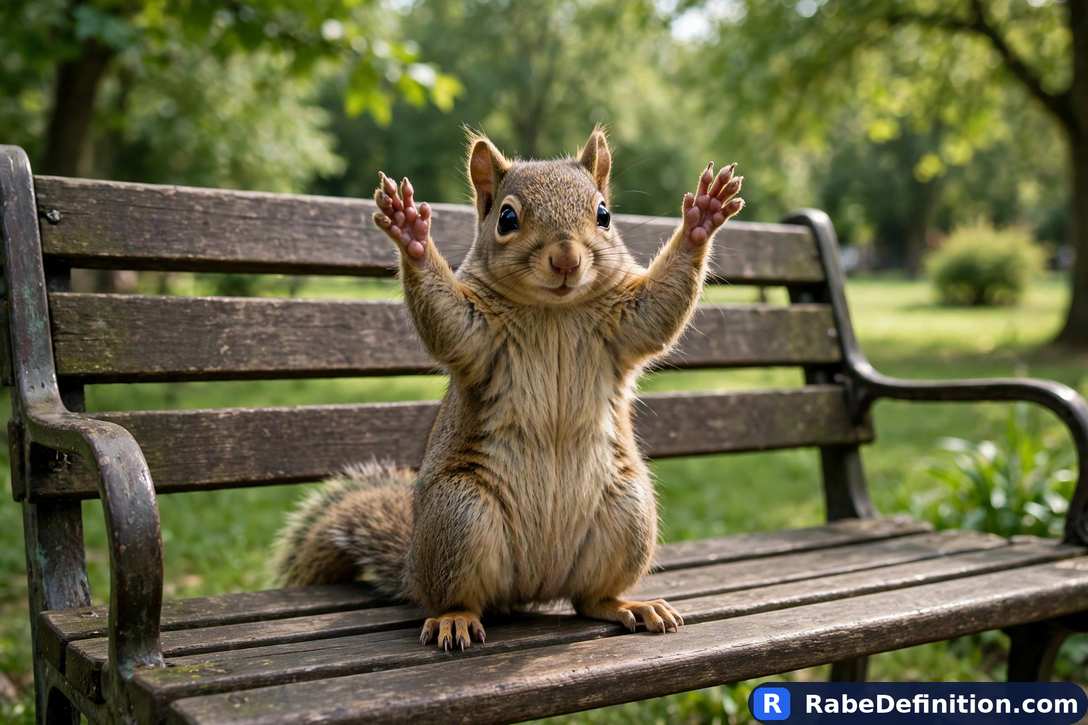
The creator of the first version is unknown, and the trail starts with a picture rather than a person. On an unknown date before April 2021, a MemeCreator.org user paired the caption with a photograph of a squirrel sitting up with both front paws raised, as if mid-celebration. Know Your Meme calls that post seemingly the first instance of the meme, and nothing firmer about its maker has surfaced.
On April 6, 2021, the Instagram account stupid.fricken.meme shared a slightly cropped copy, which gathered over 1,300 likes across the next two years. The earliest known variant followed on August 2, 2021, when Redditor ZyeAxe put the same caption over an image of Drake on the subreddit r/okbuddyretard. That post earned over 870 upvotes in two years, and a dedicated subreddit, r/Kneesurgerymemes, opened the same day.
Why Is the Knee Surgery Meme Funny?
Four habits of internet humour meet inside this one caption, and each one adds a layer.
Specificity. A named operation on a named day is far more precise than a general complaint about stress, and precision makes the pretend announcement sound oddly official.
Emotional mismatch. The face in the picture beams while the words announce a hospital visit, and the clash between the two is where the laugh starts.
Deadpan delivery. The caption never winks at the reader. It presents the feeling as obvious and universal, as though everyone has stood exactly there.
Absurdity. No reason connects the character to the surgery, and none is offered. The missing reason is not a flaw in the joke; it is the joke.
Explaining all four at once can flatten the effect, because the format depends on the reader meeting the gap alone. A short reaction keeps the bit alive longer than a long breakdown does.
How the Meme Is Read in Text and Chat
In a chat thread, the meme usually arrives as a picture with no explanation attached. Sending it after a friend mentions a deadline is shorthand for shared dread, said with a grin instead of a complaint. Sending it with no deadline in sight is a small piece of nonsense that keeps a quiet thread moving.
Readers who know the format answer in kind, often with a matching joke or a second absurd caption. Short tags work the same way in modern chats: a bare yk closing a message asks for agreement without spelling anything out. Both habits rely on the reader already holding the shared context, which is why either one can baffle a newcomer.
How Context Changes the Meaning
The caption stays fixed while the room around it changes, and the room decides what a given post is doing.
1. Actual surgery
A poster who really is booked for an operation the next day may share the meme as gallows humour about their own nerves. The joke gives them a light way to announce the news and invite support without writing a serious post. Friends usually answer that version warmly, because the target of the joke is the poster.
2. School or work stress
Students and workers borrow the caption for any deadline that looms the same way. An exam, an inspection, or a results morning can all stand in for the operation, and the exaggeration measures how large the event feels. Nobody reading that post believes a hospital is involved.
3. Random posting
Plenty of posts carry no occasion at all. The picture and caption appear because the pairing itself amuses the poster, and the audience is expected to enjoy the nonsense without decoding it. In that use, asking what it means is the one wrong response.
4. An upcoming event
The format also fits happy anticipation. A match, a launch, or a long-planned trip can be announced with the same pretend dread, and the joke flips into excitement. The surrounding post makes the flip clear, since the event named nearby is one the poster wants.
Knee Surgery Meme on TikTok, Instagram, Reddit, and X
The caption means the same thing on every platform, but each site dresses it differently.
TikTok: The picture usually appears inside short videos, sometimes held on screen under dramatic audio while the caption does the talking. Know Your Meme’s news coverage recorded a fresh wave of ironic posting on TikTok in late 2024, years after the format first spread.
Instagram: Meme pages built the format’s home. The blue Grinch version was posted there in 2022, and repost accounts still circulate the picture as a standalone joke or inside meme roundups.
Reddit: Subreddits devoted to surreal and oddly specific humour adopted the caption early, and two communities exist for this meme alone. A post’s subreddit tells readers how ironically to take it before they read a word.
X: On X the caption often appears as a reply or a quote post with no setup at all. The joke there leans hardest on recognition, since a reader who has never seen the format gets almost nothing to hold onto.
Platform habits differ for text shorthand too: lms belongs to feeds and school platforms, while this caption belongs to picture posts. Knowing which shelf a joke lives on is most of reading it correctly.
Real Conversation Examples
Fresh exchanges show the caption doing its usual work. Each one is invented for this page, in the shape of chats where the meme actually appears.
1: Friends
Arif: “Geography final at nine tomorrow. I have revised nothing.”
Bea: “That feeling when knee surgery is tomorrow.”
Arif: “Exactly that. Same dread, no hospital.”
Meaning: Bea borrows the caption to grade Arif’s exam nerves, and both of them know no operation is involved.
2: Group Chat
Sam: “Scores land at eight in the morning.”
Priya: sends the blue Grinch picture with the caption
Tom: “We are all that Grinch tonight.”
Meaning: The picture says what a plain complaint would say slower: everyone in the chat is nervous, and laughing about it helps.
3: Social Media
Reader: “Why is this Grinch blue, and why is he pleased about surgery?”
Page admin: “Nobody knows, and that is the entire joke.”
Reader: “Fair enough. It is somehow funnier unexplained.”
Meaning: The exchange shows the format’s rule for newcomers: the randomness is not a puzzle with an answer hidden inside it.

Is the Knee Surgery Meme Rude?
On its own, no. The caption mocks a situation, not a person, and in a meme-heavy chat it reads as ordinary joking. Most senders aim it at their own nerves or at nobody in particular.
Aim changes the answer. Dropping the picture into a thread where somebody is frightened about a real operation can land as mockery of that person, whatever the sender intended. The same post is kind in one room and careless in the next, and the sender is the one who has to judge the room.
Is the Knee Surgery Meme Offensive?
The words themselves carry no slur, target, or protected subject. Nothing in the caption names a group, a condition, or a real patient, which is why the format circulates so freely.
Offence enters through use rather than wording. Teasing a friend who is mid-recovery, or posting the joke under a stranger’s serious health update, turns a neutral format into a pointed one. Reading the room first is the whole safeguard, and it costs a few seconds.
How to Reply to the Knee Surgery Meme
Replies work best when they match the sender’s level of nonsense. A straight answer to an absurd post can kill the bit, while playing along keeps it moving.
Funny Replies
- “The Grinch has never looked readier.”
- “Thoughts and prayers for the fictional knee.”
- “Big day tomorrow. Huge.”
- “Why does he look proud about it, though.”
- “Posting this is the correct pre-op routine.”
Confused Replies
A plain question is a fair reply when the format is new to you:
- “I need the story behind this one.”
- “Is the surgery real or is this a bit?”
- “Why knee surgery, of all things?”
Asking costs nothing. Readers trade explanations in funny pronoun jokes threads the same way, with one short question and one short answer, and then the chat moves on.
When to Use the Knee Surgery Meme
The format earns its place where absurd humour is already the house style:
- Friend group chats trading memes back and forth
- Meme communities and oddly specific humour pages
- Reactions to a deadline, exam, or results day
- Light announcements of an event you are half dreading
- Reply threads where the picture needs no setup
Used in those rooms, the caption reads instantly, and nobody has to stop the conversation to decode it.
How to Make Your Own Knee Surgery Meme Post
The recipe is short, because the format does most of the work. Pick a picture of a character looking pleased, proud, or strangely calm, and set the caption over it exactly as written: the joke depends on the words staying fixed. A face that clashes with the announcement matters more than a famous face.
Timing gives the post its shade. Shared the night before a deadline, it reads as shared dread; shared on an ordinary afternoon, it reads as pure nonsense. Both are correct uses, and the poster picks the shade by choosing the moment.
Keep the edit plain. Heavy filters, extra captions, and explanations stacked under the picture all weaken the deadpan effect the format runs on.
When to Avoid It
Keep the format out of office email, job applications, school assignments, and formal announcements, where a joke about an operation reads as careless writing. Skip it in any serious medical conversation: a thread about real pain, complications, or a frightening diagnosis is not a room for ironic captions. When a reader would need the joke explained before they can judge it kindly, plain sentences serve the reader better.
What to Say Instead of the Knee Surgery Meme
In rooms where the picture would not land, plain sentences carry the same feelings:
- “Big day tomorrow, and I am feeling it.” — the nerves, stated plainly for a work chat.
- “Tomorrow is the exam. Wish me luck.” — names the real event instead of the pretend one.
- “I cannot stop thinking about tomorrow.” — the anticipation without the joke costume.
- “Nervous but ready.” — the short version for a message to family.
Each substitute loses the absurdity on purpose. What it keeps is clarity, and clarity is what those formal rooms were asking for all along.
Common Mistakes
Four misunderstandings follow this meme around, and each one comes from reading it more literally than it asks to be read.
Thinking knee surgery is a slang code. The words mean exactly what they say. The humour sits in the pairing, not in a hidden definition waiting to be unlocked.
Assuming the blue Grinch started the meme. The caption ran with a squirrel in 2021 and with Drake after that. The Grinch arrived in 2022 and became the face, but the joke is older than its face.
Hunting for a deep meaning. Some posts carry nerves or excitement, and many carry nothing at all. A sender who found the picture funny has given a complete explanation.
Taking every post literally. A caption about tomorrow’s surgery is usually about an exam, a deadline, or nothing. Treating it as medical news leads to worried replies the sender never asked for.
Similar Meme Concepts
The knee surgery format sits inside a family of picture jokes, and its nearest relatives show what makes it distinct.
| Meme Concept | Meaning | Main Difference |
|---|---|---|
| Knee surgery tomorrow | Oddly cheerful anticipation of a specific event | One fixed caption tied to one pretend occasion |
| “That feeling when…” posts | A reaction setup for any emotion | The ending changes every time; the surgery caption never does |
| Brainrot memes | Deliberately chaotic, nonsense-first humour | A whole style rather than a single format |
| Shitposts | Low-context posts made to be absurd | A posting habit, not a template with fixed words |
| Reaction images | A picture sent to express a feeling | Any image can serve; no set caption is required |
One post can hold several of these labels at once. A knee surgery picture dropped into a thread is a reaction image, a small shitpost, and a piece of brainrot-flavoured humour at the same time.
Is There a Real Surgery Behind the Meme?
No documented case sits behind the caption. Know Your Meme’s record traces pictures, accounts, and dates, and none of them names a patient, a hospital, or a real appointment that started the joke. Whether the first maker faced an actual operation is unknown, and the entry leaves that question open.
Real patients do use the format now, sometimes the night before a genuine procedure, as the context section above describes. That later use is documented behaviour around the meme, not evidence about its birth. The honest summary is short: the surgery in the caption is a prop, and any real knees joined in afterwards.
Origin and Popularity
The documented spread runs through 2022. On January 16, iFunny user Tidus posted a version that collected over 840 smiles in a year. On March 14, the Instagram page blinch.feels, which posts memes about a blue-tinted Grinch, shared the caption over the Grinch’s face and gathered over 1,100 likes in a year.
That Grinch version became the most popular form of the meme. It was reposted to r/Kneesurgerymemes on October 23, 2022 for over 500 upvotes in six months, and to r/oddlyspecific the next day, where it passed 10,000 upvotes. The Instagram account grubburd shared it the same day to over 85,000 likes, and a second subreddit, r/bluegrinchkneesurgery, opened on November 2, 2022.
The joke kept travelling. On February 9, 2023, blinch.feels posted a version showing the blue Grinch meme being sent to a knee surgeon, and it passed 110,000 likes in two months. Twitter user MemeHut1990 shared the original squirrel version on April 18, 2023. Few formats keep circulating indefinitely the way this one has, returning each time a new audience meets it.

What the Blue Grinch Version Changed
Before 2022, the caption floated from face to face: a squirrel, then Drake, then whoever a poster had on hand. The blue Grinch version ended that drift. One smug, blue-tinted face became the default picture, and later versions of the meme are usually judged against it.
The tint itself has no documented meaning. Know Your Meme describes the account behind the signature post as a page built around a blue-tinted Grinch, and explainers covering the meme call the character the Blinch, after that page’s name. The blueness works the way the caption does: it means nothing, and the nothing is recognisable at a glance.
A dedicated subreddit for the variant, r/bluegrinchkneesurgery, opened in November 2022, which shows how completely the Grinch took over the format. The squirrel still appears in origin write-ups, but the Grinch is the version a new reader meets first.
Frequently Asked Questions
What does knee surgery mean in text?
Beside the caption, it names the meme: a cheerful picture paired with a pretend surgery announcement.
Read as ordinary words, it is only a hospital visit, and the chat around it decides which sense is live.
Is the knee surgery meme rude?
By itself, no; the joke aims at a situation, and most senders point it at their own nerves.
Sent at somebody who is genuinely scared about an operation, the same picture can feel like mockery.
What does the knee surgery meme mean on TikTok?
On TikTok it appears inside short videos as the same fixed caption over the blue Grinch or another grinning face.
It signals absurd anticipation or plain nonsense, and the video around it sets the exact shade.
How should you reply to the knee surgery meme?
Match the sender’s tone: joke back, drop a matching reaction picture, or ask one short question if the format is new.
A long literal answer is the only reply that reliably falls flat.
Can the knee surgery meme have different meanings?
Yes. The same caption can carry real pre-surgery nerves, deadline dread, happy anticipation, or no message beyond randomness.
The picture, the platform, and the post around it show which reading a sender means.
Final Thoughts
The knee surgery meme is a fixed caption in search of a face: “That feeling when knee surgery is tomorrow,” set under a character who looks far too pleased about it. A squirrel carried it first, Drake followed, and the blue Grinch made it famous. Its humour is the gap between a serious announcement and a delighted face, each time.
Read the whole post around the picture before choosing a meaning, because the caption alone cannot tell nerves from nonsense. Match the sender’s tone when you reply, keep the joke away from anyone facing a real operation, and always let an image macro stay what it is: a picture and a caption doing one small, silly job very well indeed.