Elegy Meaning: What Is an Elegy? Definition and Examples
An elegy is a poem or song of mourning, written most often for a person who has died. The word reached English in 1501, borrowed through Latin elegia from the Greek elegos, a song of mourning. Modern writers also use it loosely for any reflective work that grieves a serious loss.
The classical sense was wider, because Greek and Roman poets counted any poem in elegiac couplets as an elegy, whatever it was about. English usage narrowed from the 1500s onward, until the word settled on lament, memory, and reflection after a death. That history explains why one term covers both a formal churchyard poem and a novel mourning a vanished neighborhood.
This page walks through the definition, the features that mark the form, and the poems readers still study most. It also separates the elegy from near neighbors like the eulogy, the dirge, and the lament. By the last section, you will know when the word fits a piece of writing and when a plainer label does the job better.

What Does Elegy Mean?
An elegy is a poem or song expressing grief and reflection, most often for someone who has died. Merriam-Webster also allows a wider reach: a speech or another work that resembles such a poem counts, and so does a short, pensive piece of music.
No fixed rhyme scheme, length, or stanza shape is required in modern English use. What makes the work an elegy is its purpose — mourning handled with remembrance and thought.
| Detail | Explanation |
|---|---|
| Meaning | A poem or other literary work of grief and reflection, above all after a death |
| Full form | None — elegy is a complete word, not initials |
| Tone | Mournful, respectful, and thoughtful |
| Common context | Poetry, literature classes, and memorial writing |
| Formal or informal | A formal, literary word |
How to Pronounce Elegy
Say it as EL-uh-jee: three syllables, with the stress landing on the first. The ending sounds like the -gy in energy, not the hard g in leg. Its plural is elegies, and the matching adjective is elegiac, said el-uh-JY-ak, which gets its own section below.
The Main Elegy Meaning in Literature
Britannica describes the elegy as a meditative lyric poem that laments a public figure or a friend or loved one, and, by extension, any reflective lyric on human mortality. That double scope matters. A private grief and a national one can both take the form, and the poem may question death itself before it settles anywhere near peace.
Mara’s elegy for her grandfather recalls his garden stories and the patience he showed everyone.
Notice what that sentence promises: not sadness alone, but memory and honor carried inside the grief.
Is an Elegy Always About Death?
Traditionally, yes — death stands at the center of the form, and a literature class will assume that reading first. Modern usage stretches the word to other endings: a closed factory town, a fading language, a childhood street now demolished. Treat those as figurative extensions. They borrow the elegy’s mourning posture without changing its home meaning.
Key Features of an Elegy
Individual elegies vary, but most draw from the same small set of features.
Grief. The speaker openly mourns a death or another heavy loss.
Remembrance. The work recalls who the person was, or what the lost thing meant.
Praise. Many elegies honor the dead person’s character, work, or kindness.
Reflection. The speaker thinks past the event, toward time, mortality, and memory.
Acceptance. Plenty of elegies end by making some peace with the loss, though the form never demands it.
One poem can hold a single family’s grief and still speak to anyone who has buried someone.
How Context Changes the Elegy Meaning
The word stays the same while the setting moves it. Four quick scenes show the range.
A poem after a mother’s death. Here the word keeps its strict literary sense: a mourning poem for one person.
A novel about a demolished neighborhood. The sense turns figurative; the book mourns a place and the life that filled it.
A film about the last lighthouse keepers. Reviewers may call it an elegy for a disappearing trade, meaning it grieves slowly and respectfully.
A syllabus entry. On a course list, the word simply tags a set poem that deals with death and memory.
Surrounding words usually announce which sense is live. Context settles this word the way it settles a label like PRN, where the same letters serve a pharmacy chart and a chat thread, and only the setting tells you which world you are in.
Famous Examples of Elegies
Thomas Gray’s “Elegy Written in a Country Churchyard” (1751) remains the most quoted of them all. Gray stands among unnamed graves and honors the generations of ordinary villagers buried there, arguing that wealth and rank end in the same soil. His famous line about the paths of glory leading only to the grave is a direct rebuke to hubris — pride dressed up as achievement.
Alfred, Lord Tennyson spent years writing “In Memoriam A.H.H.” after his close friend Arthur Henry Hallam died in 1833, and the long poem appeared in 1850. It argues with grief rather than merely reporting it, swinging between faith and doubt across its sections. Readers who hold an agnostic position often say its unanswered questions are exactly why it still convinces.
Walt Whitman’s “When Lilacs Last in the Dooryard Bloom’d” (1865–66) answered a public death: President Abraham Lincoln had just been assassinated. Lilacs, a fallen star, and a hermit thrush carry the mourning, so private feeling and national grief share one frame.
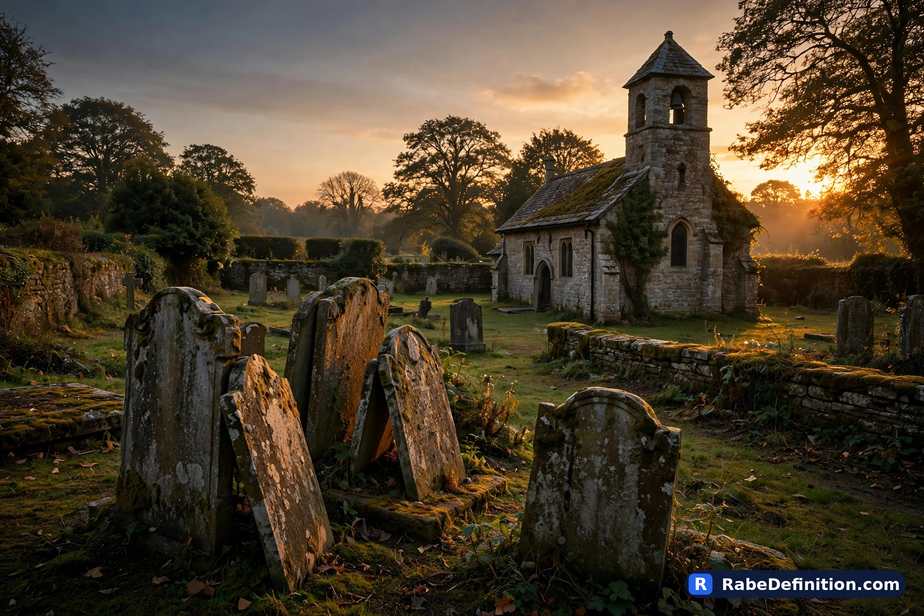
Three poems, three scales of loss — a village, a friend, a president — and the form stretches to hold each one.
Types of Elegy: Pastoral, Personal, and Public
The tradition sorts most elegies into three loose families.
Pastoral elegy. The dead person appears as an idealized shepherd in a countryside scene, with nature mourning alongside the speaker. Britannica traces the pattern through an opening grief, an appeal to the Muse, a funeral procession, and a close that accepts nature’s law. John Milton’s “Lycidas” (1638), written for his college friend Edward King, is the standard English example; Percy Bysshe Shelley’s “Adonais” (1821) mourns John Keats, and Matthew Arnold’s “Thyrsis” (1867) mourns Arthur Hugh Clough.
Personal elegy. No shepherd costume and no public role — just a speaker working through the death of someone actually known and loved. Tennyson’s long poem for Hallam is the giant of this family.
Public elegy. The subject is a figure the whole community claims: a president, a national poet, a public hero. Whitman wrote one for Lincoln, and W. H. Auden’s “In Memory of W. B. Yeats” shows the kind surviving into modern poetry.
Real-World Examples of the Word Elegy
Literature class
Teacher: “Why does this poem count as an elegy?”
Student: “It grieves for a dead friend and thinks through what his life meant.”
Meaning: the word tags the poem’s mourning purpose.
Book review
“The closing chapters turn the novel into an elegy for the mill towns of the north.”
Meaning: the reviewer uses the word figuratively, for a book mourning a world that has gone.
Memorial writing
“Her second collection is an elegy for her father, poem by poem.”
Meaning: the poems grieve while keeping his memory in view.
Elegy in Music, Film, and Memorial Posts
Merriam-Webster’s entry makes room for music on its own: a short, pensive composition can carry the name elegy with no words at all. Filmmakers borrow the label the same way, and a slow documentary about a closing railway line may be reviewed as an elegy for the age of steam. Online, the word shows up in memorial posts and tribute captions, where it lends weight to a public goodbye. Register does the sorting — the same feed can carry an elegy for a grandmother in one post and crew shorthand like GNG in the next, and readers adjust without thinking.

The Tone and Emotional Meaning of Elegy
The word carries a serious register: mournful, reflective, and respectful by default. Nobody uses it as a joke label, and it never sounds casual. Inside that register, though, the feeling can move — grief at the start, tenderness in the memories, and something close to calm by the end.
Is Elegy a Sad Word?
Mostly, yes. Death and loss built the word, and readers hear that weight first. Still, sadness is not the whole cargo: praise for a life, gratitude for it, and hard-won acceptance all travel in the same poem.
Is Elegy the Same as a Eulogy?
No, and the funeral setting is what tangles them. A eulogy is a spoken or written tribute that praises the person who has died and recalls their life, usually delivered during the service itself. An elegy is a poem, or another literary work, that laments the death and reflects on it, written for readers rather than for a room of mourners. One celebrates out loud; the other grieves on the page.
How to Recognize an Elegy
Four checks sort most candidates quickly. First, the work answers a death or another major loss — that is the entry requirement. Second, the speaker remembers and mourns rather than simply reporting facts. Third, the piece reflects, asking what the loss means for the living. Fourth, many elegies move, however slightly, toward acceptance. Form is the weakest clue of all: no rhyme scheme or stanza count can settle the question on its own.
How to Write a Short Elegy
Start by naming the loss plainly, in the first lines, so the reader knows whose absence shapes the poem. Then choose two or three concrete details — a habit, a place, a sentence the person used to say — because specifics carry grief better than general praise. Let the middle widen into reflection: what changed, what remains, what the loss teaches about time. Close with the truest note you can honestly reach, whether that is gratitude, acceptance, or simply the promise to remember. Plain language beats grand language here; a short, exact poem honors its subject more than a long, vague one.

When to Use the Word Elegy
Reach for it when a work of writing, music, or film genuinely centers on mourning and remembrance:
- “Her closing poem stands as an elegy for her older brother.”
- “The collection holds three elegies written across one winter of grief.”
- “Reviewers called the documentary an elegy for a changing coastline.”
- “He set the elegy to music for the memorial concert.”
In each case, a plainer phrase like sad poem would drop the reflective half of the meaning.
When to Avoid the Word Elegy
Sadness by itself does not earn the word. A breakup poem, a homesick letter, or a disappointed diary entry may all be moving without mourning anything in the elegy’s sense. In everyday talk, a short condolence message is just that — calling it an elegy loads a kind note with more literature than it can carry. Precision protects the term, the same way it protects relationship labels like ENM, where one short word stands for a specific, agreed arrangement.
Common Mistakes About Elegy
Mistaking an elegy for a funeral speech. The spoken tribute at a service is a eulogy; the elegy usually lives in poetry and print.
Calling every sad poem an elegy. Grief over a death or a major loss has to sit at the center; ordinary sadness is not enough.
Expecting one required structure. Poets have written elegies in nearly every form available to them, and modern ones may use no set pattern at all.
Restricting the word to dead people. The traditional sense concerns death, yet figurative use now covers lost places, eras, and ways of life.
Elegy vs. Similar Literary Terms
| Term | Meaning | Main Difference |
|---|---|---|
| Eulogy | A speech or written tribute praising someone who has died | Praise leads; the piece is often spoken at the funeral |
| Dirge | A slow song of mourning for the dead | Music first, usually tied to burial or funeral rites |
| Lament | Any open expression of sorrow or regret | Broader and freer; no fixed literary shape |
| Ode | A formal poem of praise or serious admiration | It celebrates its subject rather than mourning it |
| Requiem | A mass or musical work honoring the dead | Grows out of church and concert traditions |
The five overlap at funerals and in anthologies, which is why they get swapped. Hold on to the center of each: the elegy is the literary work of mourning and reflection, most at home in a poem.
Origin and Literary Tradition
Merriam-Webster traces elegy through Latin elegia, a poem in elegiac couplets, back to Greek elegeia and elegos, a song of mourning. In the classical world the name marked the meter, not the mood: elegiac couplets pair a line of dactylic hexameter with one of dactylic pentameter, and poets wrote love poems in them as happily as laments. English changed the bargain in the 1500s, fixing the word to poems of lament in any meter the poet liked. The 1700s added the graveyard school, whose churchyard meditations on death and fame prepared the ground for Gray’s famous poem. Since then the sense has widened again, from dead persons to dead eras.
Elegy and Elegiac: How the Adjective Works
Elegiac does two jobs. As a tone word, it describes anything that sounds like an elegy: an elegiac passage in a novel, an elegiac mood in a film’s final scene. As a technical word, it points back to the classical meter — elegiac couplets, elegiac verse — where the label says nothing about sadness at all. Context tells you which job is running, just as it does for the noun.
Frequently Asked Questions
What does elegy mean in text?
In a text or class chat, elegy names a poem of mourning for someone who has died.
The word stays literary, so it rarely appears in casual messaging.
Is an elegy the same as a eulogy?
No — a eulogy praises the dead person, often as a speech at the funeral.
An elegy is a poem, or another written work, centered on grief and reflection.
Can an elegy be about something other than death?
Yes — modern writers use it for lost places, eras, and ways of life.
The traditional sense still centers on mourning a person who died.
Is an elegy always a poem?
Traditionally yes, the elegy is a poem by definition.
Modern use also covers songs, films, and prose with the same mourning purpose.
What is the main purpose of an elegy?
To voice grief while remembering and honoring what was lost.
Many elegies also move, slowly, toward acceptance.
Final Thoughts
An elegy is poetry doing grief work in public: it names a death, remembers a life, and thinks hard about what remains. Gray wrote for unknown villagers, Tennyson for one friend, and Whitman for a president, yet each poem asks how the living should carry the dead. Form stays free; the mourning purpose does not.
Read the word by its center, not its sadness alone, and it will very rarely mislead you. A condolence note comforts, a eulogy praises, and an elegy grieves on the page, in lines meant to be reread. Keep the term for works that truly mourn a person, a place, or a passing age, and plainer words will handle every lesser sorrow honestly, with care today.