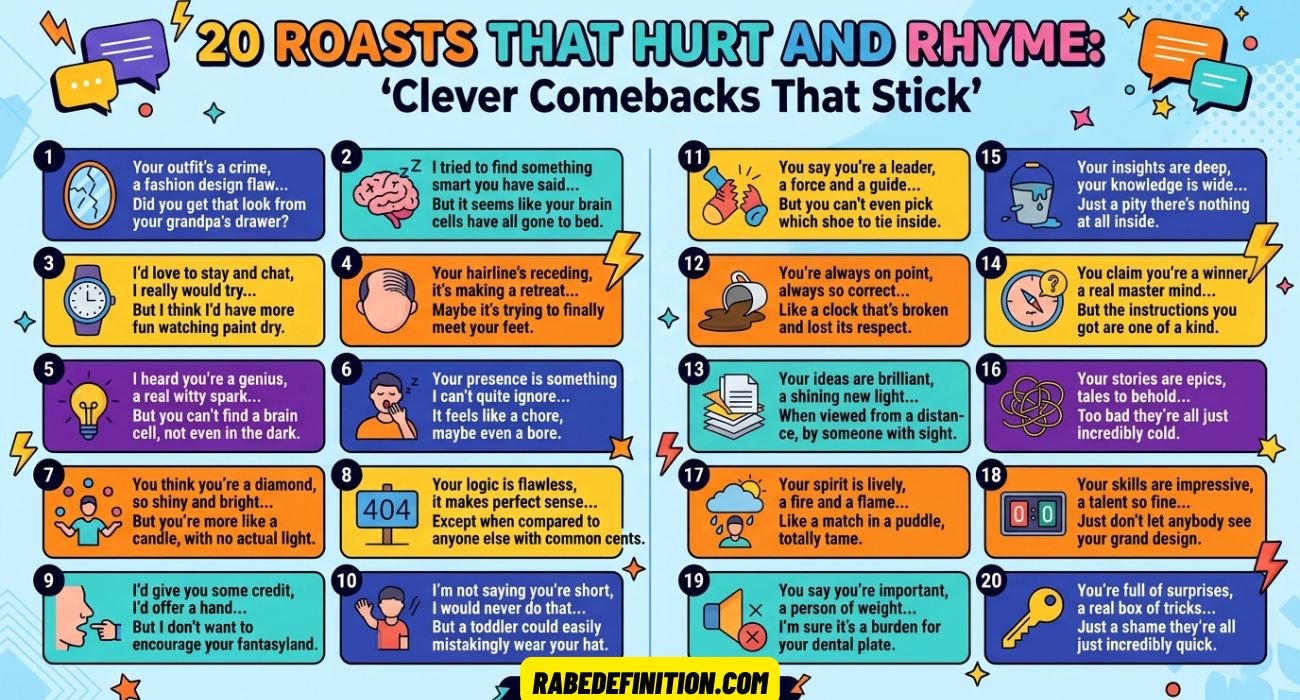
20 Roasts That Hurt and Rhyme: Clever Comebacks That Stick
A good roast does not always need to be brutal. Sometimes, the cleverest comeback is the one with a smooth rhyme that makes everyone laugh before the person being roasted even realizes what happened.
Roasts That Hurt and Rhyme are short, playful insults built around rhythm, wordplay, and a punchy ending. They can work in friendly conversations, group chats, social media comments, or casual banter when everyone understands the joke.
Below, you will find 20 original rhyming roasts, along with explanations of why they work, when to use them, and how to create your own without crossing the line from funny to genuinely hurtful.
Quick Answer
Roasts That Hurt and Rhyme are witty insults or comebacks that use rhyme and rhythm to make a criticism sound sharper, funnier, and easier to remember.
For example, “You brag nonstop, but your skill’s a flop” works because the rhyme gives the comeback a quick setup and punchline. The goal is usually playful teasing rather than serious hostility.
The best rhyming roast depends heavily on context. A line that makes a close friend laugh could sound unnecessarily rude when directed at a stranger, coworker, or someone who does not enjoy roast-style humor.
TL;DR
- Roasts That Hurt and Rhyme combine an insult with rhythm or rhyme.
- Rhyme makes short comebacks easier to remember and deliver.
- The strongest lines usually rely on clever contrasts rather than pure cruelty.
- Timing and knowing your audience matter as much as the wording.
- Use rhyming roasts for playful banter, not to target someone’s sensitive personal traits.
What Does “Roasts That Hurt and Rhyme” Mean?

The phrase “Roasts That Hurt and Rhyme” describes roast lines that are both teasing and cleverly structured around rhyming words.
A roast is a humorous insult aimed at someone, usually as part of playful banter. In a rhyming roast, the wording is arranged so that key words sound alike or have a noticeable rhythmic relationship.
For example:
“Your game’s rusty, but your jokes feel dusty.”
The line pokes fun at someone’s performance and humor while using rusty/dusty to create a memorable rhyme.
These are generally informal expressions. They are most natural in casual conversations, texting, group chats, social media, and friendly joking.
They are not a special texting abbreviation or slang term with one fixed definition. Instead, roasts that rhyme are a style of humorous wordplay.
Roasts That Hurt and Rhyme in Texting
Rhyming roasts can work especially well in text because a short message has to communicate tone without facial expressions or voice.
A well-written rhyme can make the playful intention clearer, but it can also be misunderstood if the recipient does not know you are joking.
In texting, these roasts may appear in:
- Group chats
- Friendly arguments
- Gaming conversations
- Social media comments
- Meme conversations
- Playful exchanges between friends
- Competitive banter
Emojis can sometimes reinforce the intended tone, but they do not automatically make a harsh statement harmless. The relationship between the people involved still matters.
20 Roasts That Hurt and Rhyme
1. “Your content’s thin, but your chin’s not keen.”
This line combines criticism of someone’s content with a playful jab at their confidence. The thin/keen sound gives it a compact rhythm.
It works best when teasing someone who constantly produces weak takes, posts, or ideas.
2. “You brag nonstop, but your skill’s a flop.”
This is a straightforward confidence-versus-ability roast. Someone talks themselves up, but their actual performance does not match the hype.
The nonstop/flop pairing makes the comeback easy to remember.
3. “Acting all high, but you’re just a fly.”
The joke here is about someone behaving as though they are important while suggesting they are actually insignificant.
The high/fly rhyme keeps the insult playful and exaggerated rather than overly serious.
4. “Hot air flow, but nothing to show.”
This roast targets someone who talks confidently without producing results.
It is particularly useful when a person keeps promising something but never follows through. The flow/show rhyme gives the line a clean ending.
5. “You’re bark so loud, yet your bite’s not proud.”
This puts a rhyming spin on the familiar idea of someone being loud but lacking action.
It fits situations where someone makes big claims, talks tough, or constantly challenges others without actually backing themselves up.
6. “Your game’s rusty, but your jokes feel dusty.”
This one delivers two related criticisms at once: poor performance and stale humor.
The rusty/dusty rhyme makes it especially catchy. It can fit gaming, sports, or any playful competition where someone is clearly out of practice.
7. “Walking billboard, but your value’s nil.”
This line pokes at someone who puts a lot of effort into promoting themselves without offering much substance.
The rhyme is slightly looser, which shows that a roast does not always need a perfect rhyme to sound effective.
8. “Gives advice like a sage, yet you live in a cage.”
The humor comes from contradiction. Someone presents themselves as wise while apparently being trapped by the same problems they criticize in others.
The sage/cage rhyme makes the irony more memorable.
9. “You preach your plan, yet you don’t stand.”
This is a short roast for someone who talks about taking action but rarely follows through.
Its simplicity is part of the joke. The plan/stand rhyme creates a quick verbal punch.
10. “Smile like gold, but heart’s gone cold.”
This roast contrasts a pleasant outward appearance with an allegedly cold attitude.
Because it focuses on personality rather than someone’s physical features, it can work as a more playful character-based roast when the relationship supports that kind of teasing.
11. “You posture grand, but slip in the sand.”
The image is simple: someone tries to appear powerful or impressive but cannot maintain that image when challenged.
The grand/sand rhyme gives the line a slightly cartoonish quality.
12. “Your ideas shout, but quieter thoughts have clout.”
This is aimed at someone who is very vocal but not necessarily very thoughtful.
The contrast between being loud and having actual substance gives the roast more depth than a generic “you’re wrong” comeback.
13. “You flex your wealth, still you can’t buy health.”
Here, the punchline comes from contrast. Money can purchase many things, but it cannot guarantee every desirable outcome.
The wealth/health rhyme makes the message sound almost like a proverb.
14. “Face of steel, but no true zeal.”
This line describes someone who looks confident or intimidating but seems to lack genuine enthusiasm or purpose.
The steel/zeal rhyme gives it a polished, almost poetic sound.
15. “Your attitude’s loud, your logic’s bowed.”
This roast works when someone’s confidence is much stronger than their reasoning.
The point is not simply that the person is loud; it is that their certainty does not necessarily make their argument stronger.
16. “Loud as a drum, but nothing’s to come.”
This is another roast for someone who generates plenty of noise but very little action.
The drum/come rhyme gives the line a rhythmic quality that works well as a quick comeback.
17. “Your style is bright, but your depth’s a blight.”
This targets the difference between presentation and substance.
Someone may look impressive, fashionable, or polished while still failing to offer much meaningful content.
18. “Talking like a boss, yet you floss no gloss.”
This is deliberately exaggerated and slightly absurd. That absurdity is part of what makes it funny.
The repeated boss/gloss sound gives it a playful, almost meme-like quality.
19. “All dressed to slay, but your words don’t pay.”
This line contrasts appearance with substance. Someone may look confident and impressive, but their actual words do not deliver anything valuable.
The slay/pay rhyme makes the comeback quick and catchy.
20. “You build a façade that’s bound to fraud.”
This closing roast targets someone whose impressive image may not match reality.
The idea is that the person has constructed a false presentation that cannot hold up under scrutiny. It works particularly well when the roast is meant to sound clever rather than simply aggressive.
See Also : Orange Heart Emoji Meaning: What Does Mean in Texting?
Context Is Everything: When and How to Use These Roasts
A rhyming roast can be brilliant in one situation and completely inappropriate in another.
The same sentence can sound hilarious between close friends but hostile when said to someone who does not know you well. Before using one, consider the relationship, setting, and reason for the conversation.
Tip #1: Read the Room
Pay attention to how everyone is already communicating.
If the conversation is full of jokes and playful teasing, a clever rhyme may fit naturally. If someone is upset, discussing a serious issue, or clearly uncomfortable, a roast is probably the wrong move.
Tip #2: Lead with Humour, Not Malice
The funniest roasts usually exaggerate a harmless behavior or contradiction.
There is a difference between joking about someone’s terrible gaming skills and deliberately targeting something deeply personal. Clever wordplay tends to be more entertaining when the objective is laughter rather than embarrassment.
Tip #3: Pair With Your Own Spin
Do not feel limited to these exact lines.
You can change a word, reference something that just happened, or build a rhyme around the situation. Personalizing the wording can make a comeback sound spontaneous instead of rehearsed.
Expert Insight: What Makes a Rhyme Effective?
A good rhyming roast has more going on than simply finding two words that sound alike.
The strongest lines usually combine:
- A recognizable setup
- A surprising ending
- A clear contrast
- Short wording
- Strong rhythm
- A memorable rhyme
- A situation the audience understands
The rhyme gives the listener an expectation about how the sentence will end. The punchline then uses that expectation to create the joke.
Note from Cognitive Psychology
Rhythm and repeated sound patterns can make language easier to recognize and remember. That helps explain why rhyming phrases often feel especially catchy.
However, rhyme alone does not make a roast funny. The meaning, timing, delivery, and social context still determine whether the joke actually lands.
First-Person Field Test: My “Dusty Jokes” Moment
Imagine a group conversation where someone keeps telling the same old jokes while insisting they are still hilarious.
A simple response such as “Your jokes are old” gets the point across, but it is forgettable.
Now imagine saying:
“Your game’s rusty, but your jokes feel dusty.”
The second version has a setup, rhythm, repetition, and a punchline. Even if the group has heard plenty of jokes before, the unexpected rhyme can make the response feel more entertaining.
That is the practical advantage of a rhyming roast: the structure helps turn an ordinary criticism into a line people can repeat.
The Rise of Rhyme-Based Roasts in Modern Humor
Short-form communication has made compact jokes particularly useful.
People increasingly communicate through short comments, messages, captions, memes, and quick replies. A long explanation is often unnecessary when a few well-chosen words can deliver the entire joke.
Rhyming roasts fit that environment naturally.
They are short enough for a text, structured enough to be quotable, and flexible enough to adapt to different situations. Internet humor also frequently rewards wordplay, exaggeration, and unexpected combinations of familiar phrases.
How Clever Wordplay Transforms a Simple Roast

Consider the difference between:
“You talk too much.”
and:
“Hot air flow, but nothing to show.”
The first is direct but ordinary. The second adds imagery, rhythm, and a rhyme.
That does not necessarily make it meaner. It makes it more creative.
Good roast writing often relies on techniques such as:
- Contrast: saying one thing while exposing the opposite.
- Metaphor: comparing someone’s behavior to something unexpected.
- Exaggeration: stretching a weakness for comedic effect.
- Rhyme: connecting the key words through sound.
- Rhythm: giving the sentence a satisfying cadence.
- Surprise: ending with a word the listener did not expect.
Why Rhyme Makes Roasts More Memorable
Rhyme gives a sentence a verbal hook.
When two important words have similar sounds, the line feels more complete. This is one reason phrases such as “nonstop/flop,” “rusty/dusty,” and “wealth/health” are easy to repeat.
A memorable roast is not necessarily the harshest one. Often, it is simply the one with the best combination of wording, rhythm, and timing.
Turning Friendly Insults into Poetic Art
A roast can be thought of as a tiny piece of comedic poetry.
You do not need a complicated rhyme scheme. Start with the behavior you want to tease, then look for a word that captures the joke and another word that rhymes with it.
For example:
Behavior: Someone talks constantly but rarely contributes anything useful.
Key idea: “noise”
Possible rhyme: “voice”
From there, you can build a short line around the contrast between being heard and actually saying something valuable.
The trick is to make the rhyme serve the joke rather than forcing a random word into the sentence.
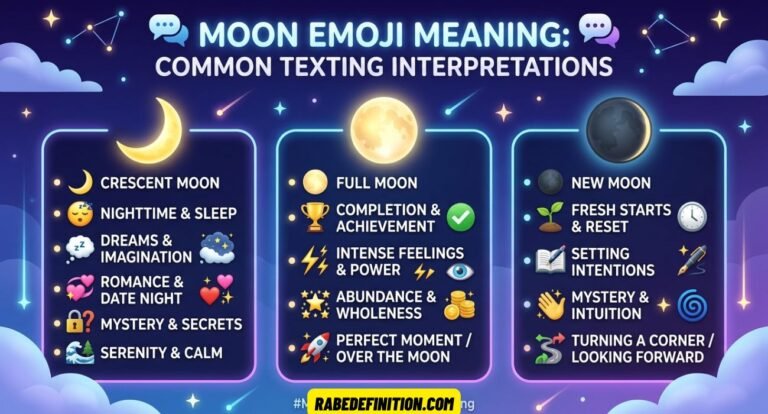
See Also : Moon Emoji Meaning: What Does the Moon Emoji Mean in Texting?
The Psychology Behind a Great Rhyme Roast
A strong roast often works through expectation and surprise.
The listener hears the first part and begins to anticipate where the sentence is going. The rhyme then provides a satisfying ending, while the meaning of that final word delivers the actual joke.
There is also an element of social play. Friendly roasting can function as verbal competition when everyone involved understands the boundaries.
That is why context matters so much. The exact same words can be playful in one relationship and insulting in another.
Mastering Timing in Witty Rhyme Roasts
Even an excellent line can fall flat if the timing is wrong.
For spoken banter, keep the delivery natural. A short pause before the final rhyming word can give the punchline more impact.
In texting, brevity usually helps. Avoid explaining the joke immediately afterward. If the rhyme works, let it stand on its own.
Most importantly, know when to stop. A good roast is often a single clever line, not a long series of increasingly personal insults.
Table: Quick Reference to Rhyme Roast Types
| Roast Type | What It Targets | Typical Approach | Example Style |
|---|---|---|---|
| Bragging roast | Excessive confidence | Confidence vs. ability | “You brag nonstop, but your skill’s a flop.” |
| Action roast | Empty promises | Talk vs. results | “Hot air flow, but nothing to show.” |
| Logic roast | Weak reasoning | Confidence vs. substance | “Your attitude’s loud, your logic’s bowed.” |
| Style roast | Appearance over substance | Image vs. depth | “Your style is bright, but your depth’s a blight.” |
| Performance roast | Poor skills | Ability vs. confidence | “Your game’s rusty, but your jokes feel dusty.” |
| Personality roast | Attitude | Outer image vs. behavior | “Smile like gold, but heart’s gone cold.” |
| Wealth roast | Material flexing | Money vs. reality | “You flex your wealth, still you can’t buy health.” |
| Noise roast | Excessive talking | Volume vs. value | “Loud as a drum, but nothing’s to come.” |
| Absurd roast | Over-the-top behavior | Exaggeration | “Talking like a boss, yet you floss no gloss.” |
| Image roast | False presentation | Appearance vs. reality | “You build a façade that’s bound to fraud.” |
When to Use Roasts That Hurt and Rhyme
These roasts are generally best suited to informal situations where playful teasing is already accepted.
They can work well:
- Among close friends
- During friendly gaming sessions
- In playful group chats
- During harmless competitive banter
- In casual social-media exchanges
- When someone clearly enjoys roast-style humor
The safest approach is to joke about something temporary, exaggerated, or relatively harmless rather than targeting a sensitive personal characteristic.
When Not to Use Them
Avoid rhyming roasts when the situation is serious or the other person has clearly indicated that they do not want to be teased.
They are also usually a poor choice for:
- Formal emails
- Job interviews
- Professional complaints
- Academic writing
- Serious disagreements
- Conversations with unfamiliar people
- Situations involving a significant power imbalance
Even in casual environments, context matters. A funny roast should create amusement, not pressure someone into laughing at their own expense.
Social Media Usage
Rhyming roasts can fit naturally into fast-moving social platforms because they are short and easy to quote.
On Instagram or TikTok, a short rhyme may appear as a comment or caption. On Snapchat, WhatsApp, or Messenger, it can work as a quick response during friendly banter.
On public platforms, however, context can disappear quickly. A person who does not know the participants may interpret a playful roast as a serious insult.
That is particularly important when replying publicly rather than privately.
Similar Terms and Comparisons
| Term | Meaning | Main Difference |
|---|---|---|
| Roast | A humorous insult | Broad category; it does not need to rhyme |
| Rhyming roast | A roast built around rhyme | Uses sound patterns as part of the joke |
| Comeback | A quick response to something someone said | Can be witty without being insulting |
| Burn | A sharp or clever insult | Often shorter and more direct |
| Banter | Playful back-and-forth teasing | Usually emphasizes mutual joking |
| One-liner | A short standalone joke | Does not necessarily target another person |
| Savage comeback | An especially sharp response | Often harsher than ordinary playful banter |
Other Meanings
“Roasts That Hurt and Rhyme” does not have a separate technical, medical, academic, or professional definition.
It is a descriptive phrase for a particular type of humorous writing or verbal comeback.
The word roast itself can, of course, have completely different meanings in other contexts, such as cooking or a comedy-roast event. Here, the intended meaning is the humorous practice of making jokes at someone’s expense.
Common Mistakes With Rhyming Roasts
A few mistakes can make a potentially funny roast fall flat:
- Forcing the rhyme: A strange word chosen only because it rhymes can make the line sound unnatural.
- Making it too long: A roast usually benefits from brevity.
- Explaining the punchline: If you need several sentences to explain the joke, the line may need rewriting.
- Ignoring context: A good roast still needs the right audience.
- Confusing cruelty with cleverness: A harsher insult is not automatically a funnier one.
- Overusing the same rhyme: Repeated patterns can quickly become predictable.
How to Make Your Own Rhyming Roasts
Creating your own rhyming roasts is easier when you start with a simple observation. Think about the behavior you want to tease, choose one strong word that describes it, and then look for a second word that rhymes naturally. The goal is to make the line sound like something a person would actually say.
Try keeping your roast short and letting the final rhyming word carry the punchline. A simple structure such as “You talk a big game, but your results are lame” can often work better than a complicated sentence packed with unnecessary words.
The Difference Between a Clever Roast and a Mean Insult
A clever roast usually gets its humor from exaggeration, timing, or wordplay rather than genuine hostility. It gives the listener something to laugh at while keeping the overall exchange light. This is especially important when using roasts with friends or in casual group conversations.
A mean insult, on the other hand, is more focused on causing embarrassment or offense. If the joke depends on a sensitive personal issue or is clearly making someone uncomfortable, the rhyme does not automatically make it funny. Good roasting depends just as much on judgment as it does on clever wording.
Funny Rhyming Roasts for Friends and Group Chats
Friends often use rhyming roasts as a playful way to compete, joke around, or respond to someone’s overconfident comment. A quick line can turn an ordinary conversation into a memorable exchange, especially when the roast connects directly to something that just happened.
In group chats, shorter is usually better. A roast that fits naturally into one message is easier for everyone to understand and react to. Keep the tone playful, avoid repeatedly targeting the same person, and remember that the funniest comeback is often the one that everyone can enjoy.
How Timing Makes a Rhyming Roast Hit Harder
Even a great roast can lose its impact if it arrives too late or feels forced. The strongest comebacks usually appear immediately after the comment or situation that inspired them. A brief pause in spoken conversation can also give the final rhyming word extra emphasis.
In texting, timing works a little differently. A short response sent at the right moment can feel spontaneous and clever, while an overly long explanation can take away the humor. Let the rhyme create the punchline and avoid adding more insults after the joke has already landed.
FAQ: Roasts That Hurt and Rhyme
What does “Roasts That Hurt and Rhyme” mean?
It refers to witty insults or comebacks that use rhyme, rhythm, and wordplay to make the roast more memorable and entertaining.
What is a good example of a rhyming roast?
“Your game’s rusty, but your jokes feel dusty” is one example. It uses the rusty/dusty rhyme while teasing someone’s performance and stale humor.
Are rhyming roasts meant to be serious?
Usually, no. They are generally intended as playful or humorous insults, although the effect depends on the relationship and context.
Are roasts that rhyme good for texting?
Yes. Their short, rhythmic structure makes them suitable for casual texts and group chats, especially when everyone is comfortable with teasing.
Are rhyming roasts rude?
They can be. A roast becomes more likely to feel rude when it targets sensitive subjects, is directed at someone who dislikes teasing, or is delivered during a serious disagreement.
How do you make your own rhyming roast?
Start with a behavior you want to tease, identify the main idea, find a strong rhyming word, and build a short punchline around the two ideas. Keep the wording natural.
What’s the difference between a roast and a comeback?
A roast is generally an insult delivered for humor, while a comeback is a response to something someone has said or done. A comeback can be funny without insulting the other person.
Can I use a rhyming roast at work?
Generally, it is safer to avoid personal roasts in professional communication. Workplace humor depends heavily on the people, culture, and situation, so a clever line that works with friends may not be appropriate with colleagues.
Why are rhyming roasts so catchy?
Rhyme creates a recognizable sound pattern, while a punchline adds the humorous meaning. Together, rhythm and surprise can make a short phrase easier to remember.
What makes a rhyming roast funny instead of mean?
The difference usually comes from context, target, tone, and intent. Playful exaggeration and clever wordplay tend to work better than attacks on deeply personal or sensitive subjects.
Conclusion
Roasts That Hurt and Rhyme are essentially clever, rhythmic insults designed to make a comeback more memorable. Their appeal comes from the combination of humor, wordplay, rhyme, and timing.
The best rhyming roast is not necessarily the harshest one. A short line with a clever contrast can get a bigger laugh than a genuinely cruel insult.
When in doubt, keep the target light, read the room, and let the rhyme do the work.