WYF Meaning in Text: What Does WYF Mean in Texting?
The wyf meaning in text is “Where You From,” a short question people use when they want to know where someone is from. It asks about the place a person lives now or the place where that person grew up. WYF is an informal short form, so it belongs in casual messages rather than careful or formal writing.
People usually send WYF early in a text, DM, or social media conversation with someone they are still getting to know. The sender may be making small talk, checking the distance between you, or trying to place an accent, school, or hometown mentioned earlier. Its tone is normally neutral, but a bare WYF as a first message can feel blunt because it offers no greeting or reason.
This article explains how WYF is used in common chat situations and how its meaning can change slightly with context. You will see clear examples, simple reply ideas, and the difference between WYF and similar short forms such as WYD and WYLL. It also covers when WYF sounds natural, when the full question is better, and how much location detail is safe to share.
Quick Answer
WYF means “Where you from?” It’s a short, informal way of asking where someone is from, and it usually appears in casual texts and DMs between people who are still getting to know each other.
What Does WYF Mean?
The letters line up with the first letters of “Where you from?” Read that way, a message that just says “wyf?” is a complete question, even though it doesn’t look like one.
The sender usually wants one of two things: the place you live now, or where you grew up. The conversation around the message normally tells you which one, and if it doesn’t, one short answer can cover both: “I’m from Ohio, but I live in Austin now.”
WYF is informal slang, not standard English. You won’t see it in a work email, and anyone who doesn’t text much may not recognize it at all.
The wya meaning is different — WYA asks where someone is right now, while WYF asks where they are from.
WYF in Texting
In a text thread, WYF tends to arrive early. Two people exchange a few messages about school or work, and then one of them drops “wyf” with nothing after it. The missing words aren’t missing to the sender. In their head, the question is obvious.
Capital letters change nothing, and the question mark is optional. Tone matters more, though a bare “wyf” as the very first message, with no greeting, can read as blunt.
Another short opener is SUP — and the best reply to SUP depends on the chat and who sent it.
Common Uses of WYF
Most uses fall into a few familiar situations. The question stays the same; the reason behind it changes.
| Situation | What the sender wants to know |
|---|---|
| Talking to someone new online | The city or area you live in |
| Chatting after meeting at an event | If you’re local or visiting |
| Getting to know a new friend | Where you grew up |
| Small talk in a group chat | A quick fact to keep the chat going |
| Talking with someone far away | Your time zone or distance apart |
The answers people expect are general. A city or a region is enough in almost every case. Nobody asking “wyf” needs your street address, and you shouldn’t offer it.
Real Texting Examples
A few short exchanges show it in practice.
Example 1
Person A: “We have that same class on Tuesdays, right?”
Person B: “Yeah. wyf btw?”
Person A: “Denver originally, I moved here last year.”
Meaning: A classmate asks where B is from.
Example 2
Person A: “ok wyf”
Person B: “I’m from Georgia, you?”
Person A: “Florida lol”
Meaning: Two people who just started talking.
Example 3
Person A: “You said you miss the food back home, wyf?”
Person B: “New Orleans. Nothing here tastes the same.”
Meaning: Here “from” means where B grew up, not where B lives now.
Example 4
Person A: “wyf? trying to see if we’re in the same time zone”
Person B: “Chicago, so Central.”
Meaning: The sender gives the reason, so the reply is simple.
How to Reply to WYF
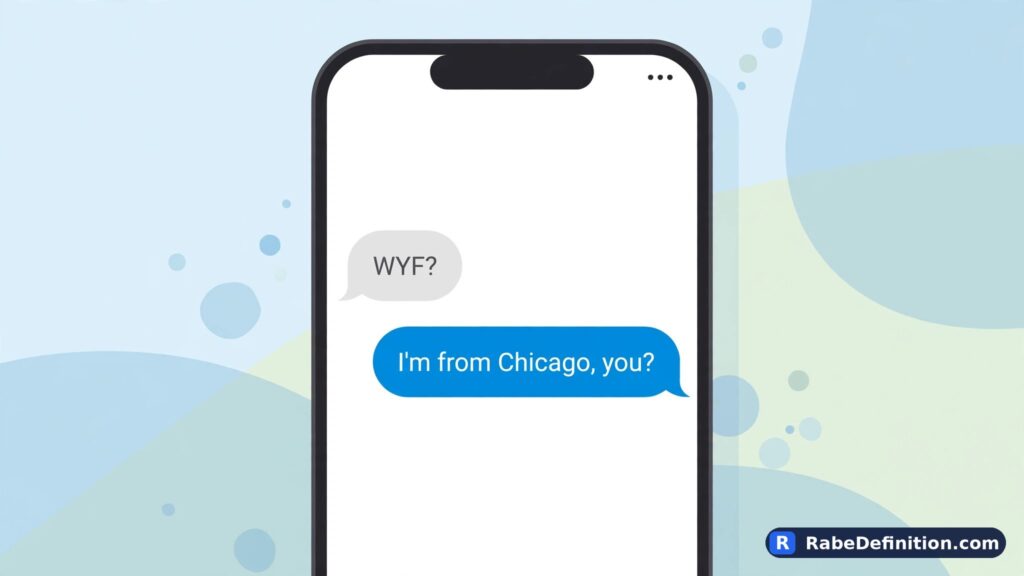
The simplest reply is a place name and nothing else. “Chicago.” “I’m from Texas.” Both work, and most people move on.
To keep the conversation going, add a little and ask back: “I’m from Seattle, but I’m in Phoenix for college. What about you?”
You also decide how much to share. With someone you don’t know well, keep it broad – a state or a region is a complete answer. If a stranger keeps pushing for an exact location, that’s a good reason to slow down or stop replying.
Confused about which “from” they mean? Ask. “Where I live now, or where I grew up?” is a normal reply, not a rude one.
A casual reply like ight works when the chat stays relaxed.
Tone and Context
On its own, WYF is neutral. It’s a question, not a compliment and not an insult. How it feels depends on who sent it.
From a friend or a new classmate, it reads as ordinary small talk. From a stranger who has sent nothing else, the same three letters can feel abrupt, because there’s no warmth around them. Timing matters too. Asked after twenty minutes of friendly chat, it’s natural. Asked first, it can feel like an interview.
The words around it can shift the reading, and if a message looks unclear, don’t guess. A one-line question back saves a strange reply.
When to Use WYF
WYF fits in casual chats with people who already use short forms like this – new online friends, classmates, teammates, and people you’ve matched with.
It also helps to wait a bit. Get a few normal messages in first, then ask. The question lands better once there’s a reason for it, like a chat about hometowns or travel.
When Not to Use WYF
Skip it in anything formal. Teachers, employers, coworkers you barely know, and relatives who don’t use texting slang are better off getting the full question written out.
It’s also the wrong choice when clarity matters. On a form, or while giving directions, “Where are you from?” spelled out is clearer for everyone.
And don’t use it to press someone. A vague answer on purpose is still an answer.
WYF on Social Media
The question shows up across the main chat apps, usually with the same meaning. Small habits differ by app.
Emoji also carry meaning in these chats — the brown heart emoji meaning is one readers look up often.
WYF on Snapchat
Snapchat chats move fast and often start with people you don’t know well, so WYF appears early there. Some users keep their answer extra general until they trust the person.
WYF on Instagram
On Instagram, WYF usually arrives in DMs after someone has seen your posts or stories. A photo from a certain city often prompts it, so the sender may already have a rough guess.
WYF on TikTok
On TikTok, WYF turns up in comments and DMs after a video reaches strangers. In a public comment, it’s often aimed at the creator’s accent or background in the video. Many creators keep the reply broad, since anyone can read it.
WYF on Dating Apps
On dating apps, WYF is a standard early question. There it normally means “where do you live,” because distance matters to both people. Most users answer with a city and ask the question back.
WYF vs Similar Terms
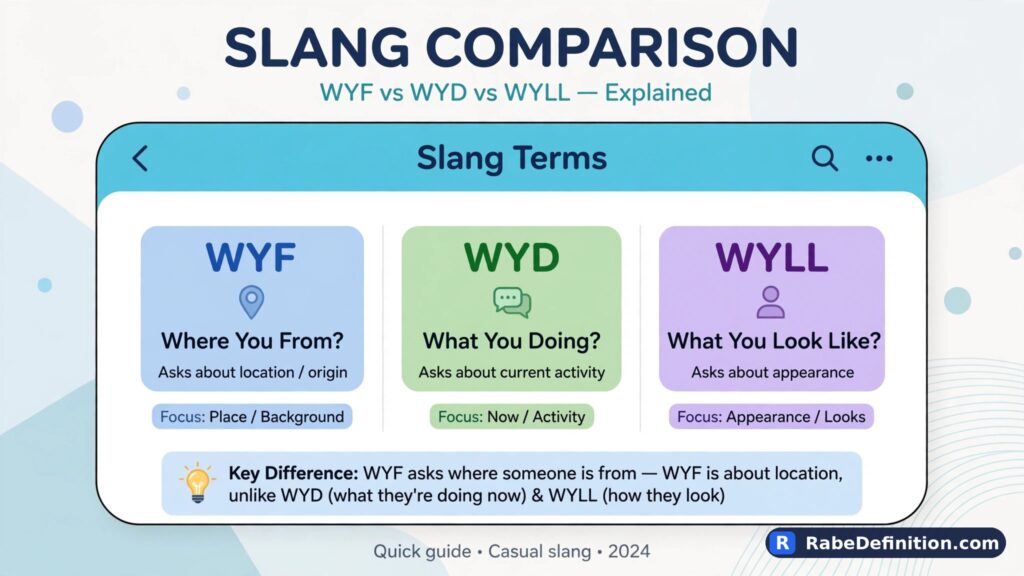
Several short questions look alike, which is where most confusion comes from.
| Term | Full form | What it’s asking |
|---|---|---|
| WYF | Where you from? | Where someone is from or lives |
| WYD | What you doing? | What someone is doing right now |
| WYLL | What you look like? | What someone looks like |
| WYO | What you on? | What someone is up to or planning |
| HMU | Hit me up | Asking someone to contact you |
The last letter helps. F points to “from,” D points to “doing,” and the two L’s point to “look like.”
Common Mistakes
One frequent mistake is reading WYF as WYD and answering with what you’re doing. “Nothing much, just watching TV” is a strange reply to a question about your hometown, and it happens often because the two look alike on a small screen.
Another is sharing far more than the question calls for. A full address or your school name is more than a stranger needs. City-level detail is the norm.
People also overthink the intent. Most senders aren’t testing you; they’re filling an awkward early silence with an easy question. On the sending side, the biggest slip is dropping “wyf” as a first message with no greeting.
FAQs
What does WYF mean from a guy or a girl?
WYF means Where You From, no matter who sends it. The conversation around it decides whether it feels like friendly small talk or a blunt question.
Is WYF asking where I live or where I was born?
WYF can ask about either your current home or the place where you grew up. When the difference matters, answer both, such as born in Miami and living in Dallas now.
How do I reply to WYF if I don’t want to say exactly where I’m from?
Give a broad answer, such as your state or region, instead of an exact place. You can also say that you would rather not share that detail yet.
Is WYF rude?
WYF is not usually rude, and most people use it as ordinary small talk. It can sound abrupt as a first message because it is short and has no greeting.
Can WYF mean something else?
In a text or DM, Where You From is the standard meaning of WYF. If the conversation suggests another sense, ask the sender what they mean instead of guessing.
What’s the difference between WYF and WYA?
WYF asks where you are from, meaning your hometown or the place you live in general. WYA asks where you are right now, at that specific moment.
Conclusion
The wyf meaning in text is “Where You From,” a casual question about where a person lives or grew up. People normally use it early in friendly chats, direct messages, and online conversations when they are getting to know someone. Its tone is usually neutral and curious, although a short first message without a greeting can sound abrupt or too personal.
Answer with a city, state, or region, and add your hometown only when both meanings matter or the difference is unclear. Keep exact addresses and school names private, especially with strangers, and feel free to give a broad answer instead. Used at the right moment, WYF is simple small talk that helps two people understand each other much better.