Skull Emoji Meaning: What Does 💀 Mean in Texting?
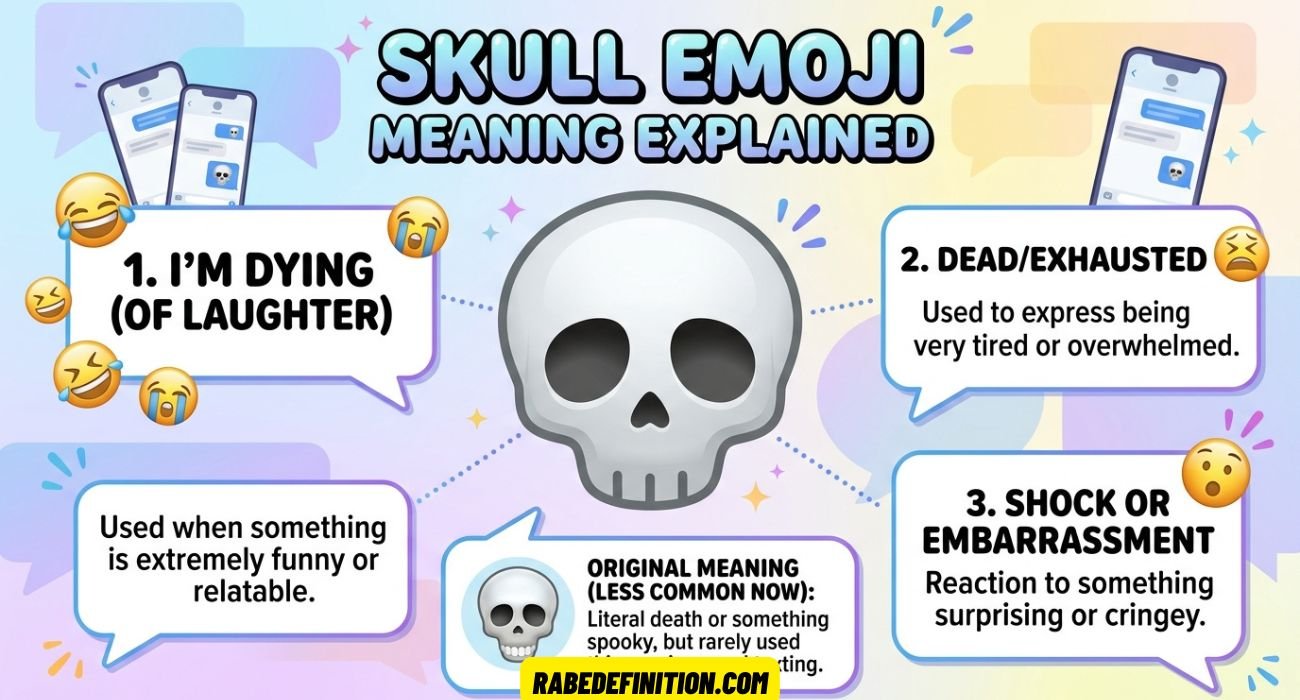
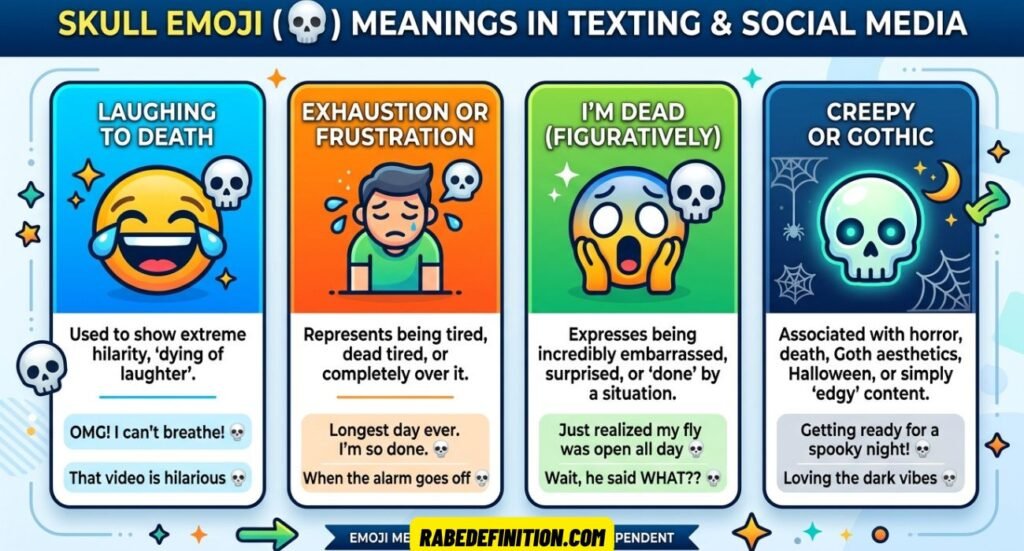
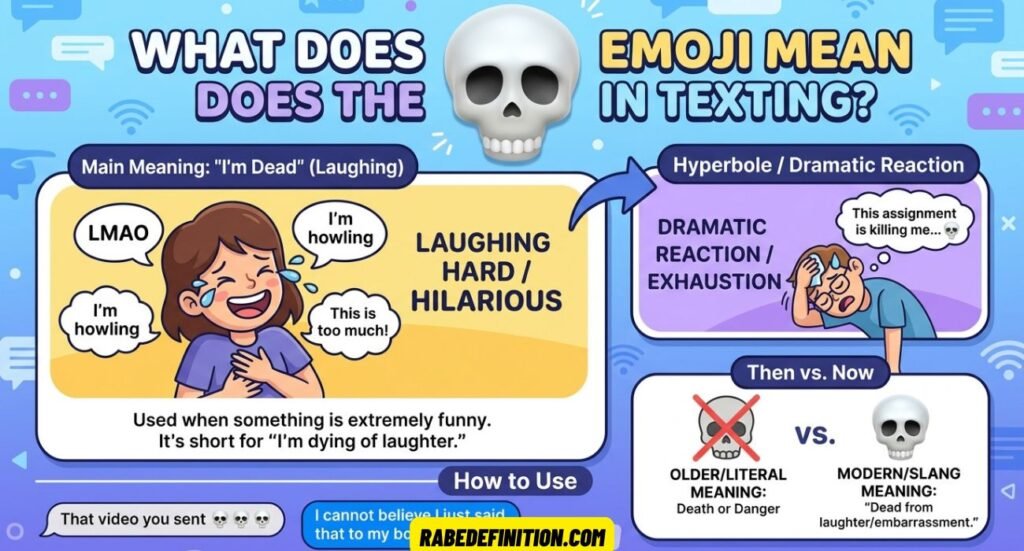
The 💀 skull emoji has a surprisingly different meaning in modern online conversations than its traditional symbol suggests. While a skull can represent death, danger, or something frightening, people often use 💀 in texts to say “I’m dead,” “That’s hilarious,” or “I can’t handle this.”
So, what does the skull emoji mean in texting? Usually, it is an exaggerated reaction to something funny, embarrassing, shocking, ridiculous, or unbelievable. However, the exact meaning depends on the conversation and the message around it.
This guide explains the skull emoji meaning, how people use it in text messages and social media, what it means in different situations, and how you can respond naturally.
Quick Answer
The skull emoji 💀 commonly means “I’m dead” in texting. In many casual conversations, “dead” is figurative and means something was extremely funny, awkward, shocking, or overwhelming.
For example, if someone texts, “He walked into the wrong classroom and started giving a presentation 💀,” the skull emoji probably means “That’s hilarious” or “I’m dying laughing.”
The emoji can also have its literal meaning of death, danger, or mortality, especially when the conversation is serious. Context is what tells you which meaning is intended.
TL;DR
- 💀 often means “I’m dead” or “That killed me” in texting.
- It is commonly used to react to something very funny, awkward, absurd, or shocking.
- The traditional meaning is associated with death, danger, and mortality.
- 💀 can feel more ironic or meme-like than 😂 or 🤣.
- Always consider the context before interpreting or sending it.
What Does the Skull Emoji Mean?
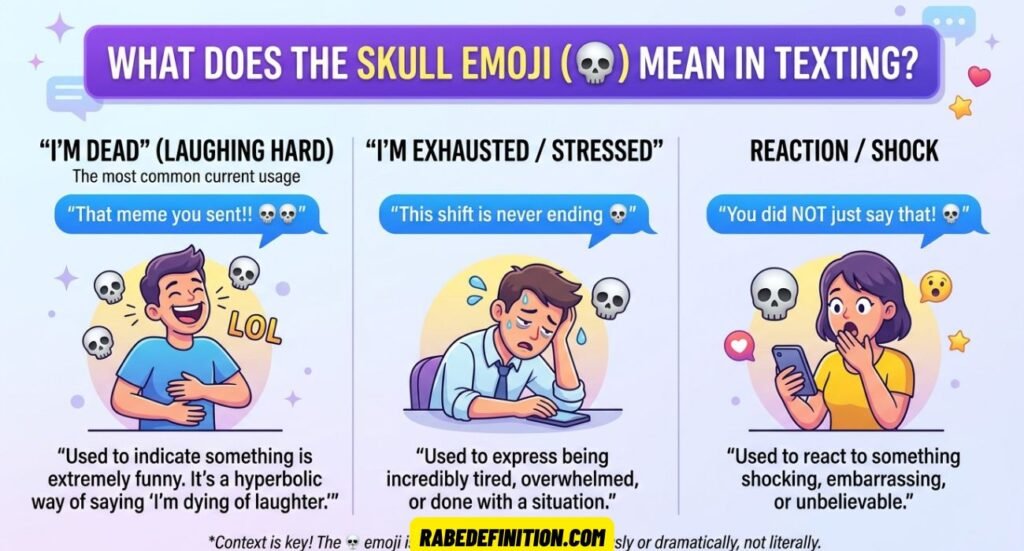
The skull emoji 💀 has both a literal and a figurative meaning.
Its literal meaning relates to a human skull, so it can represent death, danger, horror, or mortality. But internet users frequently use it in a completely different way.
In texting, 💀 often stands for phrases such as:
- “I’m dead.”
- “That killed me.”
- “I’m dying.”
- “That’s so funny.”
- “I can’t believe you said that.”
- “I have no words.”
- “That was painfully awkward.”
For example:
“You actually sent that email to the whole company 💀”
Here, the sender probably isn’t talking about an actual death. They are reacting to an embarrassing or unbelievable situation.
The skull emoji is generally informal. It fits naturally in texts, group chats, comments, memes, and casual social media conversations, but it may not be appropriate for serious or professional communication.
Skull Emoji Meaning in Texting
In text messages, 💀 is usually a reaction emoji rather than a literal reference to death.
Someone might send it after hearing a funny story:
Person A: “My dog stole my sandwich and then fell asleep on the evidence.”
Person B: “💀”
Person B is essentially saying, “That’s hilarious,” or “I’m dead.”
The tone can change depending on what came before it. The same emoji might communicate laughter in one conversation and disbelief in another.
For example:
“You wore pajamas to the interview 💀”
This could mean:
- “That is hilarious.”
- “I cannot believe you did that.”
- “That was a terrible idea.”
The sender’s relationship with you also matters. Between close friends, 💀 is usually playful. From someone you barely know, it may be harder to determine whether they are joking, criticizing, or simply reacting.
Common Uses of the Skull Emoji
| Situation | What 💀 Usually Means |
|---|---|
| Funny joke | “I’m dead laughing.” |
| Ridiculous situation | “This is too much.” |
| Embarrassing moment | “I cannot believe this happened.” |
| Unexpected message | “No way.” |
| Meme or viral post | “This is hilarious.” |
| Dark humor | “That joke is wild.” |
| Serious discussion | Literal death or something related to mortality |
The important point is that 💀 doesn’t have one universal interpretation in every conversation.
Real Texting Examples
Here are some original examples showing how the skull emoji can change meaning based on context.
Example 1: Something Funny
Person A: “My brother tried to cook pasta and forgot to add water.”
Person B: “💀💀”
Here, the skulls express strong amusement.
Example 2: Embarrassment
Person A: “I called my teacher ‘Mom’ in front of everyone.”
Person B: “You did not 💀”
The emoji means something like, “That is so embarrassing.”
Example 3: Disbelief
Person A: “He said he doesn’t know what pizza is.”
Person B: “💀 What?”
Here, 💀 communicates disbelief and surprise.
Example 4: Meme Reaction
Person A: “This video has me finished 💀”
The skull reinforces the idea that the video was extremely funny.
Example 5: Dark Humor
Person A: “That joke was way darker than I expected.”
Person B: “💀”
The emoji can acknowledge the dark or morbid humor without necessarily indicating genuine approval of the subject matter.
Example 6: Literal Meaning
Person A: “The story was about people who died in the accident.”
Person B: “💀”
In a serious context, the emoji could be interpreted literally—but it might also come across as insensitive. This is why context matters so much.
Example 7: Combining Emojis
Person A: “He posted the same selfie for the fifth time today.”
Person B: “💀😭”
The combination intensifies the reaction. It can mean something like, “I’m absolutely losing it.”
See Also : lushed Face Emoji Meaning: What Does Mean in Texting?
How to Reply to the Skull Emoji
There is no single correct response to 💀. Your best reply depends on why the other person sent it.
Casual Response
If they are laughing at something you said:
“I knew you’d find that funny 😂”
Funny Response
If you want to keep the joke going:
“I’m just getting started 💀”
Short Response
If you want to acknowledge the reaction:
“Exactly 💀”
Playful Response
If they are teasing you:
“Don’t judge me 😭”
When the Context Is Unclear
If you’re unsure what they mean, simply ask:
“Wait, what does the skull mean here? 😂”
In most casual conversations, you don’t need to overthink a single 💀. Look at the message immediately before it and the overall tone of the conversation.
Skull Emoji Meaning: Tone and Context
The same emoji can communicate different emotions.
| Context | Possible Tone |
|---|---|
| Friend tells a funny story | Amused |
| Someone makes an embarrassing mistake | Teasing |
| Unexpected news | Shocked |
| Absurd situation | Disbelief |
| Dark joke | Morbid humor |
| Serious discussion about death | Literal or potentially insensitive |
Words surrounding the emoji are especially important.
Compare:
“That video was hilarious 💀”
with:
“He passed away 💀”
The first clearly uses the emoji as a humorous reaction. The second concerns a serious subject, where the emoji could appear insensitive or confusing.
Punctuation can also influence tone. A simple “💀” feels different from “No way 💀😭” or “Bro 💀”, even though they all contain the same emoji.
When to Use the Skull Emoji
💀 works best in casual, informal conversations where exaggerated reactions are normal.
You can use it when:
- A friend sends a hilarious meme.
- Someone tells an absurd story.
- You want to react to an embarrassing moment.
- A comment leaves you speechless.
- Something is so ridiculous that “I’m dead” fits the mood.
- You’re joking with someone who understands your humor.
For example:
“You really forgot your own phone number 💀”
That sounds like playful teasing between people who are comfortable joking with each other.
When Not to Use the Skull Emoji
Although 💀 is common online, there are situations where it can send the wrong message.
Formal Emails
Avoid using 💀 in professional emails unless you have an unusually informal relationship with the recipient and the context clearly supports it.
Workplace Communication
A casual team chat may have different expectations from an email to a client or manager. When in doubt, use plain language.
Academic Writing
The skull emoji does not belong in essays, research papers, formal assignments, or other academic writing.
Conversations About Grief
Be particularly careful when someone is talking about a real death, loss, accident, or traumatic event. Using 💀 as a joke in that situation can appear disrespectful.
Instead of reacting with the emoji, a simple response such as “I’m sorry to hear that” is usually clearer and more appropriate.
Skull Emoji Meaning on Social Media
The skull emoji is especially common in informal online spaces because social media relies heavily on quick visual reactions.
Snapchat
On Snapchat, 💀 can appear in messages, reactions, and conversations between friends. It often means that something is funny, embarrassing, or unbelievable.
Instagram users commonly place 💀 in comments, DMs, and reactions to Reels or posts. A person might use it after seeing an unexpectedly funny clip or ridiculous comment.
TikTok
TikTok comments frequently use 💀 as a reaction to humorous, awkward, surprising, or chaotic videos. The emoji works well with the platform’s fast-moving meme and reaction culture.
On WhatsApp, the meaning depends heavily on the relationship between the people chatting. Friends may use 💀 as shorthand for laughter, disbelief, or playful teasing.
Facebook and Messenger
The skull emoji can also appear in comments and private messages, especially when people are reacting to jokes, memes, or surprising posts.
Across these platforms, the underlying idea remains similar: the emoji often represents an exaggerated reaction rather than literal death.
Skull Emoji Meaning vs Other Emojis
Several emojis can communicate laughter, shock, or being overwhelmed, but they do not always have exactly the same tone.
| Emoji | Common Meaning | Main Difference |
|---|---|---|
| 💀 | “I’m dead” / overwhelmed | Often ironic or meme-like |
| 😂 | Laughing | More direct expression of laughter |
| 🤣 | Laughing extremely hard | Stronger emphasis on laughter |
| 😭 | Crying or overwhelmed | Can also mean laughing intensely online |
| ☠️ | Skull and crossbones | More strongly associated with danger, poison, or death |
| 😵 | Dizzy/overwhelmed | Focuses more on confusion or being stunned |
💀 vs 😂
😂 generally says “That is funny.”
💀 can say “That was so funny I’m dead.”
The difference is subtle, but 💀 often has a more exaggerated, ironic, or internet-oriented feel.
💀 vs 🤣
🤣 is explicitly associated with intense laughter. 💀 can communicate the same level of amusement indirectly through the idea of being “dead.”
💀 vs 😭
😭 has become highly flexible in online communication. Depending on context, it can mean genuine sadness, laughter, frustration, or emotional overload.
💀 more strongly suggests the idea of being “killed” by something funny, absurd, or shocking.
💀 vs ☠️
These two are easy to confuse visually, but they have different common uses. 💀 is frequently used as a reaction in casual texting, while ☠️ is more closely tied to the traditional skull-and-crossbones symbolism of danger or poison.
Other Meanings of the Skull Emoji
The literal skull emoji meaning still matters.
Depending on the conversation, 💀 can represent:
- Death
- Mortality
- Danger
- Horror
- Skeletons
- Halloween
- Something frightening
- A fictional character or spooky theme
For example:
“The Halloween decorations are ready 💀🎃”
Here, the emoji contributes to a spooky theme rather than expressing laughter.
Similarly, someone discussing a dangerous situation might use the skull literally rather than as slang.
The key is to avoid assuming that every appearance of 💀 means “funny.”
Common Mistakes When Interpreting 💀
Assuming It Always Means Death
In modern texting, this is one of the easiest mistakes to make. When someone replies “💀” to a joke, they are usually not making a literal statement about death.
Assuming It Always Means Laughter
The reverse mistake is also possible. 💀 can have a literal meaning when the subject is death, danger, horror, or mortality.
Treating It Like a Formal Expression
💀 is primarily an informal online reaction. It is not a replacement for clear language in professional or serious situations.
Ignoring the Conversation
Never interpret the emoji completely on its own when context is available. Read the message before it and consider the relationship between the people involved.
See Also : WSG Meaning: What Does WSG Mean in Texting?
What Does 💀 Mean From a Girl or Guy?
The 💀 emoji usually has the same basic meaning whether it comes from a girl or a guy. In most casual chats, it can mean “I’m dead,” “That’s hilarious,” “I can’t believe this,” or “That was too much.” The emoji itself does not automatically indicate romantic interest or a hidden message.
To understand what someone means, pay attention to the conversation around it. For example, if they send 💀 after a joke, they are probably laughing. If they use it while teasing you, it may show playful disbelief or amusement. Context is much more useful than trying to assign a special meaning based on gender.
Can the Skull Emoji Mean Flirting?
The 💀 emoji can appear in a flirty conversation, but it does not automatically mean someone is flirting. A person might use it when you send a bold compliment, make a playful comment, or say something that catches them off guard. In these situations, the skull can add a dramatic or teasing reaction.
If the conversation already has clear romantic or playful energy, 💀 may simply make the response feel more expressive. However, one skull emoji alone is not enough to prove that someone is interested. Look at their words, tone, and overall behavior to understand the message.
Why Do People Say “I’m Dead” With 💀?
“I’m dead” is a common internet expression for saying that something is extremely funny, ridiculous, embarrassing, or surprising. The person is not usually talking about actual death. Instead, they are exaggerating their reaction to show that something affected them strongly.
The 💀 emoji became a convenient visual way to express this idea without typing a full sentence. A message like “Bro 💀” can therefore communicate a lot in just two characters, especially when reacting to a funny meme, awkward situation, or unexpected comment.
What Does 💀😭 Mean Together?
When someone uses 💀😭 together, they are usually showing an exaggerated emotional reaction. The combination can mean “I’m laughing so hard,” “This is too much,” or “I cannot deal with this.” The exact interpretation depends on what happened in the conversation.
For example, someone might reply “You actually posted that 💀😭” after seeing an embarrassing photo. Here, the emojis make the reaction more dramatic and playful. Together, they often signal that the person is overwhelmed by laughter, disbelief, or amusement.
FAQ About Skull Emoji Meaning
What does the skull emoji mean in texting?
In texting, 💀 most commonly means “I’m dead” in a figurative sense. It often expresses intense laughter, amusement, disbelief, embarrassment, or shock.
What does 💀 mean in text?
The 💀 meaning in text depends on context. In casual conversations, it often means “That’s hilarious,” “I’m dying,” or “I can’t believe this.” In serious conversations, it can refer literally to death or mortality.
Is the skull emoji a laughing emoji?
Not technically. 💀 is officially a skull symbol, but internet users commonly use it as a humorous reaction. It can function similarly to 😂 or 🤣 in casual conversations.
What does 💀 mean from a girl?
There is no special universal meaning based on gender. If a girl sends 💀, she may be laughing, expressing disbelief, reacting to something awkward, or saying that something was too much. The surrounding conversation provides the real clue.
What does 💀 mean from a guy?
Likewise, a guy using 💀 may simply be saying that something is hilarious, ridiculous, shocking, or unbelievable. It does not automatically carry a romantic or hidden meaning.
Is the skull emoji rude?
Usually, 💀 is not inherently rude. However, it can seem insensitive if someone uses it while discussing serious subjects such as death, grief, or tragedy.
What does the skull emoji mean on TikTok?
On TikTok, 💀 is commonly used as a reaction to something funny, absurd, awkward, unexpected, or chaotic. It often carries the figurative meaning of “I’m dead.”
Is 💀 the same as 😂?
Not exactly. Both can communicate laughter, but 😂 directly represents laughing, while 💀 often expresses the exaggerated idea that something was so funny or overwhelming that it “killed” you.
How do you respond to 💀?
Your response depends on the context. You can laugh back, continue the joke, tease the person, or simply reply with another reaction such as “Exactly 💀” or “I know 😭.”
Conclusion
The skull emoji meaning has expanded far beyond its traditional association with death. In everyday texting and social media, 💀 often means “I’m dead,” “That’s hilarious,” “I can’t believe this,” or “That was too much.”
Still, context matters. A skull in a meme comment is likely a humorous reaction, while the same symbol in a conversation about death may have a literal meaning—or may be inappropriate altogether.
The easiest way to understand 💀 is to look at the message, relationship, and overall tone before deciding what the sender means.