
Reading Antarctica’s Icebergs: Shape, Color, and Safe Viewing from Ship or Zodiac
Antarctica rewards slow looking. Those towering white walls and sculpted spires are not just dramatic scenery; they carry clues about their origins, ages, and stability. Understanding what you are seeing can turn a cold boat ride into a field lesson in ice dynamics and safer decision-making. From a ship’s rail or a small inflatable, you can learn to read shape, color, and motion, anticipate how ice will drift, and frame photographs that hold up long after the voyage. The goal is not to turn travelers into pilots, but to give them a practical way to interpret ice responsibly.
What Shape Reveals: From Tabular Walls to Weathered Pinnacles
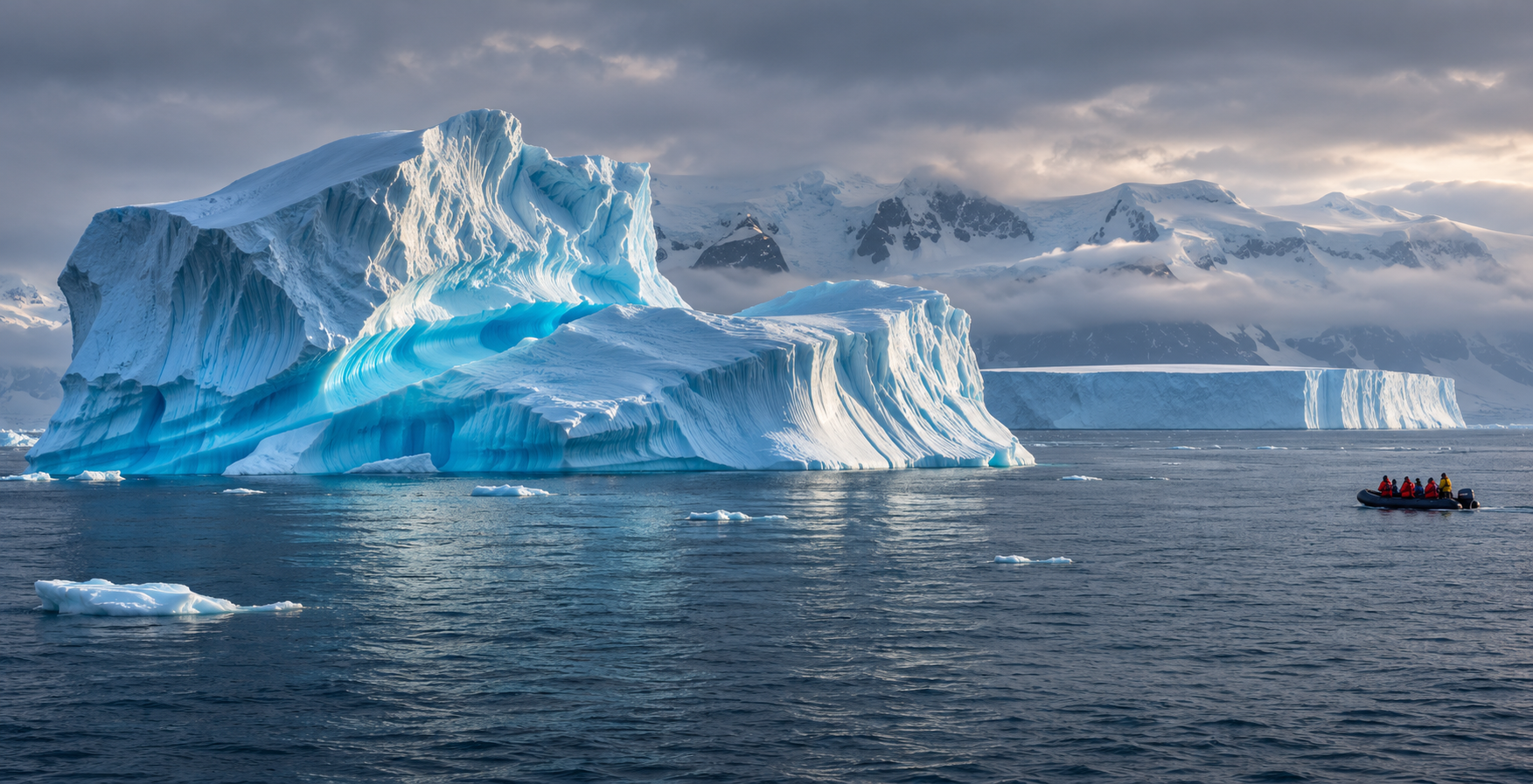
Start with the outline. Flat-topped, sheer-sided tabular icebergs typically calve from ice shelves, their faces resembling vertical cliffs. Their broad footprint and low center of gravity often make them stable, yet they still hide vast keels below the waterline. By contrast, domed or pinnacled bergs with irregular ridges usually break from glacier tongues or valley glaciers. Melt and wave action carve arches, gullies, and buttresses that look photogenic but hint at undercutting. Travel resources that explain routes, seasons, and the region’s breathtaking icebergs can help set expectations before you ever see your first tabular wall blaze gold at midnight light.
Size categories also matter on the water. “Bergy bits” and “growlers” are small fragments that ride low and can be hard to spot in chop; they can still jar a hull or foul a prop. Brash ice, the broken mix of small pieces, flows like a conveyor belt along wind or current lines and can quietly push a zodiac off its intended path. A common scenario: a smooth tabular face sits temptingly close in calm water while a stream of brash angles toward it. The smart choice is to admire the scale from a distance or choose a viewing angle that leaves you an escape route free of drifting fragments.
- Color Cues: Why Some Icebergs Glow Blue or Striped
Color reflects structure. Bright white surfaces scatter light because they contain countless air bubbles trapped during snowfall. Deep blue patches form where snow has compacted into dense glacial ice, squeezing out bubbles so longer wavelengths scatter less and blue dominates. You might also spot teal melt ponds or translucent blue rinds at undercut edges. On rare occasions, greenish tones appear in ice formed from supercooled seawater that froze under an ice shelf and later became part of the berg. The same shape can look different as clouds thin, sun angle changes, or fog drifts in, so watch the iceberg through passing light rather than taking one snapshot and moving on.
Photographically, this means avoiding one-size-fits-all settings. A camera meter looks at a white scene and tends to darken it; adding a touch of positive exposure compensation keeps whites from turning gray without losing blue detail. A polarizing filter can tame glare and reveal structure under the surface, but it can also mute reflections and over-darken seawater if rotated too far. Try bracketing a few frames, especially when backlit blue crevasses glow against a bright face. A shift of a few feet in boat position can change whether an arch reads as a flat hole or a three-dimensional curve with texture and depth.
Movement and Risk: Reading Wind, Current, and the Invisible Keel
Icebergs drift with current first, then wind steers them depending on how much of their mass sits above water. Tall, sail-like shapes catch more wind; low, broad tabs answer more to current. Meltwater streams on a face, plumes of brash peeling away, or a faint wake line can tell you which way an iceberg is moving. Popping sounds or fresh fractures near an undercut base signal active change. Rolling is most likely when melting shifts weight or large chunks calve off underwater, so asymmetrical pinnacles, recently collapsed arches, and heavily scalloped bases all deserve extra room. If the sea is pushing you toward a face, it is pushing the face toward you too.
Safe viewing is partly geometry. Guides position boats where wind and current will carry them away from the ice if the engine stalls, rather than toward it. That usually means avoiding the side where brash is piling up and giving a wide berth to downwind corners where loose pieces collect. Keeping the engine in neutral while drifting through brash can reduce the risk of pulling ice toward the prop. These choices trade closeness for control: you may not get an eye-level look at that luminous cave, but you will have time and space if the berg sheds a slab or the boat slews with a gust.
Wildlife on the Ice: Ethics and Viewing Without Disturbance
Seals and penguins use ice as rest stops, launch pads, and safe platforms. Weddell seals haul out on flat ledges; leopard seals sometimes patrol along brash lines where penguins porpoise; Gentoo or Adélie penguins hop onto low ramps before returning to the water. Noise, engine wake, and repeated close passes can alter these behaviors. Ethical viewing keeps enough distance that animals continue what they were doing before you arrived, and it avoids cutting across obvious travel paths between a berg and open water. If a seal lifts its head repeatedly to watch you rather than nap, or penguins bunch up at an edge, you are too close.
Birdlife offers more subtle tells. Snow petrels and Antarctic terns may roost on small shelves and spines, and guano stains can reveal favored perches even when birds are away. Avoid encircling a small berg with resting birds trapped in the middle; leave a clear exit line so they can take off without flying over your boat. Expedition teams follow wildlife-disturbance guidelines for good reason. Sharing those protocols with travelers before the first zodiac cruise helps people read the scene and choose the longer lens instead of the shorter distance.
Photographing Icebergs in Harsh Light and Weather
Antarctic light oscillates between matte overcast and mirror-bright sun. Midday can be flat, but it quickly turns dramatic when a ceiling lifts and rakes the ice with side light. To hold detail in high-contrast scenes, shoot RAW, watch the histogram, and protect highlights first. Gloves with grippy fingertips make dial changes quick, and a simple microfiber cloth beats back salt spray before it dries. Keep a spare battery warm in an inner pocket; cold saps charge faster than you expect. When re-boarding a warm ship, put your camera in a sealed bag so moist air cannot condense on cold glass; let it warm before opening.
Composition choices affect both safety and storytelling. Reflections are most mirror-like in sheltered water near ice, yet the same shelter can be close to an undercut face. A practical compromise is to step back and use a short telephoto to compress distance while keeping the boat in open water. Include a scale reference when possible: a distant zodiac, a line of brash, or birds gliding across a face. Lines help: melt channels lead the eye, and a diagonal ridge adds tension that a flat horizon lacks. If a polarizer kills the sheen you wanted, back it off to bring back the wet sparkle that defines the ice surface.
Reading ice is a habit built in small steps. Learn a few shapes, connect color with structure, and keep checking wind and current against the path you expect to take. The result is a richer experience and cleaner choices in the moment: staying on the side that carries you away, giving wildlife space to be themselves, and making pictures that show not only what an iceberg looks like, but what it is doing. Antarctica will still surprise you, but it will rarely catch you unprepared when you are watching the same cues the ice is giving to the sea and sky.