PMO Meaning Explained: What Does PMO Mean in Text, Business, and Social Media?
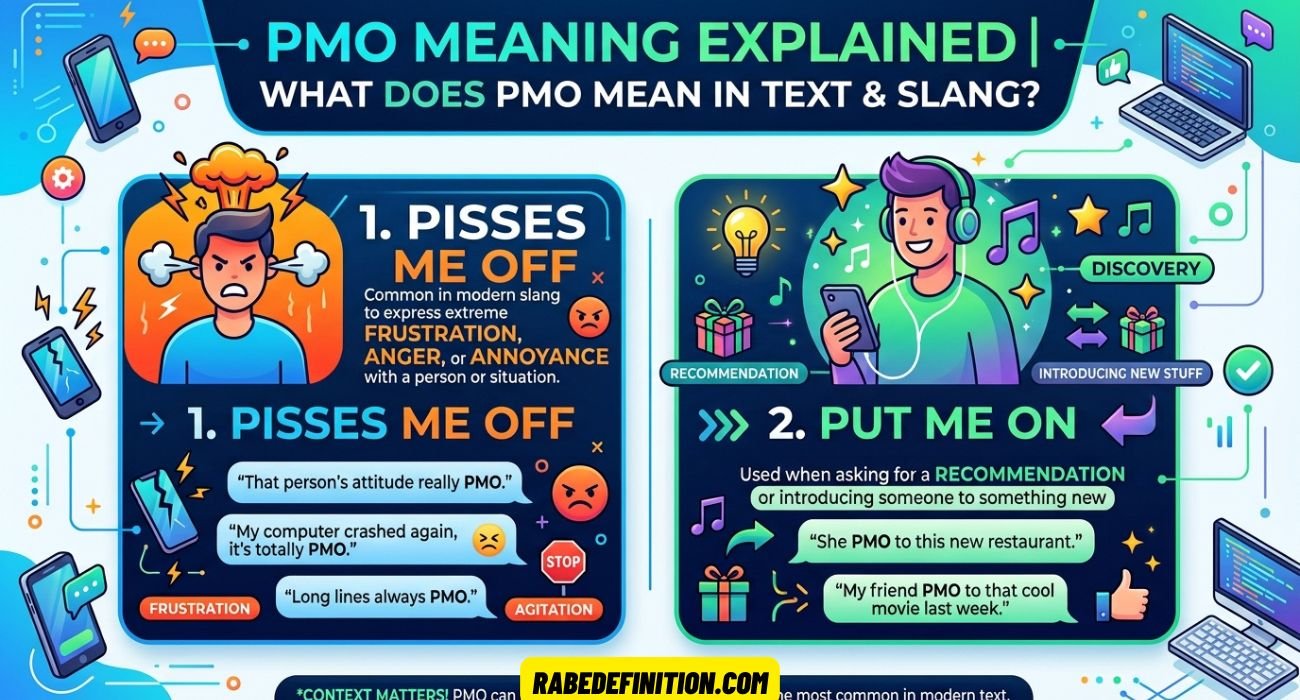
Seeing “PMO” in a text, comment, or work message can be confusing because the abbreviation has more than one meaning. In casual conversations, PMO often means “Put Me On,” while in a business setting, it commonly stands for “Project Management Office.” In some informal messages, it can also mean “Piss Me Off.”
So, what does PMO mean? The answer depends heavily on the context.
This guide explains the PMO meaning in texting, social media, and business, along with examples, common replies, alternative meanings, and tips for figuring out which definition someone intends.
Quick Answer
In texting and social media, PMO usually means “Put Me On.” It is used when someone wants a recommendation, introduction, or to be shown something new.
For example, “PMO to some good songs” means something like “Recommend some good songs to me.” If someone says “PMO to your barber,” they may be asking you to introduce or connect them with your barber.
In business, PMO usually means “Project Management Office,” a department, team, or organizational function that helps coordinate and standardize project work. In some casual conversations, PMO can also mean “Piss Me Off.”
TL;DR
- PMO = Put Me On is a common meaning in texting and social media.
- “Put Me On” can mean recommend something, introduce someone, or help someone discover something.
- PMO = Project Management Office is the common business and workplace meaning.
- In some informal messages, PMO can mean “Piss Me Off.”
- The surrounding words and context usually tell you which PMO meaning is intended.
What Does PMO Mean?
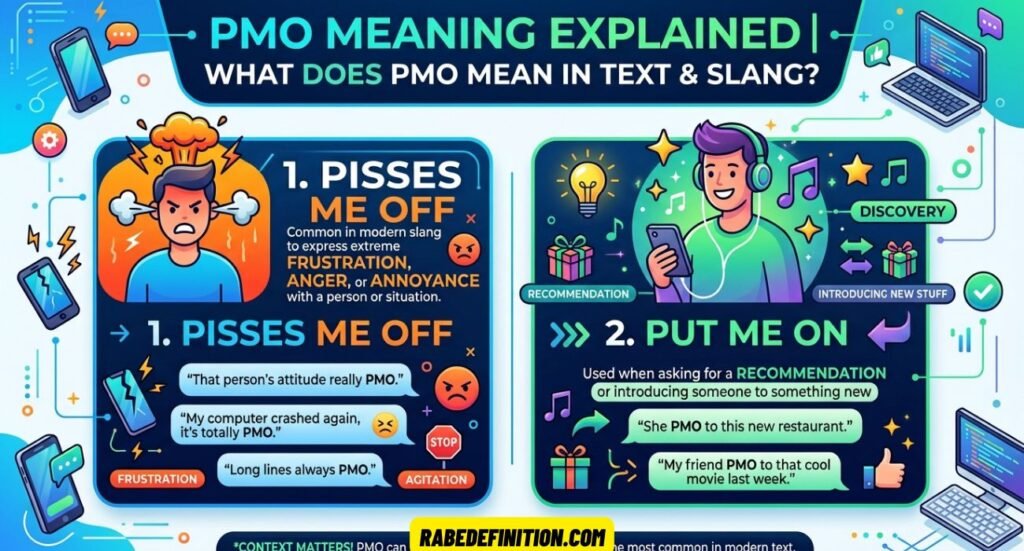
The meaning of PMO changes depending on the conversation.
In casual texting, PMO commonly stands for “Put Me On.” Here, “put me on” means introducing someone to something they do not know about or recommending something to them.
For example:
“You always know good restaurants. PMO.”
The person is essentially asking for a recommendation.
PMO can also be used when someone wants an introduction or connection:
“PMO to your friend who does photography.”
In this case, they want you to connect them with that person.
In a workplace or corporate environment, PMO generally stands for Project Management Office. This is very different from the slang meaning and relates to managing, supporting, and organizing projects.
There is also an informal interpretation of PMO as “Piss Me Off,” usually expressing annoyance or anger.
Because these meanings are so different, looking at the surrounding sentence is important.
PMO Meaning in Texting
The most useful PMO meaning to know in casual texting is “Put Me On.”
People use it when they want someone to recommend, introduce, or show them something. The phrase is informal and fits naturally into conversations between friends, followers, gaming communities, and other casual online groups.
You might see messages such as:
- “PMO to some new artists.”
- “Can you PMO to a good movie?”
- “PMO to your favorite coffee place.”
- “Who makes those? PMO.”
- “I need a new game. PMO.”
The tone is usually casual and friendly. Depending on the conversation, it can also sound curious, enthusiastic, or playful.
PMO is generally not something you would use in a formal email or professional document when you mean “Put Me On.” Writing out the request is clearer for people who may not recognize the abbreviation.
Common Uses and Situations
| Situation | What PMO Means |
|---|---|
| Asking for music | Recommend some music to me |
| Looking for a movie | Suggest a movie or show |
| Asking about a person | Introduce or connect me with them |
| Discovering a product | Tell me about or recommend it |
| Finding a restaurant | Recommend a place |
| Joining a community | Introduce me to the group or resource |
| Workplace discussion | Usually Project Management Office |
| Expressing frustration | Sometimes “Piss Me Off” |
The phrase “Put Me On” is flexible. It does not always mean a straightforward recommendation. Sometimes the person wants you to introduce them to a person, trend, community, style, or experience.
For instance, “PMO to that artist” could mean “Tell me who that artist is and show me their music.”
Real Texting Examples
Example 1: Music
Person A: Your playlist is always good.
Person B: Haha thanks.
Person A: PMO to some artists I should know.
Here, PMO means “Put Me On” and asks for music recommendations.
Example 2: Movies
Person A: I have nothing to watch tonight.
Person B: What kind of movies do you like?
Person A: Thrillers. PMO.
The speaker wants the other person to recommend some thrillers.
Example 3: Food
Person A: You said there are good taco places near you.
Person B: Yeah, there are a few.
Person A: PMO to the best one.
Here, PMO means “recommend one to me.”
Example 4: Meeting Someone
Person A: Who’s the guy you were talking about yesterday?
Person B: My friend Marcus.
Person A: PMO 😂
In this context, the person may be asking for an introduction or connection rather than a recommendation.
Example 5: Gaming
Person A: I need a new game to play.
Person B: What are you into?
Person A: Anything competitive. PMO.
PMO means “put me on to something” or “show me something you recommend.”
Example 6: Social Media Creator
Person A: I keep seeing this creator everywhere.
Person B: You should check out their videos.
Person A: PMO to their account.
The speaker wants to be directed to the creator’s account or content.
Example 7: Product
Person A: Those headphones look nice.
Person B: They’re actually pretty good.
Person A: PMO. What model are they?
Here, PMO means “tell me about them” or “put me onto them.”
See Also : What Does NTM Mean in Slang? Complete Guide to Texting
How to Reply to PMO
If someone uses PMO to mean “Put Me On,” your response depends on what they are asking about.
Casual response
“Sure, check out these three.”
Friendly response
“Absolutely. I’ve got a few recommendations for you.”
Short response
“Say less. I got you.”
Playful response
“You’re about to discover some good stuff 😂”
If they want an introduction
“Yeah, I can introduce you.”
If you are unsure what they mean
“PMO to what?”
That last response is useful when the message is too vague. Asking a quick follow-up is better than guessing.
Tone and Context
The PMO meaning can change significantly depending on the words around it.
| Context | Possible Meaning/Tone |
|---|---|
| “PMO to some songs” | Casual request for recommendations |
| “PMO to your friend” | Request for an introduction |
| “PMO this show” | Asking someone to recommend or explain it |
| “That PMO” | May mean “that pisses me off” |
| “The PMO reviewed it” | Likely Project Management Office |
| “PMO team meeting” | Professional/business meaning |
The surrounding words are often more useful than the abbreviation itself.
For example, “PMO to some restaurants” strongly points toward “Put Me On.” Meanwhile, “The PMO oversees project standards” clearly points toward “Project Management Office.”
When to Use It
Use PMO as “Put Me On” when you’re having an informal conversation with someone who is likely to understand internet or texting slang.
It works well for:
- Text messages
- Casual DMs
- Group chats
- Social-media comments
- Conversations with friends
- Informal online communities
Examples include:
“PMO to some good podcasts.”
“PMO to a good brunch spot.”
“PMO to some underrated artists.”
“PMO to a good gaming server.”
If the other person is unfamiliar with slang, simply saying “Can you recommend something?” may be clearer.
When Not to Use It
Avoid using PMO as “Put Me On” in situations where clarity and professionalism matter.
That includes:
- Formal business emails
- Job applications
- Academic assignments
- Official reports
- Client communications
- Professional presentations
For example, instead of writing:
“Can you PMO to some resources?”
in a formal email, write:
“Could you recommend some useful resources?”
There is an important distinction, however. PMO as “Project Management Office” is perfectly appropriate in professional settings when that is the intended meaning.
For example:
“The PMO will provide project governance and reporting.”
Here, PMO is not slang at all.
Social Media Usage
PMO can appear across social platforms in casual comments, DMs, group conversations, and posts. When used as slang, the basic idea remains “Put Me On.”
Snapchat
On Snapchat, PMO may appear in quick conversations between friends.
“PMO to a good place to eat.”
The sender wants a recommendation.
Instagram users may use PMO when asking about creators, products, locations, music, or other content.
“PMO to that photographer.”
This could mean “Introduce me to that photographer” or “Tell me how I can find them.”
TikTok
On TikTok, PMO may appear in comments when someone wants another user to recommend a creator, song, trend, product, or similar content.
“PMO to more accounts like this.”
The exact meaning should still be determined from the surrounding conversation.
In WhatsApp chats, PMO can function just like any other informal texting abbreviation.
“PMO to some good restaurants for Saturday.”
The sender is asking for recommendations.
Facebook and Messenger
PMO may also appear in casual Messenger conversations or comments, although the specific usage depends on the people and communities involved.
The important point is that PMO does not have a special universal social-media definition. Its meaning comes from how people use it in the conversation.
See Also : ICL Slang Meaning Explained Clearly 2026
Similar Terms and Comparisons
Some abbreviations and phrases overlap with PMO, particularly when someone is asking for recommendations or expressing frustration.
| Term | Meaning | Main Difference |
|---|---|---|
| PMO | Put Me On | Often asks for a recommendation or introduction |
| LMK | Let Me Know | Asks someone to provide information |
| IMO | In My Opinion | Used to express an opinion |
| IDK | I Don’t Know | Indicates uncertainty or lack of knowledge |
| FYI | For Your Information | Provides information rather than requesting it |
| Recommend | Suggest something | More explicit and generally clearer |
| PMO | Piss Me Off | Informal expression of annoyance in some contexts |
PMO and “recommend” can be similar, but “Put Me On” can have a broader social meaning. It may involve connecting someone with a person or community, not just suggesting an item.
Can PMO Also Mean “Piss Me Off”?
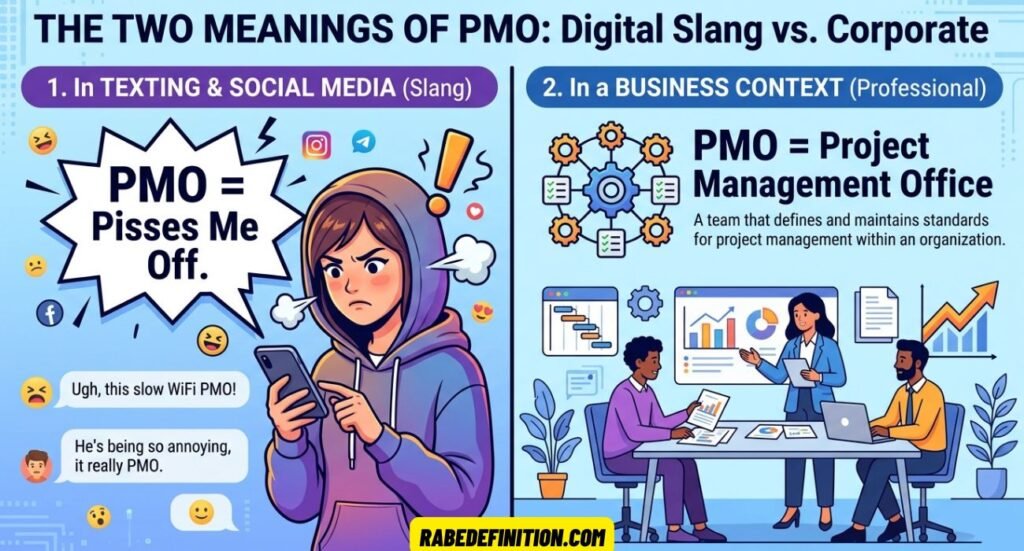
Yes. In some informal conversations, PMO can mean “Piss Me Off.”
This meaning usually relates to frustration or irritation.
For example:
“That really PMO.”
The intended meaning is roughly “That really pisses me off.”
Another example:
“People cutting in line PMO.”
Here, the speaker is expressing annoyance about people cutting in line.
The sentence structure helps distinguish this meaning from “Put Me On.”
Compare:
“PMO to some good restaurants.”
This is most naturally understood as “Put Me On.”
Versus:
“That really PMO.”
This can be understood as “Piss Me Off.”
Because “Piss Me Off” is vulgar slang, it is also more likely to appear in very casual conversations.
PMO Meaning in Business
In business, PMO commonly stands for “Project Management Office.”
A Project Management Office is an organizational function that helps projects operate in a more consistent and organized way. Depending on the company, a PMO may provide project standards, processes, reporting, governance, tools, templates, or support for project teams.
The exact responsibilities can vary from one organization to another.
For example:
“The PMO will review the project schedule.”
In this sentence, PMO has nothing to do with texting slang. It refers to the company’s Project Management Office.
Project Management Office
A Project Management Office can support an organization by creating common approaches to project work.
Its activities may include:
- Developing project-management processes
- Creating templates and guidelines
- Tracking project progress
- Supporting project managers
- Monitoring schedules and budgets
- Preparing project reports
- Coordinating information across projects
- Supporting governance and decision-making
Not every PMO operates in exactly the same way. Some are highly involved in individual projects, while others mainly provide standards and oversight.
Why Businesses Use a PMO
Companies may establish a PMO to bring greater consistency to project management.
When an organization has many projects running at the same time, it can become difficult to keep track of schedules, resources, risks, budgets, and priorities.
A PMO can provide a centralized framework for managing this work.
The goal may be to make project information easier to understand, improve coordination, and help leadership make informed decisions.
Types of Project Management Offices
Project Management Offices can take different forms depending on how much authority and control they have.
Three commonly discussed types are:
Supportive PMO
A supportive PMO mainly provides guidance, resources, templates, training, and best practices.
Project managers typically retain significant control over their projects.
Controlling PMO
A controlling PMO has a stronger role in ensuring that teams follow established processes and standards.
It may monitor compliance, reporting, documentation, and project-management practices.
Directive PMO
A directive PMO takes a more active management role. It may directly manage projects or assign project managers and establish how projects are executed.
The right structure depends on the organization’s size, project complexity, and management approach.
Roles and Responsibilities of a PMO
A PMO’s responsibilities vary between organizations, but common areas include:
- Project reporting
- Process standardization
- Resource coordination
- Risk and issue tracking
- Project governance
- Documentation
- Project-management support
- Performance monitoring
- Portfolio-level visibility
Some PMOs also help prioritize projects and coordinate resources across multiple teams.
The key idea is that a PMO provides organizational support around project work rather than simply being another name for an individual project manager.
Benefits of a Project Management Office
A well-designed PMO can help an organization create a more consistent approach to managing projects.
Key Benefits
Potential benefits include:
- Consistency: Teams can use shared processes and standards.
- Visibility: Leaders can get a clearer view of project progress.
- Coordination: Multiple projects can be managed with greater awareness of shared resources.
- Reporting: Standardized reporting can make project information easier to compare.
- Risk management: Common processes can help teams identify and track risks.
- Support: Project managers can gain access to templates, guidance, tools, and expertise.
The actual value of a PMO depends on how well its structure matches the organization’s needs. A PMO is not automatically effective simply because a company has one.
PMO vs Project Manager
A PMO and a project manager are related but different.
| PMO | Project Manager |
|---|---|
| Usually an organizational function or team | Usually an individual responsible for a project |
| May support multiple projects | Typically focuses on a specific project or set of responsibilities |
| Can establish standards and processes | Applies project-management practices to their project |
| May provide reporting and governance | Manages day-to-day project execution |
| Can support multiple project teams | Coordinates the people and work associated with the assigned project |
A project manager is generally responsible for managing a particular project, while a PMO can provide broader organizational support, standards, and oversight.
The exact division of responsibilities varies by company.
Other Meanings of PMO
Although “Put Me On,” “Project Management Office,” and “Piss Me Off” are important meanings to recognize, PMO can represent other phrases in specialized environments.
The safest approach is not to assume that every use of PMO refers to texting slang or project management.
If you encounter PMO in a technical, academic, financial, medical, or other specialized document, check the surrounding terminology or the document’s glossary.
For everyday internet conversations, however, the context will usually make the intended meaning clear.
How to Know Which PMO Meaning Someone Is Using
When you see PMO and are unsure what it means, look at the sentence around it.
1. Look for “to”
A phrase such as:
“PMO to some good books.”
strongly suggests “Put Me On.”
2. Look at the subject
If the message is about schedules, projects, budgets, reporting, or corporate processes, PMO may mean Project Management Office.
3. Look for frustration
If PMO appears in a sentence describing something annoying, it may mean “Piss Me Off.”
4. Consider the platform
A casual DM is more likely to involve slang, while a company report is much more likely to use the business definition.
5. Ask if necessary
If the meaning is genuinely unclear, simply ask:
“What do you mean by PMO?”
There is nothing wrong with asking for clarification when an abbreviation has multiple possible meanings.
Common Mistakes People Make About PMO
Assuming PMO always means “Put Me On”
This is one of the easiest mistakes to make when reading social-media slang. In a workplace document, PMO is much more likely to mean Project Management Office.
Assuming PMO always means “Piss Me Off”
The opposite mistake is also possible. Not every PMO is an expression of anger.
Ignoring the surrounding words
The words before and after PMO often provide the strongest clue.
Using slang in formal communication
Even if your friends understand PMO, a client, professor, manager, or unfamiliar reader may not.
Treating every PMO use as identical
“Put Me On” can mean recommending something, introducing someone, or helping someone discover something. Its exact sense depends on the conversation.
Why Does PMO Have Different Meanings?
PMO can mean different things because abbreviations often develop separate meanings in different communities. In texting, “Put Me On” is used when someone wants a recommendation or introduction, while in business, PMO usually refers to a Project Management Office. The sentence and situation usually make the intended meaning clear.
When PMO appears in casual conversations, the meaning can also depend on tone. For example, “PMO to some good songs” is a request for recommendations, while “That really PMO” may express frustration. Checking the words around the abbreviation is the easiest way to avoid confusion.
PMO Meaning in Casual Conversations
In casual conversations, PMO is commonly used as a short way to say “Put Me On.” Someone might use it when asking a friend to recommend a movie, introduce them to someone, share an artist, or show them something interesting. It keeps the conversation quick and informal.
The meaning can also shift slightly depending on what follows PMO. A message like “PMO to some new music” asks for recommendations, while “PMO to your friend” can mean asking for an introduction. In either case, the overall idea is getting connected with something or someone new.
PMO in Online Chats and Group Conversations
PMO can appear in group chats, online communities, gaming servers, and private messages. People may use it when they want others to recommend games, creators, music, restaurants, products, or other things they are interested in. Its short format makes it convenient for fast-moving conversations.
For example, someone might write, “PMO to some good games,” and expect other members to share their favorites. Because group conversations can include people from different backgrounds, however, not everyone will interpret PMO the same way. Context is still important.
Is PMO Still Commonly Used?
PMO is still recognizable in informal online communication, but not everyone uses or understands it in exactly the same way. Younger internet users may encounter “Put Me On” in social posts and messages, while professionals are more likely to know PMO as “Project Management Office.”
If you’re using PMO with someone who may not know the abbreviation, spelling out the phrase can prevent confusion. In formal communication, using the complete expression is usually the clearer option.
FAQ
What does PMO mean in texting?
In texting, PMO commonly means “Put Me On.” It usually asks someone to recommend or introduce the sender to something or someone.
What does PMO stand for?
PMO can stand for several phrases. In casual texting, it often means “Put Me On.” In business, it commonly means “Project Management Office.” In some informal messages, it can mean “Piss Me Off.”
What does PMO mean on social media?
On social media, PMO often means “Put Me On.” Someone may use it when asking for recommendations, introductions, accounts, creators, music, products, or other discoveries.
Is PMO slang?
Yes, when PMO is used as “Put Me On” or “Piss Me Off,” it is informal slang. PMO as “Project Management Office” is a professional business abbreviation.
Is PMO rude?
It depends on which meaning is intended. “Put Me On” is generally casual rather than rude. “Piss Me Off” contains vulgar language and can sound aggressive or frustrated.
How do you respond to “PMO”?
If someone means “Put Me On,” you can respond with a recommendation, introduction, or suggestion. For example, “Sure, check out this artist” or “Yeah, I can introduce you.”
What does PMO mean in business?
In business, PMO commonly means Project Management Office. It is a function or team that can support project-management processes, standards, reporting, governance, and coordination.
What is the difference between PMO and a project manager?
A project manager generally manages a particular project, while a PMO is an organizational function that can support multiple projects and establish project-management standards or governance.
Can PMO mean “Piss Me Off”?
Yes. In some informal conversations, PMO is used as an abbreviation for “Piss Me Off,” particularly when someone is expressing frustration.
How can I tell which PMO meaning is intended?
Check the surrounding words and the setting. “PMO to some songs” likely means “Put Me On,” while “The PMO reviewed the project” likely means “Project Management Office.” A sentence about something being annoying may indicate “Piss Me Off.”
Conclusion
The PMO meaning depends on where and how the abbreviation is used. In casual texting and social media, PMO most commonly means “Put Me On,” usually as a request for a recommendation or introduction. In business, PMO usually means “Project Management Office,” while some informal conversations use it to mean “Piss Me Off.”
When you’re unsure, don’t rely on the abbreviation alone. Look at the surrounding words, the tone, and the setting. That context will usually tell you which PMO meaning the sender intended.