Best Reply to SUP and Its Meaning: What Does “Sup” Mean?
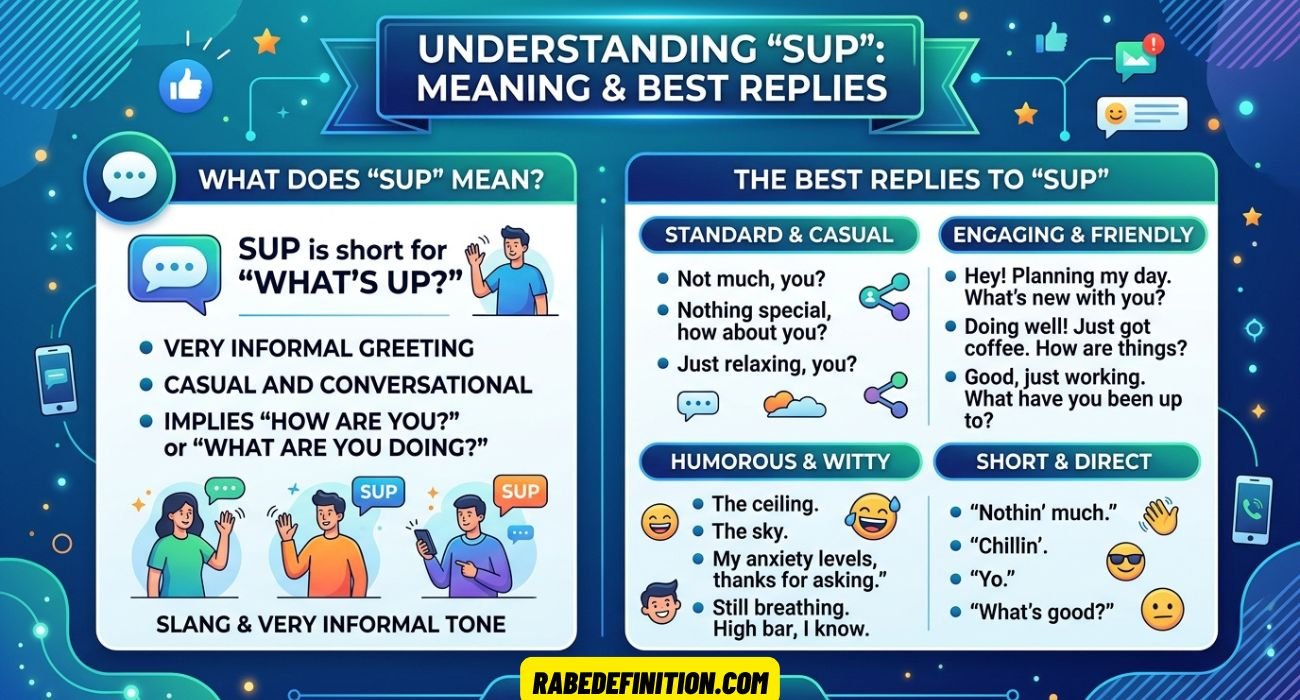
If someone texts you “sup,” they are usually asking a very casual version of “What’s up?” or “What are you doing?” It is a short, informal way to start a conversation without making the message sound serious or formal.
The best reply to SUP and its meaning depends on who sent it and what kind of conversation you want to have. A friend might get a funny response, while a crush could get something playful or flirty. A coworker may call for a more neutral answer.
Below, you’ll find the meaning of “sup,” realistic texting examples, different ways to respond, and tips for understanding the tone behind this simple three-letter message.
Quick Answer
“Sup” means “What’s up?” It is an informal greeting commonly used in texting, messaging apps, social media, and casual conversations.
When someone texts “sup,” they may simply be checking in, asking what you are doing, or looking for an easy way to start chatting. A natural response could be “Not much, you?”, “Just chilling. What’s up?”, or something more playful depending on the relationship.
There is no single best response to “sup.” The right reply depends on your relationship with the sender and whether you want to keep the conversation going.
TL;DR
- “Sup” is short for “What’s up?”
- It is casual and informal, especially common in texting and online chats.
- A simple reply is “Not much, you?”
- With a friend, you can be funny or relaxed.
- With a crush, a playful or flirty response can work.
- With a coworker, keep your reply friendly and appropriate.
What Does “Sup” Really Mean?
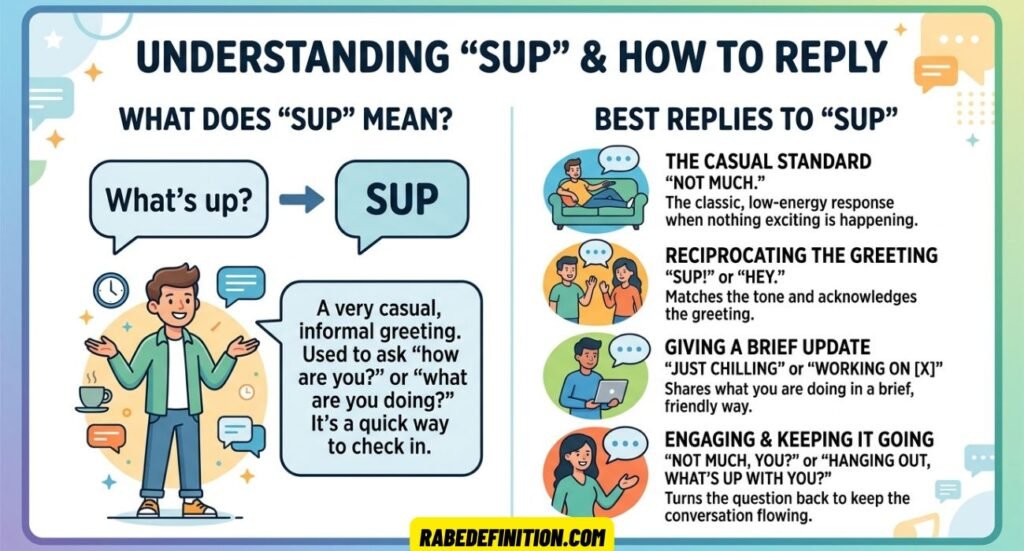
“Sup” is a shortened form of “What’s up?” It functions mainly as a casual greeting or conversation opener.
Depending on the situation, “sup” can mean slightly different things:
- “What’s up?”
- “How are you?”
- “What are you doing?”
- “What’s going on?”
- “Are you free to talk?”
Unlike a formal question such as “How are you doing today?”, “sup” is quick and low-pressure. The sender may not be looking for a detailed answer at all.
Is “Sup” Formal or Informal?
“Sup” is informal. It works naturally between friends, peers, classmates, romantic interests, and other people who already communicate casually.
It generally would not be the right choice for a formal email, academic paper, job application, or serious professional message.
“Sup” in Texting
In texting, “sup” is often less about the literal words and more about opening a conversation.
For example:
Person A: Sup?
Person B: Not much, just got home. You?
Here, “sup” is essentially an invitation to talk.
The tone can also depend on what comes before or after it. Someone who normally sends detailed messages might use “sup” as a particularly casual check-in. Someone who regularly uses slang may send it without any deeper meaning.
It can be:
- Casual: “Sup?” between friends
- Friendly: A quick check-in with someone you know
- Playful: An opening for jokes or teasing
- Flirty: A low-key way for a crush to start talking
- Neutral: Simply asking what you are doing
- Low-effort: A very short message with little context
The word itself does not automatically tell you the sender’s intention. The relationship and surrounding conversation matter.
Common Situations Where People Use “Sup”
| Situation | What “Sup” Usually Means |
|---|---|
| Close friend | “What’s going on?” |
| New acquaintance | “Hey, how are you?” |
| Crush | “Hey, want to talk?” |
| Group chat | “What’s everyone doing?” |
| Gaming chat | “What are you up to?” |
| Social media DM | Casual conversation opener |
| Coworker | Informal “What’s up?” |
| Someone you rarely talk to | A casual attempt to reconnect |
Between Friends
Friends often use “sup” because there is no need for a formal greeting. A simple response can naturally turn into a longer conversation.
In Dating or Flirting
When a crush sends “sup,” it may simply be their way of getting your attention. It can be an opening for flirting, but you should not automatically interpret it as a romantic confession.
In Online Chats
“Sup” fits naturally into fast-moving conversations on messaging platforms, gaming communities, and social media.
Real Texting Examples
Example 1: Casual Friend
Alex: Sup?
Jordan: Just watching the game. You?
The reply answers the question and gives Alex an easy topic to continue with.
Example 2: Close Friends
Maya: Sup 😂
Chris: Trying to decide what to eat. You got any suggestions?
Here, the response turns a basic greeting into a conversation.
Example 3: Crush
Sam: Sup?
Taylor: Not much. Was actually wondering when you were going to text me 😉
The reply is playful without being excessively direct.
Example 4: Busy
Jamie: Sup?
Morgan: Hey! I’m in the middle of something right now. Everything okay?
This keeps the response polite while making it clear that you may not be available.
Example 5: Funny
Drew: Sup?
Casey: Mostly the ceiling. You?
This deliberately takes “what’s up” literally for a joke.
Example 6: Coworker
Taylor: Sup?
Chris: Hey! Just wrapping up a project. What’s going on?
This keeps the tone friendly without becoming overly casual.
Example 7: Reconnecting
Jordan: Sup? Long time no talk.
Alex: Hey! Not much. How have you been?
Here, the second message makes it clear that the sender is trying to reconnect.
How to Reply to “Sup”
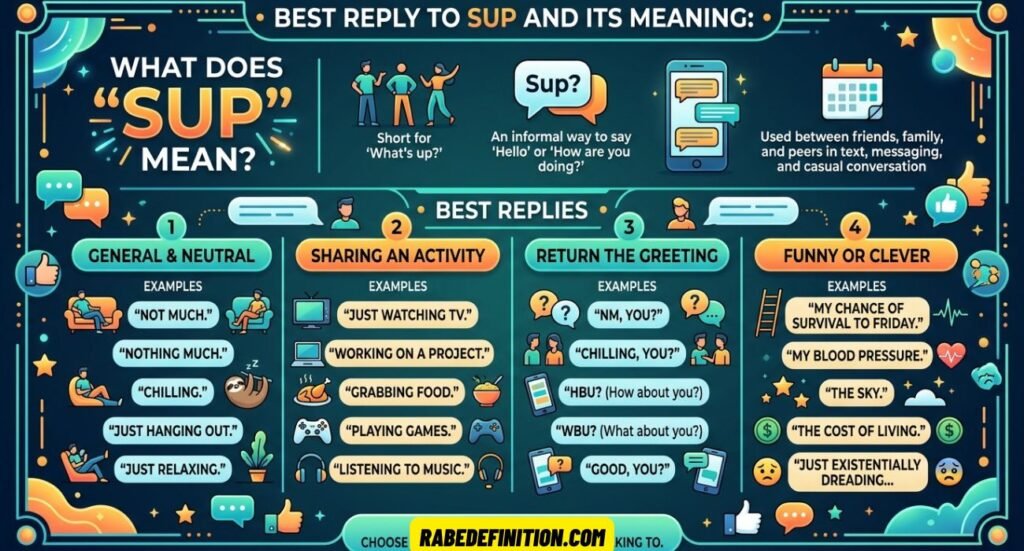
The best way to respond is to match the situation rather than searching for one perfect line.
Casual Response
Try:
- “Not much, you?”
- “Just chilling. What’s up?”
- “Nothing crazy. What are you doing?”
- “Doing good. You?”
These are easy, natural answers when you simply want to keep things relaxed.
Friendly Response
If you want to sound more interested:
- “Hey! Just finished dinner. How’s your night going?”
- “Not much! What have you been up to?”
- “Just relaxing. How’s your day been?”
Adding a small detail gives the other person something to respond to.
Funny or Playful Response
If humor fits your relationship:
- “The ceiling, apparently.”
- “Surviving 😂 You?”
- “A surprisingly long list, actually.”
- “Waiting for you to say something interesting.”
A funny reply works best when you already know the person’s sense of humor.
Flirty Response
If the message comes from someone you like:
- “Not much… now you have my attention 👀”
- “Better now that you texted.”
- “Depends. Are you planning to make my night interesting?”
- “Nothing much. What did you have in mind?”
Flirting is most effective when it feels natural rather than overly scripted.
See Also : IGHT Mean in Text: What Does IGHT Mean in Texting?
Understanding the Real Meaning Behind “Sup”
It is easy to overthink a message as short as “sup.” In most cases, it is simply a casual greeting.
Still, the message can carry different intentions.
Someone might send “sup” because they:
- Want to start talking
- Are checking whether you are available
- Have not spoken to you recently
- Are bored and looking for conversation
- Want to ask you something
- Are casually checking in
- Are interested in reconnecting
If a crush sends “sup,” there may be an opportunity for conversation, but the message alone is not enough to establish romantic interest.
Look at the broader pattern instead: how they normally talk to you, what they say afterward, and whether they actively keep the conversation going.
How to Reply to “Sup” from Friends or Peers
With friends and peers, you generally have more freedom to be casual.
Some natural replies include:
- “Not much! What’s good?”
- “Just hanging out. You?”
- “Same old stuff 😂 What are you doing?”
- “Nothing exciting yet. Got plans?”
- “Just got home. What’s up with you?”
If you want the conversation to continue, avoid answers that completely close the door, such as simply “nothing.”
Instead, add a detail or question:
“Nothing much, just making dinner. You eaten yet?”
That small change creates another direction for the conversation.
Flirty and Fun Replies for “Sup” from a Crush
When your crush texts “sup,” you can keep your answer light and confident.
Subtle Flirting
- “Not much. What made you think of me?”
- “Just relaxing. What about you?”
- “I was wondering when you’d show up.”
Playful Flirting
- “Is that your smooth way of saying hi?”
- “That’s all I get? ‘Sup?’ 😂”
- “You can do better than that.”
More Direct
- “Nothing much. Want to change that?”
- “I’m free if you’re looking for someone to talk to.”
- “Now that you’re here, what’s the plan?”
The key is to match the energy. If their message is extremely casual, a highly dramatic response may feel out of place.
Why Tone and Context Matter in Texting
Text messages do not include facial expressions or voice tone, so short words can sometimes be interpreted differently than intended.
Consider these two messages:
“Sup.”
and
“Sup 😂”
The first may feel more neutral or dry. The second has a lighter feel because of the laughing emoji.
Context also matters. If a friend sends “sup” after you mentioned having a difficult day, they may be checking in. If a stranger sends it at random, they may simply be starting a conversation.
| Context | Possible Tone |
|---|---|
| Close friend | Relaxed |
| Crush | Playful or potentially flirty |
| Coworker | Casual and friendly |
| Stranger | Conversation starter |
| After an argument | Potentially cautious or uncertain |
| Group chat | General check-in |
These are possibilities, not fixed rules. The surrounding messages usually provide better clues than “sup” by itself.
Turning “Sup” Into a Real Conversation
A message like “sup” does not have to lead to a boring exchange.
One useful approach is:
Answer + Detail + Question
For example:
“Not much, I just tried that new coffee place downtown. Have you been there?”
This works better than:
“Nothing. You?”
because it introduces a topic.
Share Something Real
Tell the person a small, genuine detail about what you are doing.
For example:
- “Just finished a workout.”
- “I’m cooking dinner.”
- “I just got back from the store.”
- “I’m watching a new series.”
- “Trying to figure out my weekend plans.”
Small details can naturally create new topics.
Ask Something Specific
Instead of only asking “you?”, try a question that requires a little more thought:
- “What are you doing tonight?”
- “How did your test go?”
- “Did you end up going to that concert?”
- “What are you watching lately?”
- “Any plans for the weekend?”
Specific questions make it easier to build an actual conversation.
Use Media or Humour
If you are chatting with someone you know well, a meme, GIF, photo, or funny reaction can make the exchange more lively.
For example:
Friend: Sup?
You: Sends a picture of your disastrous attempt at cooking
You: “Apparently I’m not ready for MasterChef.”
This gives the other person something concrete to react to.
See Also : Skull Emoji Meaning: What Does Mean in Texting?
Why Do People Even Text “Sup”?
“Sup” is convenient because it takes almost no effort to type. It also feels less formal than “How are you?”
For many casual conversations, there is no need for a long greeting. “Sup” gets straight to the point: Are you around, and do you want to talk?
It can also be useful when someone wants to reconnect but does not know exactly how to begin.
Instead of writing a long message explaining why they are reaching out, they can simply send “sup” and see how you respond.
When to Use “Sup”
Use “sup” when the conversation is informal and the person is likely to understand casual slang.
It can work well with:
- Friends
- Close classmates
- Peers
- People you regularly text
- Gaming friends
- Casual social media contacts
- Someone you are dating
If the other person already uses casual language, “sup” will usually fit naturally into the conversation.
When Not to Use “Sup”
Because “sup” is informal, it is not a universal replacement for “How are you?” or “What’s up?”
Avoid it when a more professional tone is expected, such as:
- Formal emails
- Job applications
- Cover letters
- Academic writing
- Formal business correspondence
- Messages to senior professionals you do not know well
For example, instead of:
“Sup, just checking on the meeting.”
a workplace message could be:
“Hi, I wanted to check whether the meeting is still scheduled for today.”
The issue is not that “sup” is inherently rude. It is simply very casual and may not match the situation.
“Sup” on Social Media
“Sup” can appear in casual direct messages and conversations across social platforms and messaging services.
On Snapchat or Instagram, someone might send “sup” as a quick way to begin a DM.
On WhatsApp or Messenger, friends may use it as a casual check-in.
In group chats, “sup” can mean something like “What is everyone doing?” or simply serve as a way to get the conversation moving.
The exact platform does not fundamentally change the definition. The social context is more important.
Similar Terms and Comparisons
| Term | Meaning | Main Difference |
|---|---|---|
| Sup | What’s up? | Very short and casual |
| What’s up? | What is happening / how are you? | More complete phrase |
| Wsup | What’s up? | Text-style variation |
| Yo | Casual greeting or attention-getter | Can be even broader in meaning |
| Hey | General greeting | Does not specifically ask what is happening |
| How are you? | Asking about someone’s well-being | More direct and slightly more formal |
“Sup” vs. “What’s Up?”
These are essentially the same expression in meaning. “Sup” is simply shorter and more informal.
“Sup” vs. “Hey”
“Hey” is primarily a greeting. “Sup” usually carries the additional idea of asking what the other person is doing or what is going on.
“Sup” vs. “Yo”
Both are casual, but “yo” can function simply as an attention-getter. “Sup” more directly resembles “What’s up?”
Other Meanings of “Sup”
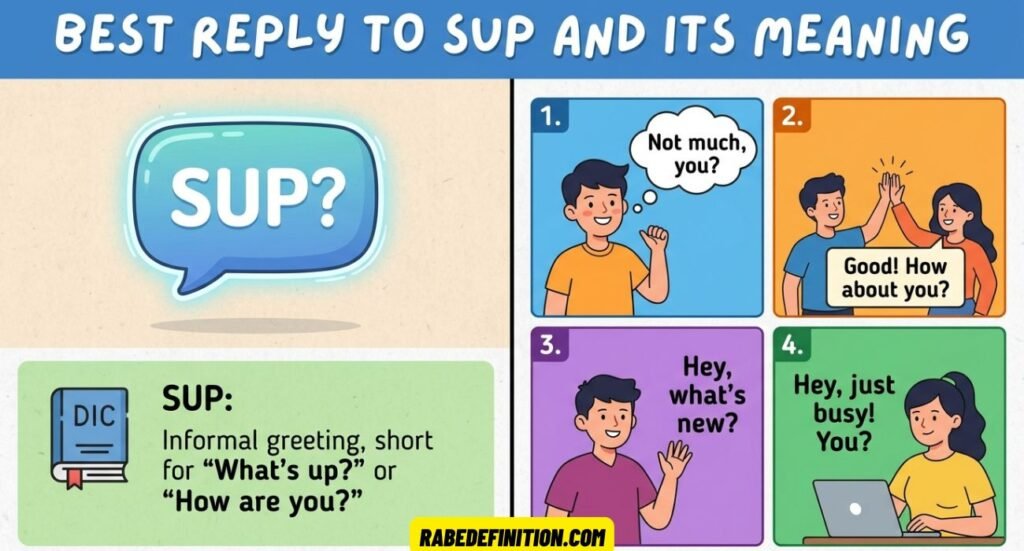
In ordinary texting, “sup” most commonly refers to “what’s up?” However, abbreviations can have different meanings in specialized settings.
For example, an abbreviation may mean something entirely different in a technical, organizational, or professional context. That is why the surrounding conversation matters.
If you see “sup” in a casual text such as:
“Sup? You free tonight?”
the intended meaning is clearly the informal greeting.
A specialized meaning would only become relevant if the surrounding subject makes it clear that “SUP” is being used as an acronym for something else.
Common Mistakes When Replying to “Sup”
1. Overthinking the message
A short “sup” does not necessarily hide a complicated message. It is often just a casual opener.
2. Giving a dead-end answer
“Nothing.”
is technically a response, but it gives the other person very little to work with.
3. Being too formal
Replying to a close friend with an overly formal message can make a simple conversation feel awkward.
4. Assuming it is automatically flirty
A crush sending “sup” might be interested in talking, but the word alone does not prove romantic intent.
5. Using a response that does not match the relationship
A sarcastic reply may work with your best friend but sound rude to a coworker or new acquaintance.
See Also : lushed Face Emoji Meaning: What Does Mean in Texting?
Best Short Replies to “Sup” When You Want to Keep It Simple
Sometimes you do not need a clever or flirty response to “sup.” A short answer like “Not much, you?” or “Just chilling, what’s up?” works perfectly when you want to keep the conversation relaxed. These replies acknowledge the message without making the exchange feel forced or overly formal.
If you want to give the conversation a little more direction, add one small detail about what you are doing. Saying “Just got home from work. You?” gives the other person more to respond to than simply saying “nothing.” The best short reply to “sup” is usually one that sounds natural for the way you normally text.
Funny Replies to “Sup” That Can Start a Conversation
A funny response can turn a basic “sup” into something more memorable. You could answer with something unexpected like “The ceiling, apparently,” or “Currently accepting questions.” These playful replies work especially well with friends or people who already understand your sense of humor.
The goal is not to force a joke into every conversation. If the sender is being casual, a lighthearted response can make it easier to continue chatting. You can also combine humor with a question, such as “Trying to figure out dinner 😂 What are you eating?” This gives the conversation somewhere to go.
What to Say After Someone Replies to Your “Sup”
If you are the person who sent “sup,” the conversation should not stop after the other person answers. Their response can give you a clue about what they want to talk about. If they say, “Just watching a movie,” you can ask what they are watching or whether they recommend it.
Try to build on something specific instead of repeatedly sending short messages. For example, if they say, “Just got back from the gym,” you could respond with “Nice! What did you work out today?” Showing genuine interest makes the conversation feel more natural than simply sending another “sup.”
How to Make Your Reply to “Sup” Sound Natural
The best response does not have to be the funniest, smartest, or most creative one. It should sound like something you would actually say. If you normally text casually, a simple “Not much, what’s good?” may work better than a carefully crafted line that feels unlike you.
Think about who sent the message, what your relationship is like, and whether you want the conversation to continue. A natural reply can be as simple as “Just relaxing. How’s your day going?” When your answer matches the existing tone, it is much less likely to feel awkward or scripted.
FAQ: Best Reply to SUP and Its Meaning
What does “sup” mean in texting?
“Sup” is a shortened, informal form of “What’s up?” It usually works as a casual greeting or conversation opener.
What is the best reply to “sup”?
A simple option is “Not much, you?” If you want to encourage conversation, add a detail, such as “Just got home from work. What are you up to?”
How do you respond to “sup” from a crush?
You can keep it casual or add a little flirtation. For example: “Not much… now you have my attention 😉”
Is “sup” rude?
Not usually. “Sup” is generally casual rather than rude. However, its very informal style may feel inappropriate in a formal or professional situation.
What does “sup” mean from a guy or girl?
The basic meaning is the same: “What’s up?” The person’s gender does not change the definition. Their relationship with you and the surrounding conversation are more useful clues to their intention.
What should I reply to “sup” if I like the person?
Try giving them an opening to continue: “Not much. What are you up to tonight?” A playful response can also work if flirting fits your relationship.
Can I use “sup” at work?
It depends on the workplace and the relationship. It may be fine in a very casual team chat, but a more conventional greeting is safer for formal workplace communication.
What is the difference between “sup” and “what’s up”?
They have essentially the same meaning. “Sup” is the shorter, more informal version.
What does “sup” mean on social media?
On social media, “sup” generally means “What’s up?” and is commonly used as a quick way to start a casual conversation.
Final Thoughts on the Best Reply to “Sup”
The best reply to SUP and its meaning is simple: “sup” usually means “What’s up?” and is used as an informal way to start a conversation.
Your response should match the person and the situation. With a friend, keep it relaxed or funny. With a crush, you can add some playful energy. With a coworker or acquaintance, a friendly and neutral response is usually better.
If you want the conversation to go somewhere, don’t just answer the greeting—give the other person something to respond to. A small detail, specific question, or bit of humor can turn a three-letter message into a real conversation.