NTY Meaning in Text: What Does NTY Mean in Texting?
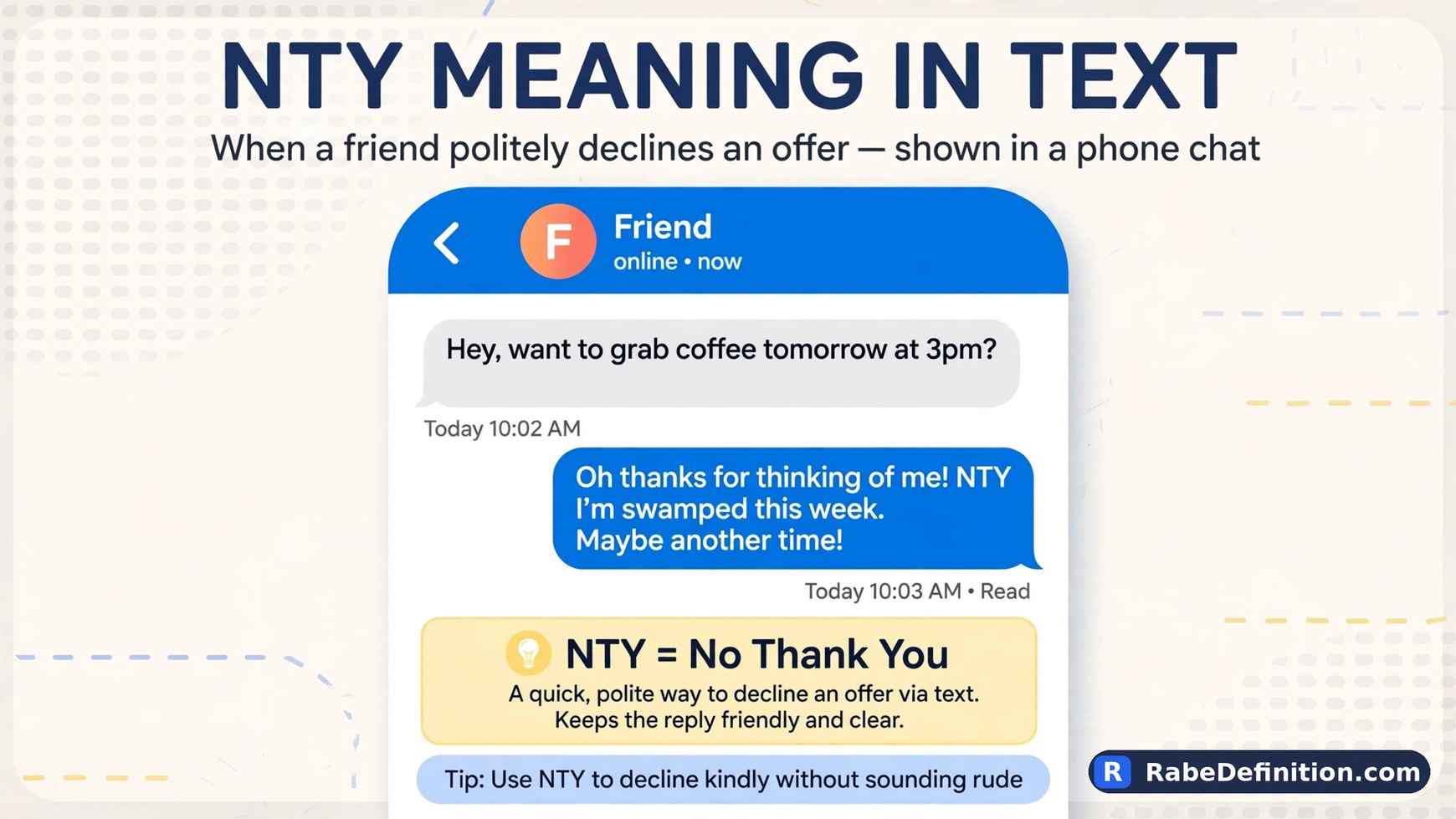
If a friend replies to your message with just three letters, you may find yourself looking up the nty meaning in text before answering. NTY stands for “no thank you,” a short way to turn something down in a chat. People type it to decline an offer or invitation without writing the full phrase.
You will see NTY most often in casual texts between friends, group chats, and quick replies on social apps. On its own it is polite, because the “thank you” is built right into it. Still, a bare “nty” can feel a little flat, so many people add a short reason or an emoji to keep the tone warm.
This guide walks through what NTY means and how people use it in everyday chats. You will see real examples, learn how it compares with replies like “nah” and “np,” and find out when it fits and when it does not. By the end, you will also know how to reply when someone sends it to you.
What Does NTY Mean?
NTY means “no thank you.” It’s a short texting abbreviation used to politely decline an offer, invite, or request in a chat. Instead of typing the full phrase, people send three letters and move on.
It fits almost any casual moment where a quick no is needed — a friend offering the last slice of pizza, a group chat planning a night out, someone asking you to join a game. Each time, it gives a clear answer with a polite edge that a plain “no” lacks.
Simple Meaning (In Plain Words)
Think of NTY as the written version of smiling, shaking your head, and saying, “I’m good, thanks.” It refuses the offer but still shows appreciation — that built-in thank-you is the whole point of the abbreviation.
Because it’s so short, NTY works best when the offer is small and casual. Turning down a snack, a ride, or one more round of a game feels natural with three letters. Bigger moments, like declining a thoughtful gift, usually deserve a full sentence instead.
Unlike the heavy drama of KMS, NTY refuses gently.
Where Is NTY Used?
You’ll run into NTY anywhere people type fast and keep things informal. Text messages and group chats are its natural home, and it shows up constantly in gaming chats, where players decline invites, trades, or rematches in seconds. It also appears in marketplace chats, where buyers pass on prices they don’t like.
NTY stays out of formal writing. Work emails and anything official call for the full “no, thank you” instead. Workplace chats full of short forms like HBS still spell this one out.
NTY on Social Media
On social media, NTY pops up in comment replies, story responses, and direct messages. Someone might answer a follower’s suggestion with “nty, not my style,” or decline a collaboration request in the DMs the same way. Polls and question stickers get it too, when a quick no is all that’s needed.
Public posts are where tone matters most. A bare “nty” under someone’s post can look dismissive to readers who don’t know the relationship behind it. A word or two of context keeps it friendly for everyone watching. The same public threads where a warm gn closes the night deserve that care.
Why Do People Use NTY?
Speed is the main reason. “No thank you” takes eleven letters plus a space; “nty” takes three. In a fast-moving group chat, that difference adds up, and people reach for it without thinking twice.
It also softens the refusal. A flat “no” can feel abrupt in writing, where the reader can’t hear your voice. NTY keeps some warmth because the gratitude is part of the phrase itself, and it closes the topic without a long explanation nobody asked for.
Real-Life Examples Of NTY In Use
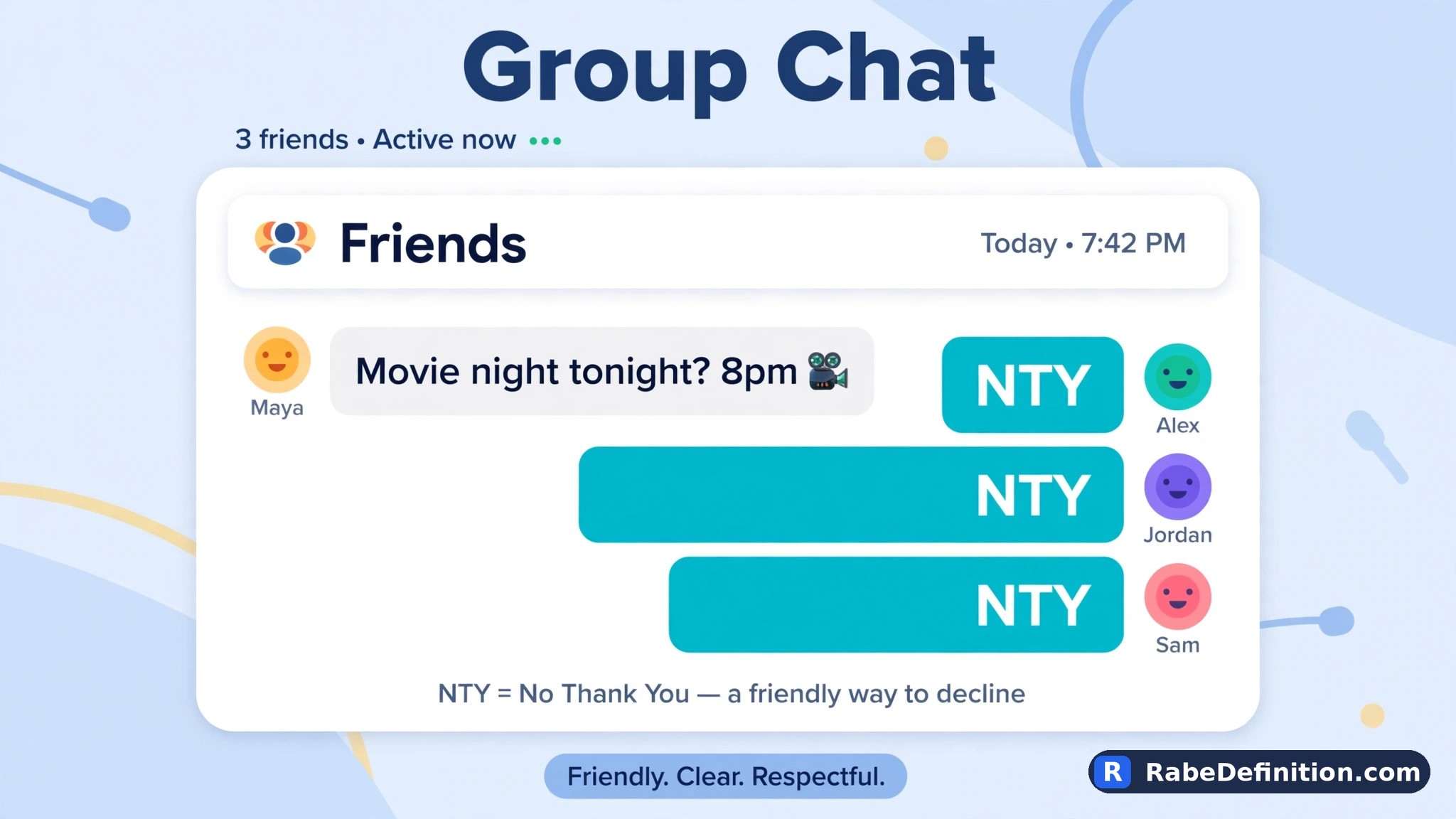
Maya’s roommate holds up a bag of chips and types, “want some?” Maya answers, “nty, just had lunch.” Simple, friendly, done.
In a family group chat, an aunt offers extra concert tickets. Her nephew replies, “nty this time, saving for my trip” — passing politely, not ignoring her.
Two friends are mid-game when one asks, “one more match?” The other writes “nty, gotta study” — a quick no that still sounds appreciative.
Now compare a dating app message. A match suggests a phone call right away, and the reply is just “nty.” With nothing after it, the same letters feel noticeably colder.
How to Reply to NTY
When someone sends you “nty,” the best reply is short and easygoing. A simple “no worries” or “sounds good” accepts it without making a big deal. No need to ask why, unless the offer actually mattered to you.
If the plan still needs people, ask someone else rather than pushing. If their “nty” came with a reason, like being busy or tired, a quick “next time then” keeps the door open. Never answer a polite pass with a shocked NFW.
NTY vs Similar Terms
| Term | Full Form | How It Feels | Best Used For |
|---|---|---|---|
| NTY | No thank you | Polite and casual | Declining offers and invitations |
| Nah | No | Blunt and very casual | A fast no between close friends |
| TY | Thank you | Grateful | Accepting or appreciating something |
| NP | No problem | Easygoing and reassuring | Answering thanks or a small apology |
| IDC | I don’t care | Indifferent | Showing the choice doesn’t matter to you |
The easy way to remember it: NTY is the only one here that says no and thanks at once.
When Should You Use NTY?
NTY fits when the offer is casual, the chat is informal, and the other person knows texting shorthand. Declining food, skipping an optional plan, or passing on a game invite are all natural spots for it. It also works when you want to say no once, clearly, without a long explanation.
Spell the words out instead for someone older, someone you don’t know well, or any formal setting. Serious conversations deserve full sentences too. If a friend is sharing something emotional, a three-letter reply can look careless even when you don’t mean it that way. When either choice is fine, an IDM answer fits better than a refusal.
What Does NTY Mean From a Guy or a Girl?
The letters mean the same thing no matter who sends them: a plain “no thank you.” Guys and girls alike use NTY to pass on offers in everyday chats, with no hidden code based on who typed it.
What people sometimes read into it is interest or distance, especially in dating chats. A quick “nty, maybe next weekend” is a pass with the door left open. A lone “nty” may just mean the person is busy, so judge the whole conversation, not three letters.
Common Misunderstandings About NTY
The biggest mix-up is assuming NTY means the sender is annoyed. Most of the time it doesn’t — the person is just declining quickly, the way they’d say “I’m good” out loud. Short answers are normal in texting, not a sign of attitude.
Another common mistake is reading NTY as “nice try.” In gaming chats, “nt” alone can mean that, but NTY with the Y is the “no thank you” abbreviation. People also assume everyone knows it, which isn’t true — older relatives or coworkers may stare at it the way you once did.
Other Meanings of NTY
In texting, NTY almost always means “no thank you,” and that’s the reading to trust first. Outside chat, the same letters occasionally appear as plain initials — in a username, a team tag, or the shortened name of a local group or business. There it isn’t slang at all, and the context makes that obvious.
If “no thank you” makes no sense in the sentence, initials are the likely explanation. NTY has no other widely used slang meaning.
Pro Tips For Using NTY The Right Way
- Add a short reason when the offer mattered — “nty, already ate” feels warmer.
- An emoji can soften it further, but one is enough.
- Match the other person’s style: if they write full sentences, write full sentences back.
- Don’t use NTY to end an argument or dodge a real conversation; it reads as dismissive.
- When unsure how it will land, spell it out. Nobody misreads “no thank you.”
FAQ Section
What does NTY mean in a text message?
NTY means “no thank you” in a text message. People use it to politely turn down an offer, an invitation, or a request without typing the full phrase.
Is NTY rude?
NTY is not rude by itself, since the “thank you” keeps it polite. It feels cold only when it arrives alone, with no reason or friendly follow-up.
What’s the difference between NTY and NAH?
NTY means “no thank you,” so it declines something with a polite touch. “Nah” is a plain, casual “no” with no thanks built in, which makes it sound blunter.
Can I use NTY in professional messages?
NTY is best kept out of professional messages, where a full “no, thank you” reads better. Save it for friends and casual chats with people who already text that way.
Final Thoughts
NTY is a short and friendly way to say “no thank you” when someone offers you something in a chat. The nty meaning in text stays the same in almost every casual conversation, whether the offer is food, an invitation, or a favor. What changes is the feeling around it, which comes from the words, emojis, and timing that surround those three small letters.
Use NTY with friends who already text in short forms, and add a brief reason when the moment calls for one. That small effort keeps a polite reply from sounding distant or dismissive. When the setting is formal or the person may not know the abbreviation, write the words no thank you out in full instead.