
PMO Meaning: What Does PMO Mean in Text and Slang?
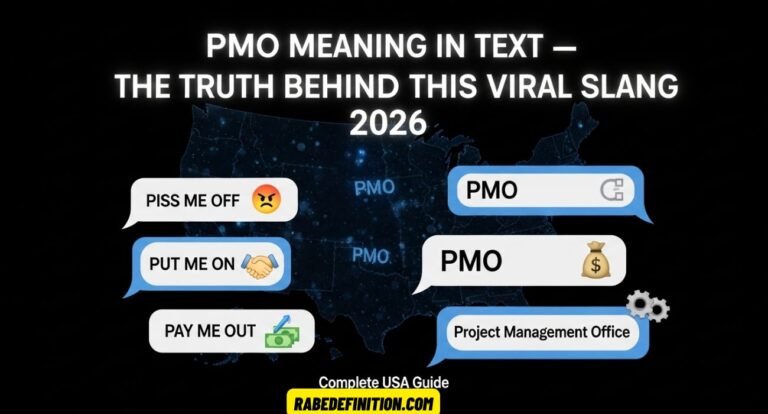
When somebody looks up pmo meaning slang, the reading they usually want is “put me on” — a short request asking a friend to introduce or recommend something. Wiktionary records that sense as Internet slang, and it records a second one beside it: “piss me off,” said when something has annoyed the sender. At work the same three letters belong to a Project Management Office instead, so the room a message lands in decides which record it belongs to.
The request sense runs on trust. A person types the letters at somebody whose taste they already rate, and the ask itself is a small compliment: your finds are worth having. The annoyed sense does the opposite work, filing a complaint in three letters, and telling the two apart takes nothing more than reading the messages around them.
This page separates the records the letters keep. It gives the request sense its full treatment — platforms, fresh conversations, and replies for the person being asked — then sets out the annoyed reading, the office sense, and the look-alike codes readers mix it up with. It closes with the muddles the letters attract and the questions readers bring to them most often.

Quick Answer Box
In chats, PMO most often means “put me on”: a request for an introduction or a recommendation. The same letters can also grumble “piss me off,” and in a workplace they name the Project Management Office instead.
| Element | Details |
|---|---|
| Meaning | Put Me On in chats; Project Management Office at work |
| Context | Texting, social media, or professional settings |
| Usage | Asking for an introduction, a recommendation, or a connection |
| Platforms | TikTok, Instagram, Snapchat, WhatsApp, and office email |
| Example | “PMO to the producer who mixed that track” |
| Tone | Casual and friendly as a request; annoyed in the second slang sense |
Three records share one spelling, and none of them borrows anything from the others. The sections below take them in the order a reader is likeliest to meet them: the request first, the complaint second, and the office last.
What Does PMO Mean?
In Texting & Social Media
In a text thread, the letters are a request, and the request is nearly always the same shape: you have access to something I want, so open the door. The something might be a singer, a barber, a group chat, a landlord, or a person. Wiktionary glosses the phrase behind the letters as “to show; to draw someone’s attention to something useful or interesting,” which is the whole job described in one line.
The ask travels light. It needs no greeting, no build-up, and no explanation of why the thing is wanted, because the wanting is the message. A bare “pmo” under a friend’s post carries the complete thought, and the friend answers with a link, a name, or an introduction.
The annoyed reading. Wiktionary’s second slang sense points the letters the other way: “piss me off,” for the moment something has irritated the sender. A double notification, a cancelled plan, a thread that will not stop buzzing — the letters file the complaint and move on. Nobody mistakes it for a request, because a request names a thing it wants and a complaint names a thing it is tired of.
In Business & Project Management
At work the letters stop being slang entirely. A PMO there is the Project Management Office: the team that sets how projects are run across a company, keeps templates and timelines in order, and reports on progress. Dictionary.com’s entry records the office senses only — “Program Management Office or a Project Management Office” — alongside the Prime Minister’s Office used in parliamentary countries.
The two worlds never share a sentence. A colleague who writes “check with the PMO” is sending you to a department, and a friend who writes it is asking you for a door to be opened.
As a Typo
One more sighting belongs in the margin. Now and then the letters appear where “PM” — private message — was plainly meant, and the extra letter is nothing more than a thumb landing wide. No dictionary records a messaging sense for the three letters, so when a request reading makes no sense and a private-message reading makes complete sense, a typo is the honest verdict.
How to Pronounce PMO
Say the three letter names: pee-em-oh. They are never run together into one word, because an initialism is read letter by letter — P for put, M for me, O for on, in the request sense.
In speech the letters mostly disappear. Somebody who would type them says “put me on to that” out loud, or “that would really annoy me” for the complaint sense, and the short form belongs to the keyboard rather than the voice. When you do hear them spoken, somebody is usually reading a message aloud for a listener who has never met the code.
Full Definition & Core Meaning
Primary Meaning: Put Me On
The request sense is the one the slang record is built on. The crowd-sourced record is dominated by it, with Urban Dictionary entries running from 2015 onward, and Wiktionary’s citations show it at work in posts from 2022 and 2023 — songs being shared, food being praised, friends being thanked for the tip.
Three things ride inside every use. The sender trusts the taste of the person being asked, the thing being asked about is treated as worth having, and the ask is casual enough to need no ceremony. Strip any one of those away and the letters stop fitting: nobody types them at a stranger whose judgement they doubt, for a thing they do not want, in a room that expects formal wording.
The fuller phrase does the same work with the edges showing. “Put me on to that” names the act directly — being placed onto a list, a scene, a sound, or a circle you were outside of a moment earlier.
Secondary Meaning: Project Management Office
The office sense is a definition of a different kind: not a phrase people say, but a department companies build. A Project Management Office sets the standards every project in an organisation follows, supplies the templates and reporting habits, and watches deadlines and budgets across the whole portfolio.
Its paperwork trail is the one the standard dictionaries keep. Dictionary.com records the office readings and no slang at all, which makes the split easy to state: the request sense lives in the slang references, and the department lives in the general ones.
Context & Usage
When to Use PMO (Slang)
The letters earn their keep wherever a friend has something you want and the relationship can carry a three-letter ask:
- A training partner mentions a physio who fixed their shoulder → “PMO to her, mine has been loud for weeks”
- A coworker brings leftovers that stop the office mid-sentence → “PMO to that recipe before you sit down”
- A cousin posts a jacket that looks tailored → “PMO to the shop, I need that exact one”
- A group chat is organising a five-a-side game → “PMO, I can play keeper”
Each ask is small, specific, and easy to grant, which is most of why the code survives.
When NOT to Use PMO
Keep the letters out of rooms where the shorthand is not shared. A manager, a client, or a brand-new acquaintance may never have met the code, and a reader who has to look a request up experiences it as effort rather than friendliness. Formal writing of any kind — applications, proposals, official email — wants the request written out in words.
The office sense creates the second trap. In a workplace thread the same three letters are already taken, and a slang ask dropped into project talk can be misread as a department reference before it is read as a request.
Tone & Emotion
On its own the request is neutral: a door being knocked on, politely. How warm, funny, or urgent it feels is contingent on what surrounds it — the emoji beside it, the punctuation after it, and how long the two of you have been trading favours.
- Casual: “pmo to that barber when you get a chance”
- Enthusiastic: “PMO to that singer right now, that chorus is unreal”
- Teasing: “PMO to whatever morning routine makes you this cheerful”
- Serious: “For real — pmo to that accountant, tax season is coming”
The annoyed sense carries its own weather. It arrives flat, often alone, and the flatness is the message: no request is being made and nothing is being asked for.
PMO From a Guy vs. a Girl
No reference behind this page divides either slang sense by sender. A guy asking a friend to put him on to a new producer and a girl putting the same ask to the same friend have typed the same three letters, and the reading does not move in either direction.
The complaint sense is equally even-handed. Annoyance typed in three letters reads as annoyance whoever types it, and the thread around it — not the sender — tells you how serious the irritation is. What varies between people is habit: some friends ask for recommendations daily, others save the letters for the one find that genuinely matters.
PMO in Dating and Relationships
Dating gives the request sense its trickiest job, because asking to be put on usually means asking about a person. “Your friend in the second photo — pmo” is a request for an introduction, and it lands as interest stated plainly, with no game around it.
Short openers are the local currency. A code like wyo asks what somebody looks like; PMO skips the description and asks for the meeting itself, which makes it the bolder of the two moves. Boldness cuts both ways: with someone you already talk to, the directness reads as confidence, while aimed at a near-stranger it can read as presumption.
The standing courtesy is to let the mutual friend decide. An introduction spends somebody else’s social credit as well as yours, so the ask stays a request — easy to grant, easy to decline, and never owed.
Real-Life Examples
Conversation Example 1: Music Recommendation
Dario: “Found a drummer last night who plays like the kit owes him money.”
June: “Say less. PMO.”
Dario: “Sending his page now — start with the live session.”
Meaning: June’s whole reply is the request. Dario answers with the thing itself, which is how the exchange is supposed to end.
Conversation Example 2: Professional Connection
Priya: “My neighbour is hiring a Saturday assistant for her bakery.”
Tom: “Wait — pmo to her? I have been looking for weekend work for months.”
Priya: “Send me your number and I will pass it on tonight.”
Meaning: The ask names a real opportunity, and Priya’s answer shows the polite shape of granting one: the introduction moves through her, not around her.
Conversation Example 3: Restaurant Recommendation
Marcus: “That noodle place by the station just ended my search for the perfect bowl.”
Elena: “Where exactly? PMO.”
Marcus: “Two doors past the bookshop. Order the hand-pulled ones, trust me.”
Meaning: Elena wants the find, not a review. The letters ask for the location, and the recommendation rides along free.
Conversation Example 4: Gaming
Rex: “Our squad needs one more for the Saturday tournament.”
Kai: “Bro, pmo — I have been trying to break into tournaments all season.”
Rex: “Tag me your username and I will add you to the server.”
Meaning: In gaming rooms the request usually asks for a seat rather than a thing: an invite, a slot, a way into the group.
Conversation Example 5: Fashion
Alba: “Vintage market find. This coat cost less than lunch.”
Noor: “PMO to that stall, immediately.”
Alba: “Corner of the market, the one with the blue awning. Go early, the good rails empty fast.”
Meaning: A bargain spotted on somebody else triggers the ask at once, and the answer is a location plus the local knowledge that makes it useful.

Is PMO Slang?
Yes — the request and complaint senses are documented slang, and the record for them sits exactly where slang records usually sit. Wiktionary enters both as Internet slang and backs them with dated posts: the request at work in 2022 and 2023, the complaint in 2024. The Urban Dictionary record runs older still, carrying the request sense in entries dated from 2015.
The general dictionaries complete the picture from the other side. Dictionary.com’s entry for the letters records office senses and nothing else, while Merriam-Webster’s entire entry is one line — “principal medical officer” — with no slang and no project office at all. A reader who checks only the big books would conclude the letters are never slang; a reader who checks only chat would never guess at the department.
Both halves hold at once. Unlike a reaction code such as ctfu, which only reports a laugh, PMO does different jobs in different buildings — and each building keeps its own paperwork.
Platform-Specific Meaning
PMO Meaning on WhatsApp
On WhatsApp the request sense rules, since the app already carries most people’s everyday recommendations. Group chats trade it for restaurants, tradespeople, and links worth saving, and the business sense almost never appears in a personal thread. A typical run: a photo of a haircut lands in the family chat, and the first reply is the three letters and a name — “pmo to your barber.”
PMO Meaning on Snapchat
Snapchat’s replies are built for speed, and the letters fit the format. A story showing a rooftop, a dish, or a new pair of shoes draws the code as a one-word answer: put me on to that. The meaning does not change on the platform; the exchange just runs shorter, because a reply typed slowly arrives after the story has moved on.
PMO Meaning on TikTok
TikTok is the request sense’s natural habitat, because the whole app is a machine for finding things through other people. Comments under a recipe, a routine, or a sound fill with the letters, each one asking the creator to share the source. On a platform where a new creator can reign over the feed for a week, the ask for the original is constant — and the complaint sense shows up too, aimed at glitches, removals, and sounds that vanish mid-trend.
PMO Meaning on Instagram
Instagram keeps the code mostly inside DMs, away from the public comment row. A post shows a place, a product, or a face worth asking about, and the ask arrives privately: put me on to the shop, the host, the friend in the frame. The privacy suits the request, since an introduction is a personal favour and not a public transaction.
PMO Meaning in Business
In business settings the letters belong to the department, full stop. Meetings, project documents, and internal mail use them for the Project Management Office — the team a manager means when she says the timeline needs clearing with that office first. The slang senses do not merely sound casual there; they are simply not what the letters say.

Alternative Meanings of PMO
The fetched record adds a shelf of further senses beyond the two slang readings and the project office. Dictionary.com and Wiktionary both record the Prime Minister’s Office of parliamentary countries, Wiktionary adds a Provost Marshal Office in military use and postmenopausal osteoporosis in medicine, and Merriam-Webster’s single line names a principal medical officer. Wiktionary also tags one further slang sense used inside online recovery communities, where the letters label a habit cycle members are working to break; it belongs to those rooms and travels nowhere else.
His page’s four headings below are kept, but the record check matters: none of the four expansions in them appears in any dictionary fetched for this page, so each is carried at the strength it has earned — a claim in circulation, not a documented sense.
Please Move On
Explainer pages offer this expansion for threads that have run too long, as a polite way of asking for a topic change. No fetched dictionary or glossary records it, and the dated citations behind this page show the letters doing other work. Treat a sighting as a local coinage: possible in one community, documented nowhere.
Performance Management Office
A business variant occasionally listed beside the project office. The fetched record gives the office as Project Management Office, or Program Management Office in Dictionary.com’s wording, and records no performance variant — so a workplace that uses this expansion is running a house version, and its own documents are the only authority for it.
Personally My Opinion
An opinion-marker reading surfaces now and then in explainer lists, modelled on IMO. Nothing in the fetched record supports it: the dictionaries keep office senses, the slang references keep the request and the complaint, and no dated example of an opinion reading appears in either. It is carried here as a claim, not a sense.
Post-Medium Operations
The most technical of the claimed expansions, and the least documented. No fetched source of any kind records it, no field is named for it, and no example accompanies it anywhere behind this page. A reader who meets the expansion should ask the writer what it means, because the reference record cannot help.
Related Terms & NLP Variations
Variations of PMO
Lowercase “pmo.” The casual casing is the commonest form in fast chats, and it changes nothing about the reading.
“P.M.O.” with periods. The dotted form shows up when a writer wants the initialism to look deliberate rather than typed in haste.
“Put me onto.” The fuller version of the phrase, with the destination attached: put me onto that playlist, that trainer, that street. Wiktionary enters the slang with the “to” built in — put me on (to) — because the request so often names its target.
Synonyms for “Put Me On”
“Hook me up.” The closest everyday equivalent: same request, same casual register, same trust in the other person’s access.
“Connect me.” The plainer version, at home in slightly more formal rooms where the three letters would jar.
“Introduce me.” The direct form, used when the target is a person and there is no reason to dress the ask up.
“Fill me in.” The information-only cousin: it asks for the knowledge behind a find rather than the find itself.
“Recommend.” The fully spelled, anywhere-safe option — the request with the slang taken out of it.
Related Slang Terms
Gatekeeping. The refusal the request exists to answer: holding a find back on purpose. “Why are you gatekeeping — pmo” is the pair working as a set, accusation first, request second.
Lowkey. The volume knob. Attached to the letters, it asks for the favour quietly, without an audience: “lowkey pmo to that spot.”
Fr. Short for “for real,” it underlines that the ask is genuine rather than polite noise.
No cap. The sincerity stamp. Added to the request, it swears the wanting is honest.
Bet. The standard one-word acceptance. The letters ask, “bet” grants, and the link or the name follows.

What to Say Instead of PMO
- “Put me on to that.” — the phrase in full, clear to every reader.
- “Can you introduce me to them?” — the person version, polite in any room.
- “Where did you find that?” — the find version, which asks for the source instead of the thing.
- “Send me the link.” — the direct version, for the chats where a link is the whole answer.
Every alternative trades brevity for certainty. With close friends you will rarely bother spelling anything out; at work, around strangers, or in a first conversation, the long form carries better and risks nothing.
How to Respond to PMO
Responding with a Recommendation
When the ask is about a thing, the answer is the thing: the name, the link, the address, or the handle, sent without ceremony.
- “Here — this is the mix I meant. Start with the second track.”
- “It is the stall by the north gate. Tell her I sent you.”
- “Sending the page now, the booking link is at the top.”
Responding with an Introduction
When the ask is about a person, the introduction runs through you, and a moment of care is part of the job.
- “Let me check with her first — if she is good with it, I will connect you tonight.”
- “Send me a line about yourself and I will forward it with your number.”
- “He is actually looking for a training partner. I will set up a group chat.”
Responding When You’re Not Comfortable
Not every ask can or should be granted, and a clean refusal beats a slow fade.
- “I do not know him well enough to make that intro in good faith, sorry.”
- “That one is not mine to pass on — it came to me in confidence.”
- “I can’t today, but if that changes you will be the first to know.”
Responding When You Don’t Have the Answer
Sometimes the find was second-hand for you too. Saying so plainly keeps the chain honest.
- “Wish I could — it reached me through a friend of a friend.”
- “I have lost the link, but let me dig and get back to you.”
- “That one was not mine to begin with, so I am the wrong door to knock on.”
Misinterpretations & Common Confusions
A pedantic reading of the three letters settles nothing, because the letters keep three separate records and only the room announces which one is open. Most confusion with this code is really confusion about which building the conversation is standing in.
“PMO” vs “PM” vs “DM”
| Code | Stands For | What It Does |
|---|---|---|
| PMO | Put Me On (slang) | Requests an introduction or a recommendation |
| PM | Private Message | Names a message kept off the public thread |
| DM | Direct Message | The same private-message idea in social-app wording |
The three look alike and do unrelated jobs. PM and DM name a channel — a private thread — while the slang PMO names a request that can travel through any channel at all. A reader who files the request under messaging will misread every example on this page.
“PMO” vs “HMO” vs “IMO”
HMO. A Health Maintenance Organization: a health-plan structure from the business and medical world. It shares two letters and nothing else.
IMO. “In my opinion,” the opinion marker. It is the expansion the undocumented “personally my opinion” claim borrows its shape from, and the genuine article is worth not confusing with the copy.
What PMO Isn’t
- It does not open a conversation; it answers something already in one.
- It is not a reply to “how are you,” and it carries no greeting in it.
- As a request it expresses wanting, not an emotion — the emotion belongs to the complaint sense only.
- It invites nothing by itself; it asks, and the other side decides.
When NOT to Use PMO
Formal Settings
Workplace writing runs on the office sense, so the slang ask has no clean place there. In applications, proposals, client mail, and anything addressed upward, write the request in full: “Could you recommend,” “Would you introduce me to,” “Can you connect me with.” The spelled-out versions cost a few seconds and can be misread by nobody.
With Strangers
The request presumes a relationship. Typed at somebody you have never spoken to, it asks them to spend access and trust they have not agreed to spend, and it can read as entitlement rather than friendliness. A little conversation first turns a stranger into the kind of person the letters work on.
When Something is Clearly Private
Some finds are shared in confidence: an unlisted link, a friend’s number, a plan that is not public yet. Asking to be put on to a thing like that puts the holder in the position of breaking a trust to grant a favour. When a find smells private, the respectful move is to admire it and leave the door closed.
Usage Tips
Natural Usage
- Keep the ask specific: name the song, the shop, the person, so the favour is easy to grant.
- Send it only when the wanting is real; a request typed just to sound current reads as noise.
- Let it stand alone or trail the message it answers — both shapes are standard.
- Answer other people’s asks quickly when you can; the code runs on generosity.
Social Media Strategy
- Ask under the post that showed you the find, where the source is one tap away.
- When somebody puts you on, say so publicly — credit keeps the chain generous.
- Share your own finds without being asked now and then; the letters are a two-way economy.
FAQs
What does PMO stand for in text?
In texts, the letters usually stand for “put me on”: somebody asking to be let in on a find or introduced to a person.
Read as a complaint instead, they stand for “piss me off,” and the thread around them tells you which.
What does PMO mean on Instagram?
On Instagram the letters mean “put me on,” usually sent in a direct message about a post.
The ask targets a tagged product, an event, or a person shown in the frame.
What does PMO mean in business?
In business the letters name the Project Management Office, the department that standardises project work.
That office sense is the one the general dictionaries record.
What does PMO mean on Snapchat?
On Snapchat the letters mean “put me on,” sent as a fast reply to a story or a snap.
The ask is usually about the place, the item, or the person the story showed.
What does PMO mean on WhatsApp?
On WhatsApp the letters mean “put me on,” traded inside personal and group chats.
Friends and family use them to ask for recommendations, introductions, and links.
What does PMO mean in gaming?
In gaming the letters mean “put me on,” asking for an invite, a team slot, or access to a server.
The request is about joining the group rather than receiving a thing.
What is the full form of PMO?
In slang the full form is “put me on”; in professional settings it is “Project Management Office.”
Each form belongs to its own rooms, and the conversation announces which one applies.
Is PMO formal or informal?
The slang senses are informal, at home in chats and comment sections.
The office sense is formal vocabulary, used in meetings, documents, and internal mail.
Can I use PMO at work?
Use the letters at work only for the Project Management Office, where they are standard.
For a recommendation or an introduction, write the whole request out in words.
What’s the difference between PMO and PM?
PM names a private message — a channel — while PMO asks for an introduction or names an office.
The extra letter changes the job entirely, so the two are never interchangeable.
Conclusion
Anyone chasing pmo meaning slang is chasing a request wearing three letters: put me on. In chats the ask trusts the other person’s taste and asks them to open a door — to a song, a contact, a place, a chance. Read as a complaint the letters file an annoyance instead, and in an office they name the team keeping projects in line. One spelling, three separate records, no overlap.
Grant the ask when you can, and answer it the way you would want yours answered. Keep the slang out of formal threads, where the same letters already work for the office, and when a find is not yours to share, say so plainly and early rather than practise gatekeeping.



One Comment